
I’m fascinated by how stories change over time. Once upon a time, in the Middle Ages, ghosts were as solid as you and me, but today they’re usually insubstantial, see-through wisps.
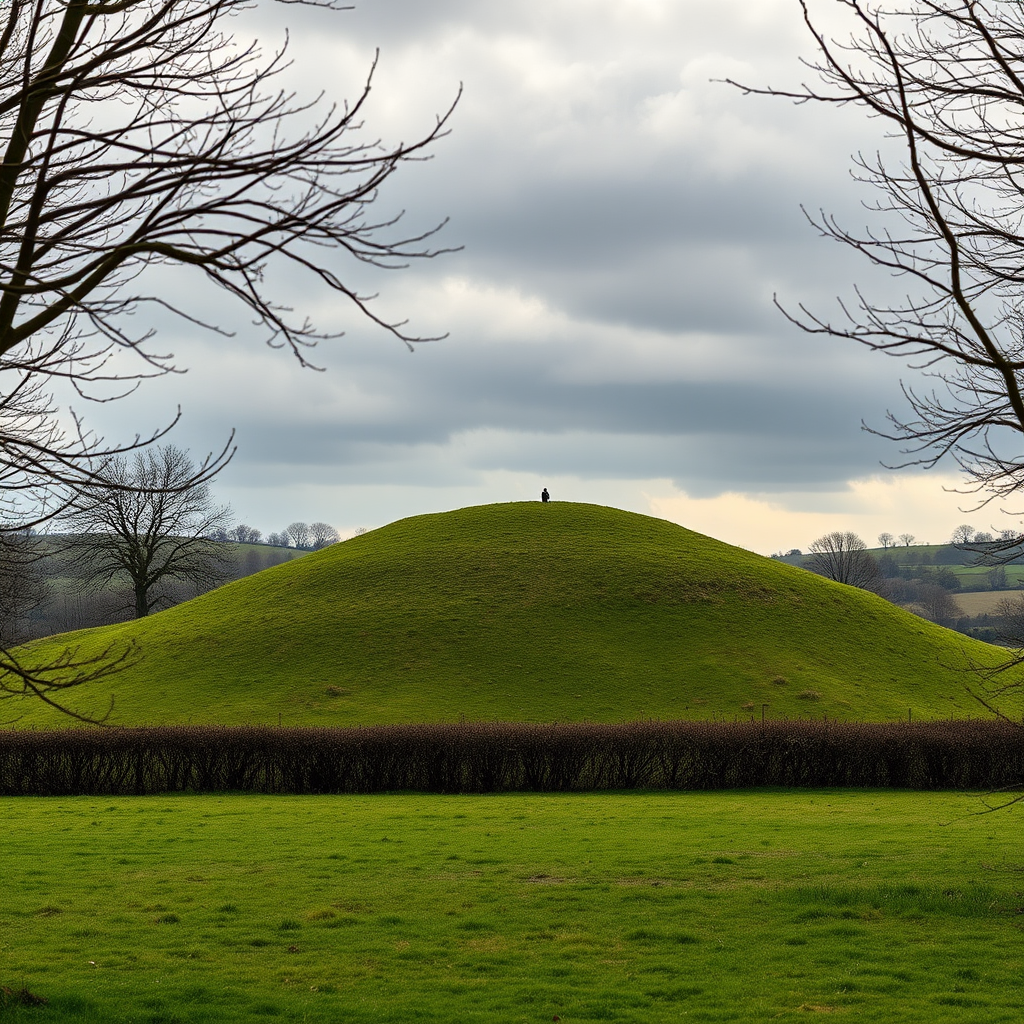
Our perceptions of the prehistoric structures in the landscape have changed over time too. Last month we looked at some of our region’s standing stones and their stories. This month we turn to burial mounds.
From just a little way outside the Cotswolds comes a story that possibly preserves some of the earliest thinking about the long barrows created by our Neolithic ancestors between roughly 4000 and 2200 BC. Arthur’s Stone is in Herefordshire, near the Welsh border.
In Wales the tales of the giants who once populated the land have remained, whereas in Gloucestershire they have almost disappeared: save for the tales of Goram and Vincent in Bristol. At Arthur’s Stone, Arthur fought a giant – and of course he won.
This long barrow is the giant’s grave.
Folklore of King Arthur can be found in the Cotswolds too, but he’s especially prevalent in Somerset and Wiltshire – and his mentor, Merlin, is said to have met his mysterious end in Marlborough, in the stepped mound in the grounds of Marlborough College.
There the enchantress Nimue worked her magic upon him, lulling him into a sleep that will last until Arthur once more returns to our land.
Such stories are rooted in the beliefs of the Middle Ages, in which it made sense that an enormous burial mound should contain the remains of a giant or a culture hero like Arthur – or even be a portal to another world.
A godling lurks in Wayland’s Smithy, reduced to shoeing horses for a penny. Wayland’s association with that long barrow on the Ridgway is borne out in other place names from Wayland’s dark story which were recorded in the Middle Ages.
The whole story was mapped out in the Wessex landscape by the Saxons who made their homes there in about the sixth or seventh century.
Merlin’s Grave at Marlborough may be a mound, but it’s not a barrow. It’s thought to be an artificial hill, akin to Silbury Hill near Avebury, where folklore says a knight was buried upright in golden armour.
This is the kind of thing that people in the 17th and 18th centuries imagined about the barrow mounds. Gloucestershire barrows such as Notgrove near Bourton, Windmill Tump near Rodmarton, and a mound near Oakridge were said to contain gold coffins.
The Oakridge one sat in Golden Coffin Field and was said to be the resting place of a Roman general; a Roman villa was indeed discovered nearby. Tar Barrow, near Cirencester, held rooms full of strange Roman treasures. No golden coffins have so far been found!
Last month, we heard about Molly the Dreamer trying to get gold from the Long Stone, near Minchinhampton, but she originally dreamt that the Saxon chieftain Wolfhang told her of golden treasure buried in his own burial mound, Gatcombe Tump.
The idea that it was Saxons and Vikings who were buried in these mounds makes sense when you think of Sutton Hoo in East Anglia. Until recently, people’s idea of prehistory only went back to the Iron Age immediately before the Roman invasion.
They knew nothing about the Neolithic and Bronze Age people who lived here before the Iron Age.
The author at Windmill Tump, Rodmarton a few years ago (Image: Kirsty Hartsiotis)
INHABITANTS OF THE BARROWS
Scarier encounters have taken place, too. Sometime before Bisley Commons were enclosed in 1869, two Chalford men were returning from the Bisley Feast – probably at harvest time – a little worse for wear. Nothing that a brisk night-time walk wouldn’t sort out.
On the track from Nash End to France Lynch, as they passed Money Tump, a Bronze Age round barrow, they saw a group of men ahead of them. Thinking they were their friends from the Feast, the Chalford duo hurried towards them.
But when they drew near, they stopped in horror. The men had no heads! The recorder of this encounter, RJ Burton, writing in 1931, notes that ‘the consequent fright had an abiding effect on the men’.
He says that in Victorian times people believed that such mounds contained the remains of men who had died in battle. Perhaps even more unsettling is that the Pole’s Wood South long barrow near Upper Swell can sometimes be seen swathed in flames.
By the late-19th century, archaeologists were getting to grips with the true dates of the barrows and their inhabitants.
In July 1880, GB Witts, one of the great Gloucestershire archaeologists of that period, was on a Bristol and Gloucestershire Archaeological Society (BGAS) outing to investigate archaeological sites.
The party was heading from British Camp on Painswick Beacon to Buck Barrow, a recently excavated bowl barrow at Brimpsfield, containing the remains of a woman and child. Interesting, yes, but more mysterious was what Witts found en route to the barrow.
He says: “Most of the members of the society, being in carriages, kept to the roads.
“I was on horseback, and in taking a short cut through Buckholt Wood, with my mind intent on archaeology, I suddenly saw before me a huge mound.
“A quick scramble over it confirmed that it was a long barrow.”
With the briskness of things back then, Witts applied to the landowners that very day and got permission to dig. He and his colleagues found a number of bones, including those of an adolescent buried with a dog – and, we now know, about 22 other people.
Witts published his report in the BGAS journal, the finds were eventually given to The Wilson in Cheltenham, and that, you would think, would be that.
However, for the locals of the Birdlip and Cranham area, that was only the beginning of the story. Rumours began that gypsies were camping in the woods; just glimpses of them were sighted.
Then one day a young woman was heading from Birdlip to Cranham and, as she was passing West Tump, she saw them. They were not gypsies. They were like no people she’d seen before. They wore long leather cloaks, their faces were covered in tattoos, and the men carried long spears with leaf-shaped stone points.
The girl saw of all this in a moment and then she fled through the bracken as fast as she could run.
After that, these strange people were seen many times. The local folk blamed it on the archaeologists: they had raised the dead from their graves and now the spirits couldn’t rest easy. Today, West Tump is rather forgotten, hidden in the woods.
Unlike the much more famous Belas Knap and Notgrove long barrows, it isn’t even on a footpath.
This story shows us that once folk knew a little about the ancient people who had buried their dead in the mounds, so the stories told of uncanny happenings at the mounds changed accordingly.
West Tump long barrow by Michael Murray (Image: Kirsty Hartsiotis)
LEAVE GRAVE GOODS BE
The Bronze Age round barrow at Manton, near Marlborough, was excavated by Maud and Ben Cunningham. In this grave had been buried an older woman, whose rich grave goods were made of materials from all over Europe.
The grave goods were spirited away to the Wiltshire Museum, but the skeleton was reburied – save for a bone from the little finger, which the caretaker nicked and gave away.
An old woman living nearby subsequently began to hear a scratching on her windows and saw a lined face looking back at her. Was it the old woman from the mound, searching for her finger – or for someone to befriend?
As for the caretaker, his fingers began to ache that winter, then turned black at the tips. His little finger had to be amputated. He buried it with the skeleton and all was quiet after that.
Even today we like to imagine things into our archaeological finds. In Gloucester Museum you can see the Iron Age grave goods found near Birdlip: beautiful Celtic items including the famous bronze mirror.
They were buried with a woman aged about 35. She must’ve been a powerful woman to have had such wealth. The best-known woman of that time was Queen Boudicca of the Iceni tribe far away in East Anglia.
Of course, some have speculated that the buried woman must have been her; she must have fled to the safer Cotswold lands of the Dobunni after the Romans wiped out her army at the Battle of Watling Street.
Three women were buried at Birdlip. Could these be Boudicca and her daughters? There were trading links between the Iceni and the Dobunni. Some say that Boudicca was originally a Dobunni, who married an Iceni man.
It’s a neat theory, but it too belongs to the realm of folklore. If we know of one or two powerful women in Britain at a time of which we know about only a handful of individuals, there must have been many more.
The Birdlip woman we can know only through her grave goods. Boudicca – well, she has a good story..
COMPASS POINTS
PLACES MENTIONED: Arthur’s Stone, in Herefordshire; Marlborough Mound, Silbury Hill, and Manton Barrow, in Wiltshire; Wayland’s Smithy, in Oxfordshire; Notgrove Long Barrow, Windmill Tump, Bisley 7 ‘Golden Coffin’ round barrow, Tar Barrow, Gatcombe Tump, Money Tump, West Tump, and Birdlip, in Gloucestershire.
MAP: google.com/maps/d/edit?mid=1NpTnEaVJ4Selq4Lgax_FHQah1dNRwCk&usp=sharing
FURTHER READING: Find out more about Gloucestershire’s barrow mounds and their folklore in Lesley Grinsell’s article Gloucestershire Barrows in the Bristol and Gloucestershire Archaeological Society Journal, Volume 79.
There’s a full retelling of The Ghost of Manton Barrow in Kirsty Hartsiotis’ Wiltshire Folk Tales (History Press, 2011)
Kirsty Hartsiotis is based in Stroud and available for hire as a storyteller and speaker.
She is an Accredited Arts Society lecturer. Her books include Wiltshire Folk Tales and (with Anthony Nanson) Gloucestershire Ghost Tales and Gloucestershire Folk Tales for Children.
She is also the curator of decorative art at a Gloucestershire museum.