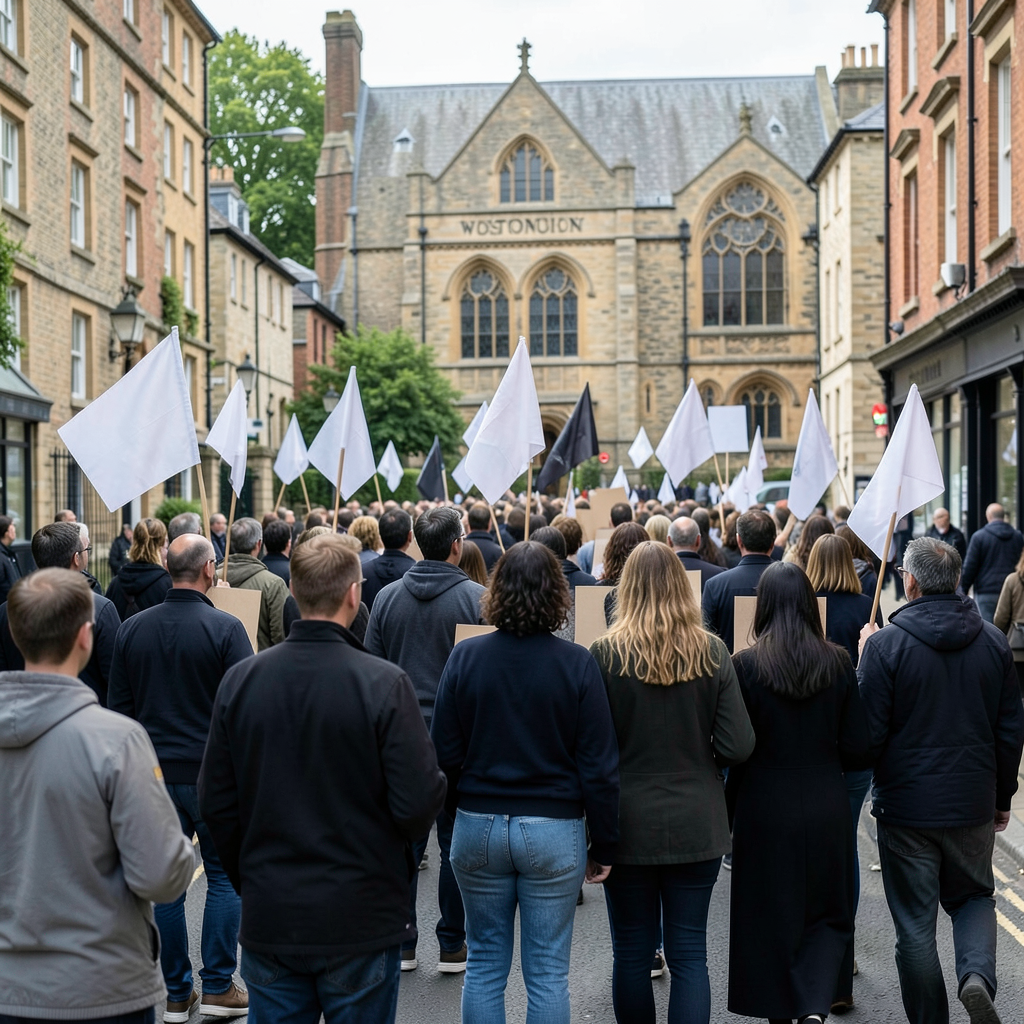

About 80 people assembled at Manzil Way Garden in East Oxford on 17th October 2026 ahead of the Unity March, which later made its way through the city centre and concluded with speeches outside the Weston Library’s Bodleian Shop on Broad Street.
Publicity had circulated through social media and elsewhere in the city, with Oxfordshire Stand Up To Racism prominently sharing details of the gathering and march.
Oxfordshire Stand Up To Racism, a community organisation seeking to build a mass movement against racism, said more than 20 local political, social and community organisations appeared on its poster.
Those listed included Unison, the National Education Union, Coalition to Close Campsfield, Oxford Renters’ Union, Women Against the Far Right and Oxford Students for Palestine.
Banners carried during the event also featured organisations absent from the original publicity, including the Oxford and District Labour Party and the Oxford Green Party.
The Oxford branch of the Indian Workers’ Association, Oxford and District Trades Union Council and a Communist Party group were among the other participants.
The gathering began at noon.
Two police officers were initially present, and that presence continued throughout the march.
Music came from the local community street band Horns of Plenty, which performed anti-fascist songs including Bella Ciao, while XR Rhythms, associated with Oxford Extinction Rebellion, supplied percussion.
A brass band and a samba band were later assembled on the garden’s northern side as attendance rose to at least 100.
Louis Hall, whose name was taken from French Jacobin revolutionary Louis de Saint Just, said a danger of proto-fascism was gathering across the country.
Wearing a leather jacket and keffiyeh, he described the emphasis on unity as a progressive response to that threat.
A representative of the convening organisation also declared that the assembled groups remained united.
The Oxford Renters’ Union said anti-racism was connected to its own campaign and displayed a banner declaring solidarity with immigrant neighbours.
Its members attended the event at Manzil Way Garden.
At 12.45pm, with more than 200 people present, the procession began along Cowley Road towards the centre.
Bands provided the soundtrack as residents filmed the march and sounded vehicle horns in support, despite resulting traffic disruption.
Wadham College student Max regarded the event as a joyful occasion.
A local business owner accepted the disruption while arguing that the march was necessary to communicate its message.
The crowd expanded beyond 300 people by Cowley Place, near the end of Magdalen Bridge, at around 1pm.
Four police officers were stationed at the bridge and accompanied the march as it continued along the High Street.
Chants called for fascists to be stopped, for the protection of Sikhs, Muslims and transgender people, for racist borders to be dismantled, for opposition to profit and for an end to deportation.
Attempts were made to attract matriculating University of Oxford students, although only two students wearing sub fusc were reported to have joined.
Punting and the surrounding activities attracted considerably more interest among the other students.
One matriculant expressed concern for bus drivers and said the combination of the Communist Party and Green Party was surprising.
Vihaam Sharma of Corpus Christi College said it was important to remember shared ground and called the moment a crossroads in British history.
Verity Glover of Balliol College described the demonstration as impressive and welcomed the range of participating groups.
The march reached Cornmarket Street at 2pm before turning at the junction towards Broad Street.
It arrived at the Weston Library at 2.15pm, where the convening organisation installed its sound equipment for further speeches.
Green Oxford City Councillor Chris Jarvis compared the event with the 1936 Battle of Cable Street, when opponents of anti-semitism prevented Oslwald Moseley’s British Union of Fascists from marching through an East London district with a substantial Jewish population.
Jarvis criticised Reform and Nigel Farage before widening his criticism to other parties that he said had adopted elements of their agenda and policy platform.
He paused and looked towards the Oxford Labour Party group as counter-protestors unfolded a Union Jack behind him.
The political disagreement had developed during the preceding week.
Oxford City Council Labour leader Susan Brown issued a press release on 8th October attacking the Green Party motion stating that Zionism is racism.
Lubna Arshad, a Labour councillor, told the gathering that racism would not divide its participants and that solidarity had become stronger.
A chant responding with the claim that the Labour Party was racist arose from the rear of the crowd during her address.
Emma Jones of Coalition to Close Campsfield, which campaigns against the Immigration Removal Centre at Campsfield House near Oxford, described immigration detention as racist and as part of a system dividing people according to birthplace.
Her account of the treatment of detainees at Campsfield prompted calls of shame from the audience.
Pat Carmody of Unite the Union rejected claims by far-right figures that they were not racist, characterising them as hypocrites.
He cited anti-immigration demonstrators on the South Coast wearing balaclavas while demanding restrictions on people arriving in small boats.
Describing the position as old-fashioned racism, he also said cuts imposed by councils and harming working-class communities strengthened support for the far right.
Labour and Green city councillors were standing only a few metres away when he made that point.
The final speaker was Ian McKenrick of Oxfordshire Stand Up To Racism.
He said language once associated exclusively with the Nazis had entered the mainstream through political figures including Rupert Lowe and Nigel Farage, as well as senior Labour government ministers attacking indefinite leave to remain.
McKenrick called for a mass movement that would intimidate racists and remove their electoral influence.
Joseph Ricketts, a matriculant at St John’s College, discussed the frequent use of the word fascism by demonstrators.
Although firmly opposed to fascism, he said distinctions between opposing groups were necessary to prevent polarisation.
Another student opposed the march and argued that matriculation activities in Oxford should not be made entirely political.
A further student said the scale of fascist and far-right activity did not appear sufficient to explain the demonstration.
Four counter-protestors were observed, including Aidan Noble, leader of Oxfordshire Patriots.
Noble disputed the characterisation of his organisation as racist, asked what constituted racism and questioned who wanted irregular migrants to enter the country.
He displayed statistics on small-boat costs on his Small Boat Watch app.
French participant Emma Correia said she had originally intended to protest in France.
After seeing the Oxford event advertised on the same day as protests in France, she travelled to the march instead.
She described what she regarded as heavy-handed oppression of French protesters by the French police.
The event brought together a broad range of political perspectives, aims and motivations, despite the continuing antagonism between organisations such as Oxfordshire Patriots and Oxfordshire Stand Up To Racism.
The demonstration was titled the Unity March.