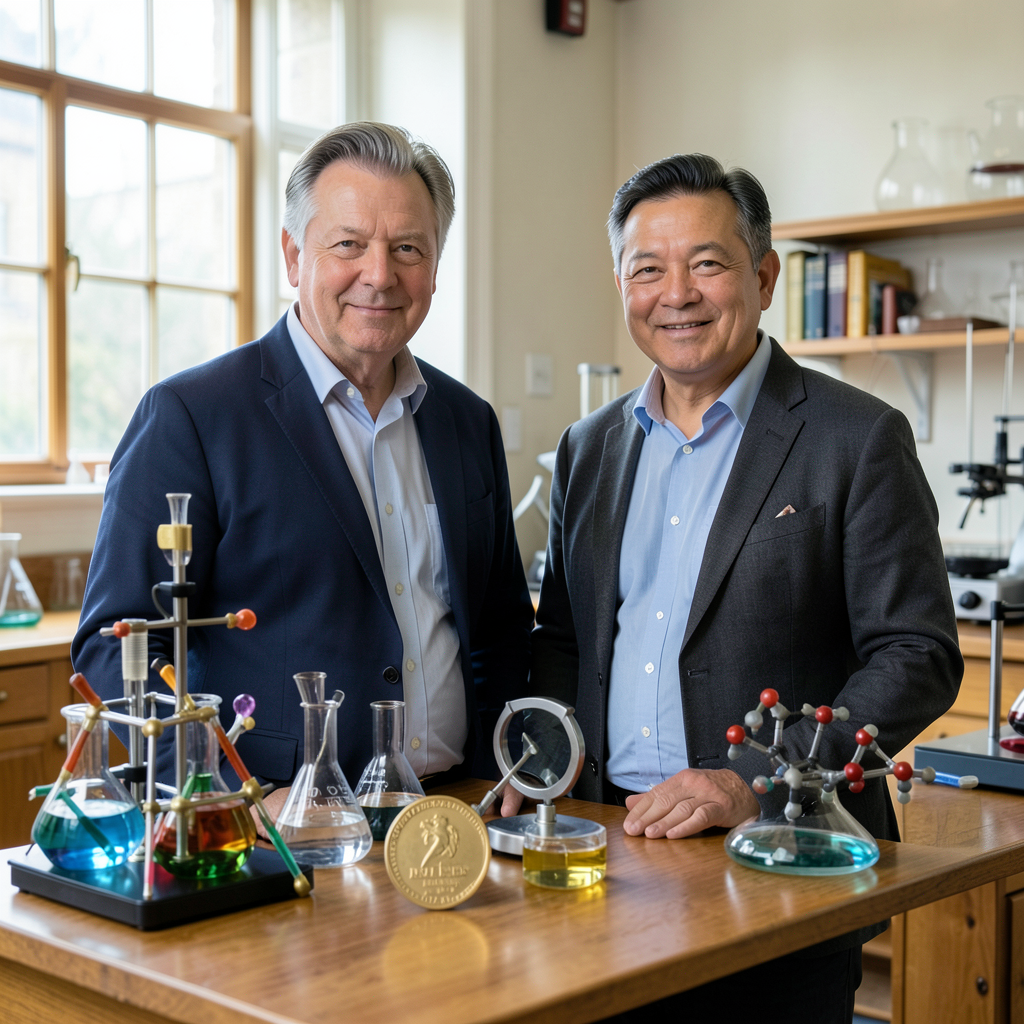

Professors Henri Kagan and Kenso Soai received this year’s Nobel Prize in Chemistry from the Royal Swedish Academy of Sciences for discovering non-linear effects and autocatalysis in asymmetric organic synthesis.
The honour followed the 2001 Nobel Prize awarded for asymmetric synthetic methods and recognised work that enabled the more efficient production of chemical compounds.
Many chemical products are chiral, meaning that they can exist as mirror-image forms resembling left and right hands.
The two non-superimposable structures share the same chemical formula, but their atoms occupy different positions in three-dimensional space, resulting in markedly different behaviour.
In biological systems, most natural products, including proteins and DNA, occur in only one of the available chiral forms.
This situation created difficulties for synthetic chemists because reactions conducted in laboratories commonly generated mixtures of both left- and right-handed molecules.
The problem was particularly significant in medicine and pharmaceuticals, where one form might be effective while the other was useless or harmful.
Thalidomide was cited as an infamous example.
Some reactions could transfer the handedness of a starting material to its products, but producing only one handedness from achiral reagents remained an elusive objective in asymmetric synthesis.
Enzymes within living organisms can create pure, complex products, whereas laboratory catalysts had proved ineffective and inefficient for the same purpose.
In 1986, Kagan became the first researcher in the field to observe non-linear effects.
He began with a small excess of one mirror-image form and obtained an almost entirely single-handed product.
The reaction mechanism departed from conventional thinking, which held that a catalyst’s handedness ratio would map directly onto the products formed.
This finding established non-linear catalysis as a research field in its own right.
Mathematical foundations were subsequently laid for modelling these reactions, making it possible to design materials capable of producing numerous useful chemical products.
Soai reached a comparable conclusion in 1995 after beginning with a slight excess of one mirror-image form and obtaining a product of high purity.
Subsequent examination of the mechanism led to the Soai reaction.
Under this process, the formation of one product molecule accelerates the reaction and determines the handedness of the molecule formed next.
This autocatalytic mechanism yields an almost pure product.
The discoveries renewed scientific interest in asymmetric synthesis and prompted discussion about the reasons why nature became dominated by compounds possessing a single handedness.
Kagan and Soai developed a new understanding of chemical synthesis mechanisms and methods for obtaining pure products that had previously been observed only in nature.
Their work transformed an important area of organic chemistry and has been applied extensively in industry, particularly in pharmaceutical manufacturing.
Asymmetric catalysis remains an developing area of chemical research that continues to attract international interest, including from Oxford’s Steve Fletcher, who is seeking more effective approaches to producing useful chemicals.