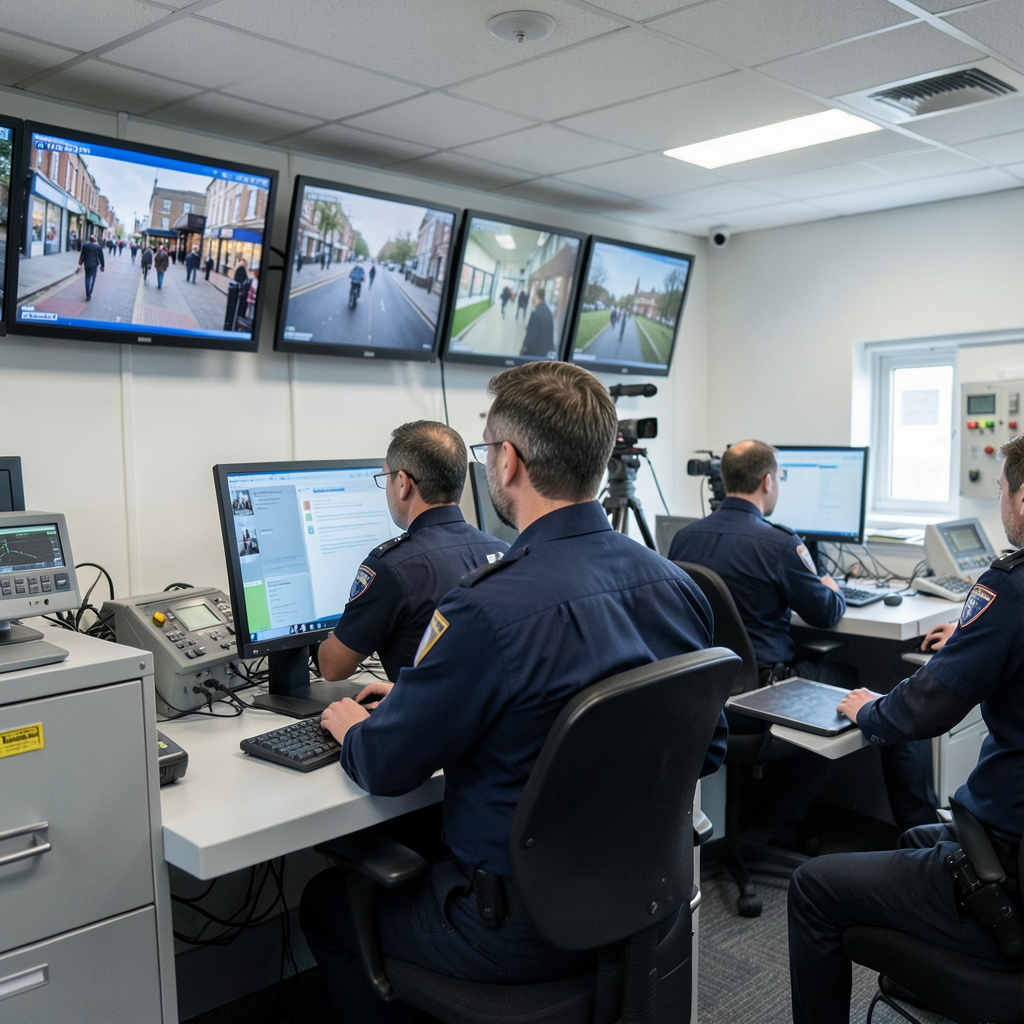

A new surveillance facility has been established at Abingdon police station following a joint initiative between the Police and Crime Commissioner and local council representatives.
The upgraded CCTV control room, representing an investment of £300,000, now serves as the central hub for monitoring public spaces across Oxfordshire.
The operation falls under the banner of the Thames Valley CCTV Partnership, with surveillance personnel at the Marcham Road facility currently overseeing 452 camera feeds.
Responsibility for public space CCTV systems has been transferred from Oxfordshire district councils to Thames Valley Police, supported by funding from the Police and Crime Commissioner and continued contributions from local authorities.
The arrangement is expected to enhance capabilities for detecting and preventing criminal activity throughout the county.
Technological improvements include updated equipment, broader camera deployment, and more sophisticated monitoring systems.
The Police and Crime Commissioner confirmed that the initial £300,000 funding came from his office, while operational expenses would be shared between the district councils and Thames Valley Police.
At the facility opening, he stated that no statutory obligation exists for either police or councils to provide CCTV services, making such cooperation vital for delivering reliable, uniform coverage across Oxfordshire.
He indicated that the modernised infrastructure would facilitate better coordination with officers on the ground and police command centres, supporting crime prevention efforts, criminal identification, and enhancing public confidence in shared spaces.
The programme encompasses all public space surveillance in Oxford city and the districts of West Oxfordshire, Cherwell, South Oxfordshire, and Vale of White Horse, with substantial upgrades applied to sections of the existing camera infrastructure.
The Abingdon control room employs eight surveillance operators and a supervisor, coordinating camera monitoring across Oxfordshire from a single location.
This consolidation enables quicker responses to unfolding situations and allows intervention during incidents as they occur.
Economic advantages were noted, with the merged arrangement offering cost efficiencies for council taxpayers.
The enhanced camera quality also permits integration with Automatic Number Plate Recognition systems.
Technological improvements include compatibility between CCTV systems and current police technology, enabling officers to retrieve footage from external locations and distribute high-resolution imagery throughout the force more efficiently.
Superintendent John Batty, responsible for community policing, described the facility as marking considerable progress in collaborative safety efforts.
He observed that the partnership working had permitted strengthening of Oxfordshire’s surveillance capabilities while maintaining a contemporary, functional service.
The technological enhancements and improved system reliability would assist in crime prevention, safeguarding vulnerable individuals, and collecting evidence to protect communities.
Representatives from several district councils expressed support for the arrangement.
Geoff Saul, responsible for housing and community safety at West Oxfordshire District Council, acknowledged the council’s role in initiating the surveillance hub.
Lubna Arshad, the city council member overseeing community safety matters, noted Oxford’s participation in the partnership, emphasising joint efforts with police and district authorities to address criminal activity, support missing person inquiries, reassure residents, and enable swift coordinated responses to emergencies.
Georgina Heritage, communities cabinet member at South Oxfordshire District Council, highlighted that the facility would deliver contemporary, dependable surveillance supporting local communities.
Helen Pighills, communities cabinet member at Vale of White Horse District Council, observed that the collaboration illustrated what becomes possible when local government and police work in concert.
The partnership model has previously operated successfully in Milton Keynes and Slough since January 2024.