
Saxony-Anhalt’s electoral outcome on September 6, 2026, delivered a record-setting result for the right-wing populist Alternative für Deutschland.
The party secured 43.8 percent of the vote, surpassing any previous state election performance since German reunification.
The party’s branding employs a shade of light blue comparable to Reform UK’s, and like its British counterpart, the AfD has cultivated support in post-industrial regions left behind by economic change, offering a platform centred on opposition to immigration and the political establishment.
However, meaningful distinctions exist between the two parties.
The AfD has advocated for mass deportations of non-citizens under the policy term remigration, while senior party members have downplayed the significance of Germany’s Nazi-era history.
Constitutional protection authorities classified the party’s Saxony-Anhalt branch as extremist in 2023, and France’s Rassemblement National under Marine Le Pen has formally separated itself from its German equivalent.
The AfD’s trajectory reflects distinctly German circumstances, particularly the migration surge of 2015 and the party’s deliberate outreach to former East German states.
Weißenfels demonstrated the party’s strongest performance locally, with 52.4 percent backing.
Reporting from the town revealed a charged political atmosphere far removed from typical electoral campaigning.
Political messaging saturated the urban landscape.
Campaign materials adorned lampposts and thoroughfares throughout the municipality.
Though ideologically opposed, both symbols express nostalgia for vanished social orders that AfD minister-president candidate Ulrich Siegmund pledges to restore.
Siegmund’s likeness appeared frequently on official party merchandise worn by supporters.
Certain adolescent male pupils at the local educational institution adopted a deliberate aesthetic signalling right-wing affiliation.
Left-leaning residents countered with counter-messaging apparel.
Anti-AfD insignia were considerably more prevalent than comparable political apparel in Germany’s metropolitan centres.
Local perspectives on the municipality diverged from external portrayals.
Burgenlandkreis youth wing representative Christian Meusel of the Christian Democratic Union noted that empty structures and renovation needs dominated residents’ assessments of civic priorities.
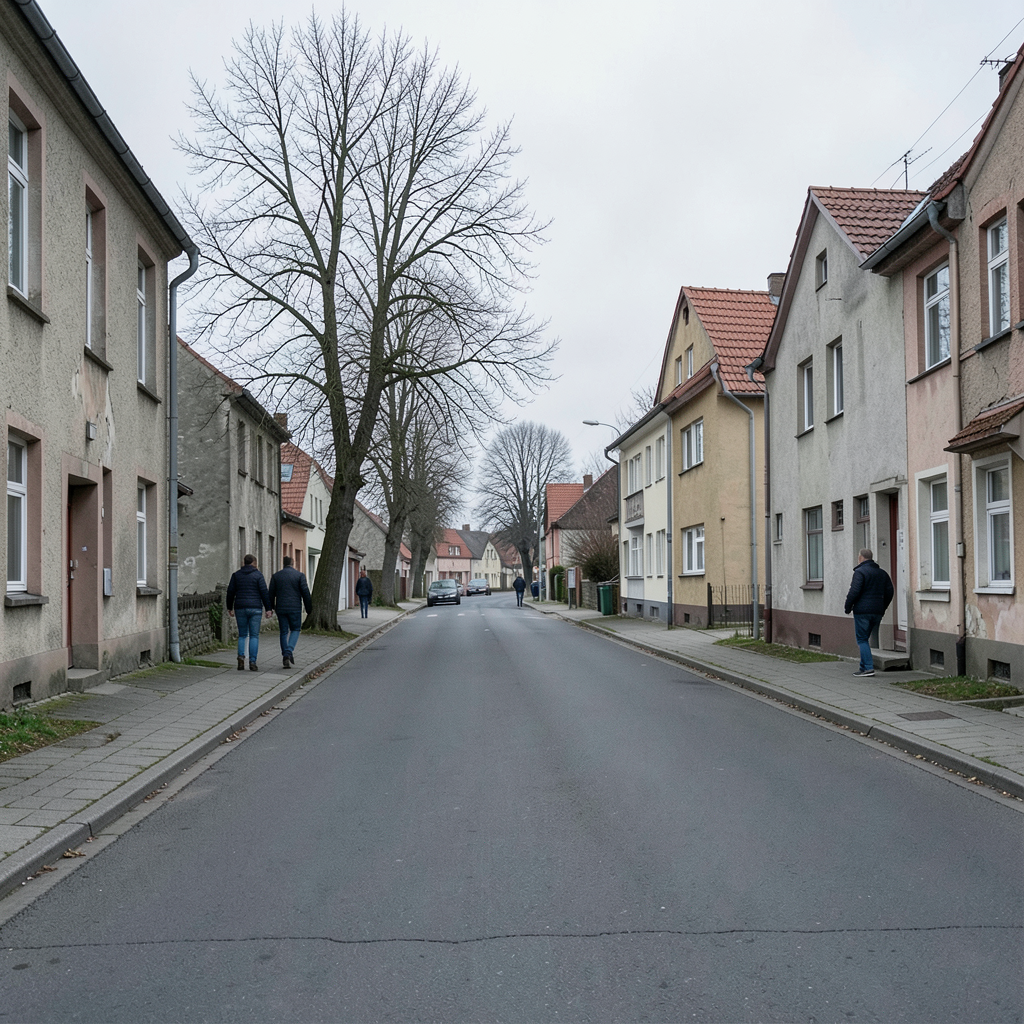
Travellers arriving by rail confronted an abandoned footwear manufacturing facility at the primary approach, while the central square featured boarded commercial premises.
Meusel expressed frustration that such imagery consistently became conflated with Christian Democratic Union governance, despite his party’s continuous administration since 2002.
The state’s economic challenges predated Christian Democratic Union stewardship.
Like numerous eastern municipalities, Weißenfels confronted acute deprivation and joblessness following reunification’s disruption of centrally planned economic structures.
The footwear factory’s 1992 shutdown terminated a traditional industry spanning centuries.
Saxony-Anhalt continues ranking among Germany’s least prosperous territories.
Bbs student Arthur cited immediate grievances motivating his AfD vote.
Security deterioration in the New Town, attributable to criminal activity, figured prominently alongside perceptions of mainstream parties either ignoring or evading the issue.
Escalating fuel expenses, inadequately offset by unreliable municipal transport, exemplified what he characterised as national decline.
The AfD effectively weaponised this combination of material and social anxieties.
The party’s Saxony-Anhalt platform invoked remigration as a supposed solution to unlawful immigration, presenting enforcement as purely a matter of political resolve.
Dissatisfaction over fuel pricing proved particularly resonant.
The campaign slogan refuelling without tears condemned climate policies characterised as alarmist and burdensome to rural populations dependent on economical private motoring.
The party additionally linked fuel costs to regional identity by incorporating the Simson, an affordable petrol-powered motorcycle brand originating from GDR production that retains popularity in eastern regions, into public events.
Supporters were encouraged to bring personal Simson machines to rallies, trailing behind Siegmund on an AfD-branded model.
Oliver Leisner, a designated Weißenfels Christian Democratic Union member, contested the notion that his party had neglected voter concerns.
He referenced August 2026 legislation equating imported Simson motorcycles with domestically manufactured versions, arguing that parliamentary Christian Democratic Union members acted voluntarily out of recognition for eastern German pride.
Young people commute to educational institutions on Simson motorcycles, colloquially termed swallows.
Regarding the broader economic climate, Meusel contested characterisations of Christian Democratic Union governance as having produced sustained decline.
He highlighted that under incumbent minister-president Sven Schulze’s administration, Weißenfels secured construction of a new correctional facility anticipated to inject three hundred million euros and generate hundreds of employment positions.
He additionally referenced efforts to restore Neu-Augustusburg castle, though he believed this initiative had failed to resonate with voters.
While the Christian Democratic Union’s achievements appeared politically unsuccessful irrespective of material impact, Leisner argued that campaign rhetoric had compounded the party’s reputation difficulties.
He commended Elke Simon-Kuch for tangible community involvement, though he deemed the broader party messaging inadequate.
He observed that the Christian Democratic Union had long displayed arrogance regarding voter outreach, prioritising criticism of the AfD over articulation of its own positive agenda.
Street-level observations supported this assessment.
Christian Democratic Union advertising for incumbent Sven Schulze implicitly positioned against an extremist AfD, with a minister-president for everyone appearing most frequently.
Other parties articulated more explicit opposition.
The centre-left Social Democrats abandoned the fire-wall prohibiting cooperation with the AfD, instead asserting themselves as a protective barrier.
The Greens courted voters with more provocative language questioning tolerance for extremist presence in government.
On the campaign trail, affirmative messaging originated overwhelmingly from the AfD.
Everything is possible functioned as the campaign’s dominant aspirational theme, frequently accompanied by the reassuring qualifier everything will be all right.
This ambiguity was supplemented with concrete proposals including calls for public consultation, demands for normalcy restoration, and assertions regarding immediate enforcement measures.
In rural settlements adjacent to agricultural land, AfD signage complemented the pastoral setting with calls to remove bureaucratic interference from rural affairs.
Leisner acknowledged respect for the AfD’s rhetorical directness, noting clarity regarding their positions and non-positions.
His assessment applied equally to the Christian Democratic Union’s left-wing populist challenger.
The Sahra Wagenknecht Alliance, a minor left-wing conservative formation, had achieved outsized influence through eye-catching artificial intelligence-generated imagery in campaign materials.
The party’s aesthetic parallels with the AfD extended to joint condemnation of cooperation restrictions, with speculation suggesting potential coalition formation until BSW candidate Claudia Wittig definitively excluded this possibility slightly over a week after polling.
Beyond public electoral competition, the campaign revealed social transformations affecting Weißenfels.
Party emblems and political attire integrated with the street environment less conspicuously than might be anticipated, and notably less antagonistically than the tattered Union flags visible in British urban settings.
However, Bbs student Lotta, who coordinated a mock election at her school alongside classmates, observed that political animosities manifested more starkly within educational and community settings than during campaigning.
She reported regular expression of what she characterised as anti-democratic and dehumanising viewpoints, including one instance during instruction where a pupil shouted inflammatory statements about religious texts.
She had personally encountered far-right hostility, receiving a slur targeting left-wing individuals with evident resonances to Nazi-era characterisations of marginalised groups.
While left-wing discourse avoided such troubling associations, it could not claim to moderate political dialogue.
Initiatives such as pensioner-led anti-right demonstrations had imbued the term right wing with pejorative connotations absent in anglophone contexts, and political actors freely applied extremist terminology to opponents.
Beyond verbal attacks, such vigorous condemnation of the AfD appeared genuine.
Many residents considered the rhetorical label appropriate given concerns about advancement of Saxony-Anhalt AfD members with previous involvement in the Neo-Nazi Heimattreue Deutsche Jugend, an organisation modelled on the Hitler Youth, into significant governmental positions.
Several educators expressed such profound alarm that they wore black attire on election result morning, conveying the gravity of what they viewed as a national setback.
Following the AfD’s victory, speculation about potential governance approaches replaced opponents’ earlier resignation and supporters’ earlier optimism regarding a sweeping electoral shift.
While the AfD fell three seats short of a governing mandate and no coalition agreement seemed imminent, formation of a state administration without the party’s involvement appeared problematic.
Similarly unclear was how implementation of its most controversial proposals, including abolition of mandatory school attendance and reduction of historical instruction regarding the Nazi period, could be prevented.
Leisner expressed concern that the party might pursue more fundamental administrative changes through early retirement measures for disfavoured civil servants, a power within ministerial prerogatives.
The AfD had yet to take executive action, lacking precedent for party-led administration.
Scrutiny of the party’s conduct had concentrated primarily on verbal statements, leading numerous centre-right observers to advocate discontinuing what they characterised as unwarranted alarmism that had sustained the fire-wall since the AfD’s 2014 establishment and inadvertently stimulated support among disillusioned voters.
Arthur argued that the AfD’s exclusion from mainstream politics reflected a political culture he believed had shifted excessively toward progressive positions.
He viewed an AfD administration as necessary corrective to perceived liberal dominance.
However, Arthur acknowledged awareness of potential dangers associated with his chosen party.
When questioned about prospects for an AfD-BSW coalition, he indicated this outcome would hold considerable appeal, as governmental oversight would provide some constraint on the AfD while preventing catastrophic political regression.
Notably, such a coalition arrangement might also have resulted had the school’s mock election determined actual outcomes.
Arthur represented 39 percent of pupils voting AfD, while the BSW achieved 7 percent.
At time of publication, the BSW maintained its rejection of government formation with the AfD.
Numerous dramatic scenarios remained possible, including potential departure of Christian Democratic Union legislators to the AfD or a fresh electoral contest.
Regardless of subsequent developments, the election left Weißenfels and Saxony-Anhalt with heightened political participation and persistent frustration regarding regional and national circumstances.
September’s end brought an AfD victory in Mecklenburg-Western Pomerania alongside a resurgent far-left party in Berlin, demonstrating that radical populist movements from both political extremes had found substantial support across eastern Germany.
With Friedrich Merz’s chancellorship under pressure, assuming western regions would remain uninfluenced would prove naive.