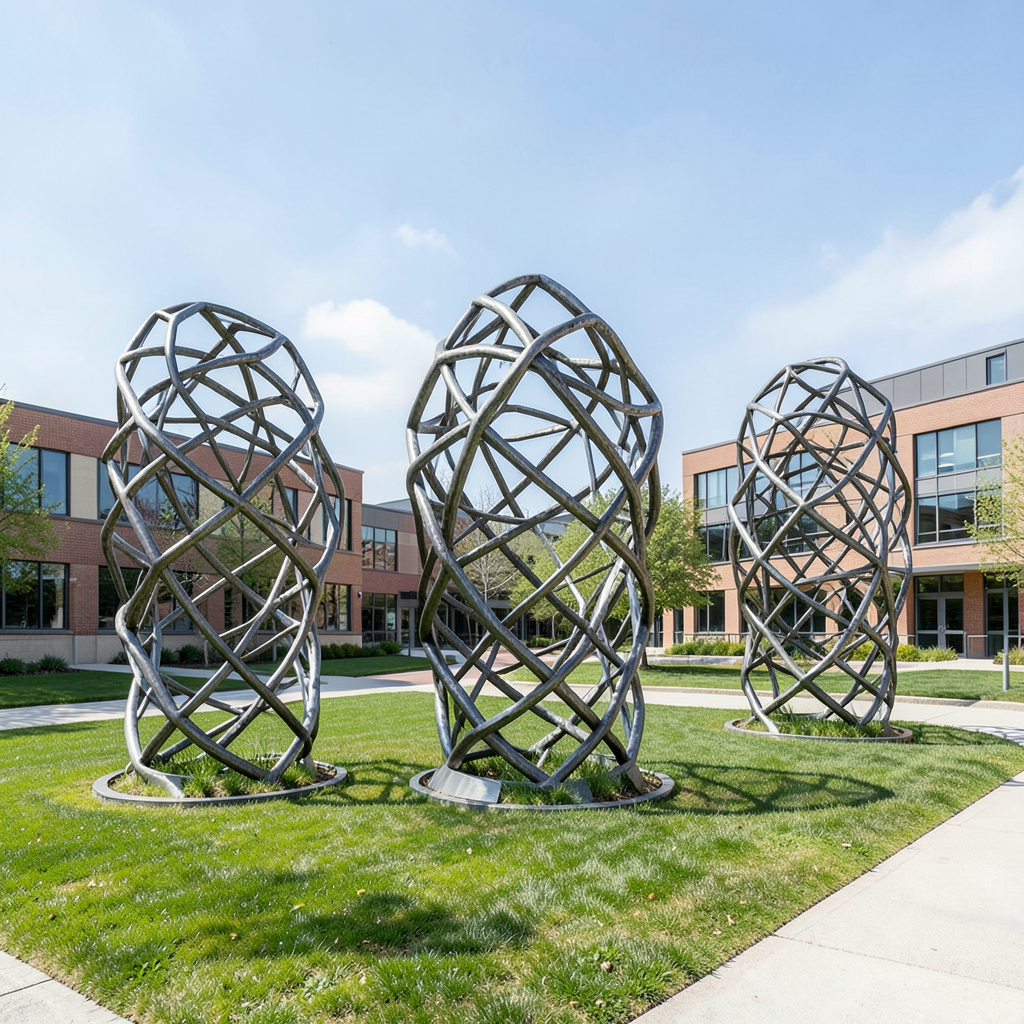

A trio of interactive sculptures has been installed at a major UK science campus, bringing molecular research into a public outdoor setting.
The installation, titled Fragments, was officially opened at Harwell Campus in Oxfordshire on September 3.
The large-scale artwork draws its inspiration from protein-ligand crystal structures and serves as a tribute to scientific breakthroughs achieved at Diamond Light Source, Britain’s national synchrotron facility.
Rebecca Duvall, who leads community engagement at Harwell Campus, commented on the project’s dual purpose of fostering curiosity alongside scientific advancement.
According to Duvall, the installation honours discoveries that have transformed lives globally while simultaneously establishing a communal area where both campus workers and external visitors can engage with scientific concepts in an accessible manner.
The sculptures were developed by design firm Acrylicize alongside James Sandy, a senior beamline scientist employed by Diamond Light Source.
Their objective was to translate complex molecular science into a format approachable for general audiences.
Each piece represents chemical fragments at a scale exceeding two billion times their actual molecular dimensions.
Constructed from steel and finished in vivid hues, the sculptures have been placed in proximity to the campus cricket pitch.
Members of the public are encouraged to examine the structures closely, sit upon them, and interact with the installation directly.
The Covid Moonshot research initiative provided the primary conceptual foundation for the project.
During the coronavirus pandemic, researchers operating the synchrotron at Diamond Light Source successfully mapped the three-dimensional configuration of Mpro, a viral protein essential to Covid-19 replication.
Through extensive screening of numerous chemical compounds, scientists identified potential inhibitors capable of disrupting the protein’s function.
Sandy explained that the molecular forms depicted within Fragments originated from international collaborative research efforts involving scientists and facilities across multiple countries.
Sandy expressed satisfaction that such research had been translated into a public art format, noting that the sculptures establish a tangible relationship between the foundational scientific work conducted at Diamond and its practical applications in pharmaceutical development.
Data generated through the Covid Moonshot initiative contributed to the creation of the inaugural crowdsourced coronavirus antiviral treatment and established one of the most comprehensive open-access repositories for antiviral drug discovery research worldwide.
Fragments functions as a lasting commemoration of the worldwide significance of investigations carried out at the Harwell site.
The installation also highlights the campus’s continued investment in developing public areas designed to inform and inspire visitors.
Harwell Campus accommodates more than 250 organisations and employs approximately 7,000 scientists, engineers, and technical staff members, positioning it among Britain’s foremost centres for scientific research and technological innovation.
The site contains sophisticated research equipment including particle accelerators, quantum computing systems, and chambers capable of simulating space conditions.
Diamond Light Source, situated within the campus, employs a light beam with intensity approximately ten billion times greater than solar illumination.
This powerful radiation enables investigators to analyse diverse materials ranging from ancient fossils to aircraft components, as well as pathogenic organisms and vaccination preparations.