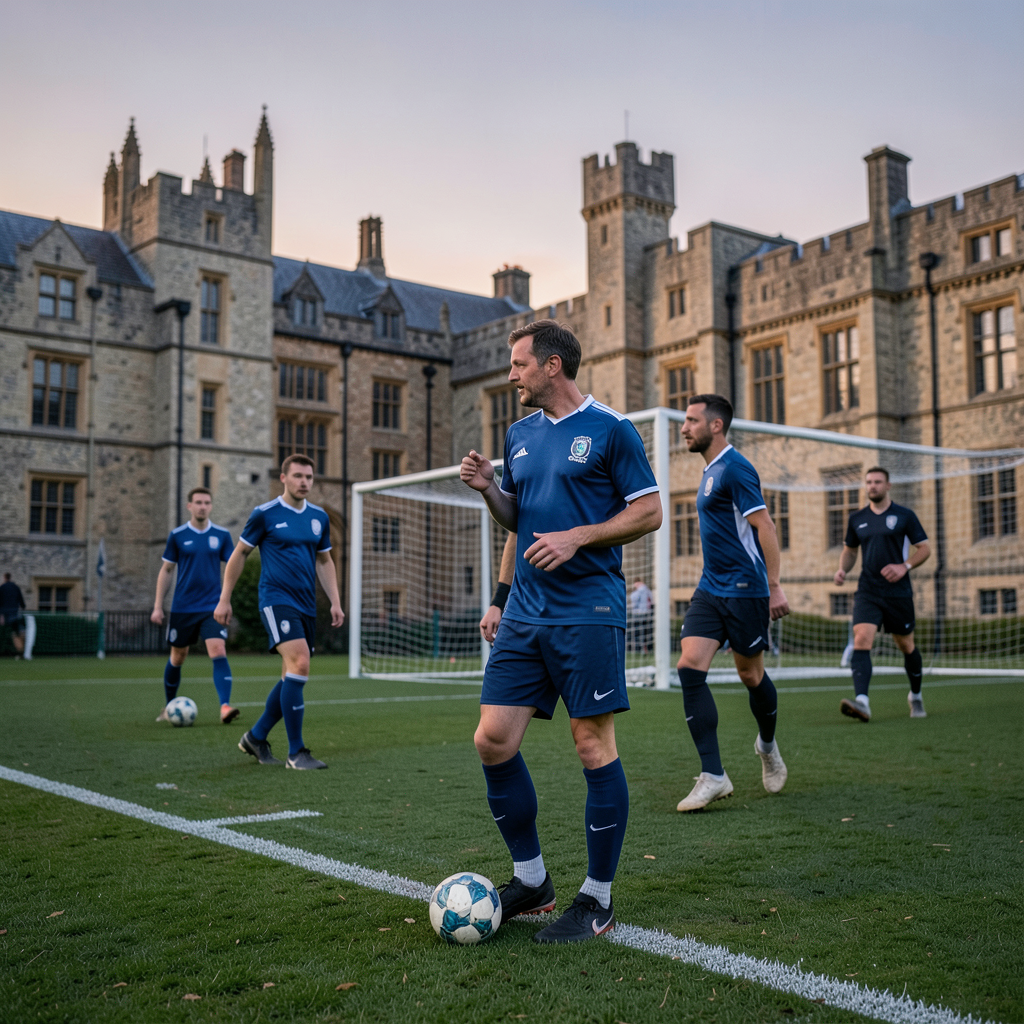

At 56, Sean Qualter has established himself as an accomplished figure within Balliol College’s football setup.
As the leading goalscorer for the club’s second team, he has also accumulated several appearances at the senior level.
His contributions have proven decisive on numerous occasions, helping the college avoid defeat, including during a victory against St John’s Cambridge the previous year.
Following these performances, he was officially appointed to the honorary position of chairman at Balliol Football Club.
Beyond his sporting achievements, Qualter serves as the night porter at Balliol, a role that places him among the first points of contact for anyone arriving at the college during evening hours.
Students beginning their time at Balliol consistently identify the night porters as essential to maintaining the college’s smooth daily operations and overall safety.
The foundations of Qualter’s life trace back to the Rose Hill council estate in the vicinity of Iffley.
He characterises his upbringing as occurring in a challenging and demanding setting, albeit one characterised by a strong sense of neighbourhood solidarity.
His mother held a position in the catering department at Magdalen College School, an arrangement that exposed young Sean from an early age to both the town and academic communities of Oxford.
He explains that even during childhood, he became aware of an alternative dimension to Oxford existing beyond institutional walls, a reality he found puzzling when observing young people residing in educational establishments rather than family homes.
While Oxford frequently confronts accusations of exclusivity, Qualter suggests that genuine experience inside the institution reveals a different picture.
He identifies football as a unifying force that brings diverse individuals together.
His initial involvement with football materialised during childhood participation with Rose Hill Football Club.
The club boasted considerable youthful talent and achieved significant success across competitions.
During this period, Martin Keown, who would later become associated with Arsenal, spent twelve months at the same club.
Qualter observes that significant footballing ability frequently emerges from estate communities, though such potential sometimes went unrecognised in previous eras, whereas contemporary structures now offer improved youth development pathways.
At thirteen, Qualter’s trajectory shifted as he became involved in lifestyle choices that detracted from his sporting ambitions.
Competitive football did not feature again in his life until he reached his thirties.
During those intervening years, he found himself observing from the sidelines as former teammates built successful local playing careers.
While he initially believed himself content with his circumstances, he reveals that interior turmoil accompanied this period, a deep longing to participate that his commitments prevented.
He identifies this as among the most significant disappointments of his existence.
His return to the sport occurred during his time employed as a psychotherapist.
While in that role, he established a team comprising himself and his clients.
Now at fifty-six, he has maintained continuous involvement with the game.
Upon relocating back to Oxford during his forties, having previously resided in Somerset, Qualter rejoined Rose Hill Football Club.
His previous playing companions had retired from the sport, yet he found himself competing alongside significantly younger footballers, approximately ten years his junior.
Remarkably, he finished as the club’s top scorer during his inaugural season back.
The club recognised this achievement with a trophy that he regards as his most treasured possession, symbolising personal reconciliation for lost time.
His counsel to students centres on prioritising work before recreational activities, a philosophy he believes proves more effective than reversing this sequence.
Following this period, Qualter commenced his involvement with Balliol’s football programme.
Considerable effort was required to persuade the team’s captain at that time to grant him an opportunity.
He encountered remarks suggesting opponents would underestimate him on account of his age, yet upon his first appearance he immediately found the net twice.
The competitive environment provides him with a rare mental escape.
After two decades spent in a demanding professional capacity, he notes that the football pitch represents the sole context where his thoughts disengage from professional concerns.
He accepts that joint problems may develop in later life, viewing this as a necessary exchange for recovering the years he previously forfeited.
Club president and former captain Alfie Moore describes working with Qualter as consistently enjoyable, noting his positive influence both as an individual and as a player.
Moore highlights how Qualter elevates those around him and demonstrates particular value during challenging early-morning training sessions when squad morale might otherwise be low.
Qualter’s influence extends beyond the football pitch.
Will Gulliford, who manages the Balliol bar and previously captained the college rugby side, identifies Qualter as fundamental to college social life and a representation of collegiate sporting culture.
The position of night porter encompasses multiple responsibilities.
Qualter effectively operates as a security presence, a welcoming figure, and frequently an informal advisor.
Given his personal history, he possesses an ability to identify struggles that others might miss.
Rather than issuing directives, he shares his own experiences as a resource for those facing difficulties.
His guidance emphasises the importance of constructive habits and honest communication, drawing particular attention to the isolation that can accompany growing up in environments where emotional expression was discouraged.
He actively promotes openness and transparency.
Regarding football’s broader significance, Qualter views the sport’s popularity as fundamentally rooted in human connection.
It provides participants with a sense of belonging and an emotional outlet.
The universal nature of football creates natural opportunities for interaction and the formation of relationships.