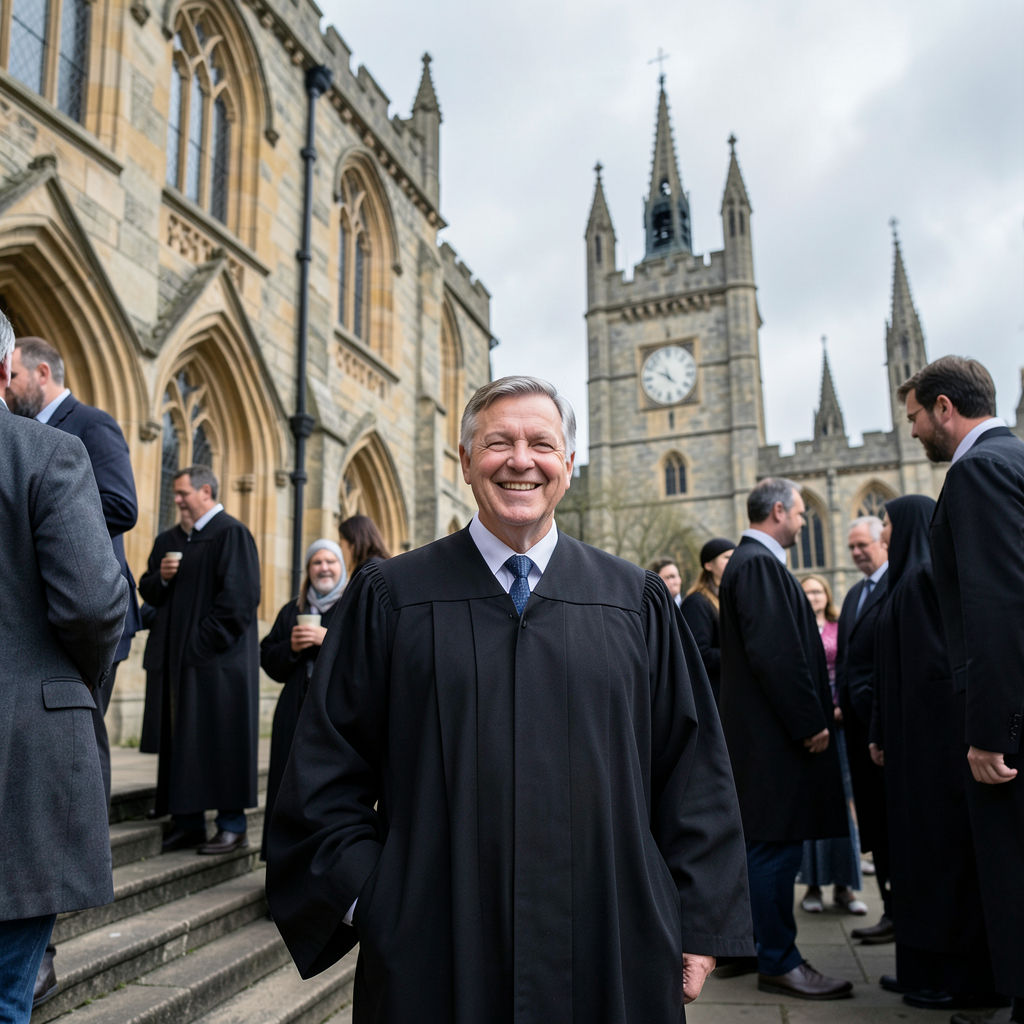

Professor Matt Jarvis, an astrophysicist and Vice-Master at St Cross College, Oxford, grew up in Swadlincote, a former coal-mining community in Derbyshire, and attended state schools in the area.
During his first visit to Oxford’s colleges alongside a small group of companions, the imposing architecture and grandeur of the institutions failed to make a significant impression on him.
He recalls experiencing a sense of unease within such elaborate surroundings.
According to his recollection, the collegiate structure struck him as somewhat peculiar.
Several decades later, Jarvis has become an established figure within that very environment, now holding a senior leadership position at St Cross while continuing his work as an astrophysicist.
Research indicates that individuals from Britain’s privileged classes are five times more likely to have received private education and twenty-one times more likely to have studied at Oxford or Cambridge compared to the broader population.
Despite private school pupils comprising merely seven percent of the UK’s total population, they represent approximately one-third of Oxford’s home undergraduate admissions.
These figures raise a fundamental question: what is the experience of teaching at one of Britain’s most traditionally exclusive institutions for someone who progressed through the state education system?
For Jarvis, this distinction carries personal weight rather than remaining an abstract concept.
He became the first member of his family to pursue higher education when he commenced his Physics with Astrophysics studies at Birmingham University, completing his undergraduate degree in 1993.
He subsequently relocated to Oxford in 1997 to undertake doctoral research in Astrophysics.
Upon commencing his university studies, the experience proved unfamiliar, though Jarvis remembers feeling predominantly excited about the opportunity.
He relocated to university accommodation where he encountered fellow students who had also progressed through state schools.
Surrounded by friends in similar circumstances, adapting to university life proved, in his words, fairly straightforward.
Oxford, however, presented what he describes as an unusual transition.
The departmental atmosphere facilitated a relatively smooth adjustment to his new circumstances.
Graduate students and researchers in scientific disciplines, he observes, typically dedicate more time to their academic departments than to their colleges, and everyone was engaged in comparable work and came from diverse backgrounds.
It was the collegiate environment, rather than his academic department, that felt unfamiliar, representing something he never truly adjusted to.
Jarvis recalls selecting Linacre College based primarily on the standard of their football programme.
He acknowledges that certain aspects of Oxford culture took considerable time to become accustomed to, including variations in how people communicated.
He noted that the conventions governing interaction differed from those he had grown up with, and found himself adopting a more direct and assertive communication style compared to other Oxford academics, admitting he has never fully reconciled this difference.
The discussion turned to habitus, referring to the habits and assumptions absorbed from one’s surroundings, and whether meaningful distinctions exist between private and state school environments.
When questioned about whether the primary advantages of private schooling lie in academic provision or the social environment created, Jarvis explained that separating these factors proves challenging.
He articulated that if a student attends a high-performing state school with established pathways to elite universities, they may internalise higher education as an achievable goal.
Conversely, a student at a state school with limited resources and no tradition of sending pupils to university would be less likely to view higher education as accessible to them.
He identified both aspirational and environmental factors as significant.
The same principle, he contended, applies within families: when university attendance represents a family tradition, it appears a natural progression rather than an exceptional circumstance.
For Jarvis, educational inequality cannot be confined to the classroom setting alone, extending instead to the expectations placed upon students and the visions of possibility presented to them.
When questioned about whether he had ever contemplated enrolling his own children in private education, his response came without hesitation.
He stated his objection to the system and questioned why he would then support it.
His stance holds that with appropriate support both at home and in educational settings, every individual possesses the capacity to achieve success.
He further contested the assumption that choosing private education for one’s children signifies greater ambition for their future.
Jarvis characterised this particular discourse as counterproductive, noting that the overwhelming majority of parents harbour aspirations for their offspring.
He emphasised that financial capacity to afford private education does not inherently indicate greater ambition or aspiration compared to other parents.
The conversation also addressed recent legislative changes requiring private schools to apply twenty percent Value Added Tax to their fees.
For Jarvis, the underlying principle remains clear: if families currently spending money on private education instead directed those funds toward state schools, all state schools would benefit from increased funding, thereby enhancing resources and learning opportunities beyond the classroom environment.
He acknowledged the presence of complexities surrounding this issue but maintained his core conviction that children should not face diminished experiences or reduced opportunities simply due to their parents’ financial circumstances.
He argued that such a shift would establish a considerably more just and balanced system, ultimately producing a higher proportion of students excelling across all areas of education, including academically.
He expressed the view that if substantial investment in education is deemed valuable, redirecting such expenditure through taxation would benefit society and the United Kingdom as a whole.
Reflecting on his own trajectory, Jarvis recalled that when he commenced his university studies in 1993, there was a marked expansion in participation from individuals across all social backgrounds, supported by government grant provisions that meant students incurred no tuition fees, creating an environment where university attendance felt genuinely accessible.
While he remembered this era as a period when opportunities broadened for many, his primary concern throughout his studies remained financial.
Between the ages of sixteen and twenty-five, spanning his pre-university years, undergraduate studies, and doctoral research, Jarvis balanced his academic commitments with part-time employment.
He was not merely studying for A-levels, not merely completing an undergraduate degree, not merely pursuing a doctorate, but continuously maintaining additional work responsibilities.
Only upon securing income from postdoctoral positions was he able to dedicate his full attention to academic work.
Jarvis argued that students compelled to work alongside their studies possess considerably less time to devote to their education.
The same principle, he contended, applies to those with caring duties, disabilities, or mental health difficulties.
He stressed that such circumstances do not indicate academic inadequacy but simply result in reduced available time.
Throughout his professional career, Jarvis has devoted considerable effort to equality, diversity, and inclusion initiatives within physics and across Oxford.
He has held positions chairing both the Physics Department Equality and Diversity Committee and the Postdoc Liaison Committee, and was eager to acknowledge that colleagues involved in equality, diversity, and inclusion work at the university demonstrate exceptional dedication and work tirelessly to enhance conditions for others.
More recently, Professor Jarvis has participated in multiple committees, including serving as Associate Head of Division, as well as the People Committee and Equality, Diversity and Inclusion Committee.
Nevertheless, he also acknowledged the constraints of depending upon academic staff experiences to fully comprehend the obstacles confronting contemporary students.
Individuals such as himself, he noted, can enter a room and declare their state school background, claiming understanding of the circumstances, despite their experiences belonging to thirty years prior and reflecting state school conditions in Derbyshire.
The students navigating Oxford today inhabit a markedly different landscape.
Jarvis highlighted that he attended university during an era devoid of tuition fees, social media platforms, and mobile telephone technology.
Consequently, he recognises that many of the challenges currently faced by students differ substantially from those he encountered.
He believes universities should improve their recognition of these evolving circumstances.
Rather than permitting senior academics to define those challenges, he advocates for institutions to engage directly with existing students.
He would welcome universities offering considerably greater opportunities for students to assist academic staff in understanding the obstacles they face.
One of his most significant sources of disappointment emerged during his involvement with the race equality task force approximately five years ago.
Following the prominence of the Black Lives Matter movement, considerable momentum developed to address improvements in matters relating to race and ethnicity.
Jarvis noted that the task force itself functioned effectively, comprising numerous dedicated individuals from diverse backgrounds collaborating to develop meaningful recommendations.
However, the outcome was the production of an attractive strategic document containing extensive recommendations, yet subsequent implementation remained minimal.
He observed that the final result often becomes a question of whether particular actions represent what should be undertaken, rather than actually executing those agreed-upon actions.
Drawing upon his experience, he expressed the view that insufficient understanding does not prevent institutional change.
Rather, he perceives a deficiency in commitment among those holding decision-making authority, questioning why individuals would seek to modify systems that have demonstrably served their interests.
Institutional inequality, he argued, manifests in less visible forms as well.
Students’ experiences diverge depending upon which college they attend, which tutors supervise them, and what support networks surround them.
Jarvis expressed the view that receiving markedly different levels of support based on college assignment or tutor allocation represents an unacceptable situation.
He maintains strong commitment to addressing these imbalances and continues dedicating himself to enhancing equality, diversity, and inclusion initiatives, striving to render the university a more welcoming and accessible institution for all students, including those from state school backgrounds.
His own pathway into academia followed a considerably less deliberate course than might be assumed.
When asked when he first conceived of an academic career, Jarvis stated that such a path had not originally appeared on his radar as a professional possibility.
Instead, he effectively stumbled into academia, making choices at each stage without any predetermined career trajectory.
He did not and continues not to experience any compelling need to occupy an academic position.
He simply proceeded with the next available opportunity and finds himself in his current position as a consequence.
Despite his progression from state school education in Swadlincote to holding a senior administrative role at an Oxford college, Jarvis maintains that his journey was far from carefully planned.
However, he argues that this progression was made possible through support mechanisms that contemporary students should not be required to simply hope to encounter.