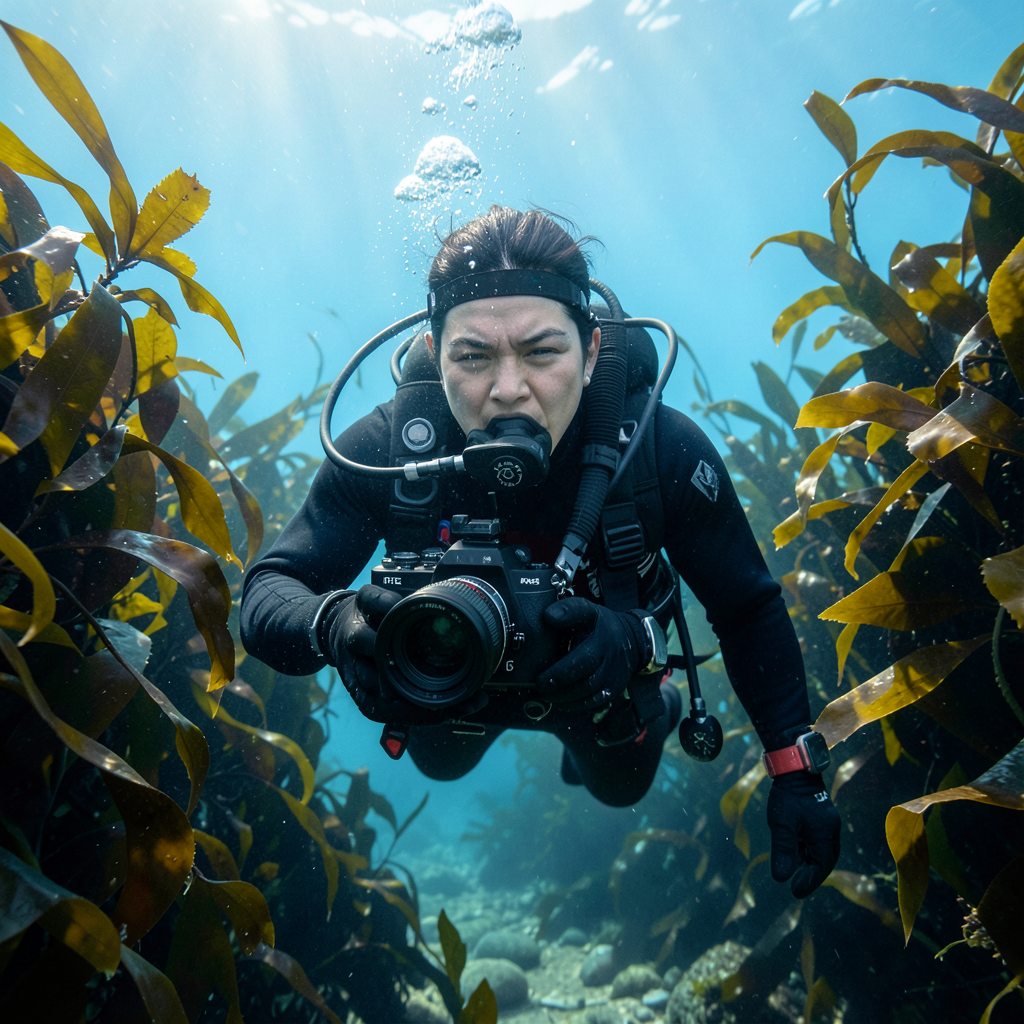

Maxwel Hohn is an Emmy Award-winning cinematographer specializing in wildlife and underwater productions.
Based on the Pacific coast of Canada, he has contributed footage to significant natural-history series in recent years, capturing scenes from polar regions to the kelp forests off Vancouver Island.
His professional journey followed an unconventional path.
Growing up in a remote coastal community, he developed an early connection with marine environments.
As a young child, he would accompany the family dog into the ocean while wearing a life jacket and mask, allowing the animal to pull him through the water.
During summer months, he spent considerable time in local lakes, searching for crustaceans among the submerged rocks and vegetation.
That underwater realm felt simultaneously foreign and welcoming, a hidden ecosystem accessible only to those willing to enter it.
Initially, he had enrolled in a film programme at an institution in Vancouver at seventeen years old, having secured academic funding for studies in the arts.
Before commencing the course, he embarked on an extended journey through Central America.
That excursion ultimately extended to approximately a decade.
During this period, he obtained instructor certification in scuba diving and discovered that professional underwater work could serve as a vehicle for global travel.
Financial rewards remained modest, though the educational value proved immense.
He worked through progressively demanding diving disciplines, including technical, cavern and rebreather certifications.
Throughout this period, he continued developing camera skills independently, learning through experimentation due to limited financial resources and absence of professional mentorship.
Initial equipment comprised compact cameras and early action-recording devices before he transitioned into commercial diving for improved income and equipment investment.
His commercial diving career encompassed diverse assignments throughout Canada, ranging from structural welding and shellfish harvesting to environmental assessments and collaborative projects with government scientists.
He routinely carried filming equipment to isolated sites, including early aerial platforms when they became commercially available.
Remuneration provided access to locations that production crews typically found prohibitively expensive to reach, and he dedicated non-working hours to recording footage.
Family members remained supportive of this alternative trajectory.
Approximately twelve months into his travels, relatives visited him at his Central American base, arriving to find him operating modest motorized transport.
They embraced the lifestyle he had constructed and continued encouraging his unconventional choices.
He regarded this period not as rejection of formal education but rather as engagement with a different form of learning that would ultimately support his original cinematic ambitions.
During his time in Central America, instruction from a New Zealand-born diving professional proved particularly influential.
That mentor introduced him to the diving lifestyle and the fundamentals of instruction.
A decade subsequently, he visited this individual back in New Zealand, discovering him established in construction work and family life.
The instructor expressed that reports of his subsequent adventures had become inspirational to him, representing an unexpected reversal of their original dynamic.
While no direct connections existed with natural-history cinematographers during his formative years, he found inspiration in completed productions.
Broadcasts featuring marine life sparked aspirations to participate in similar projects.
The international diving community also became significant, providing friendships spanning multiple continents as the sport created rapid connections across borders.
His initial decade-plus of professional activity centred on recreational diving and instruction at accommodation-based dive operations and vessel-based liveaboards.
Instructor credentials included professional-level recreational diving certification alongside technical diving qualifications.
Supervising numerous students and accumulating thousands of submersions cultivated expertise in underwater safety, environmental awareness and maintaining composure under pressure.
When responsibility for another person’s safety underwater becomes routine, personal diving competence and observational capacity develop substantially.
Subsequent commercial diving certification through Canadian regulatory bodies covered occupational scuba and surface-supplied diving categories, progressing to instructional and supervisory designations.
Rebreather credentials expanded his capability to operate using open-circuit apparatus, closed-circuit rebreather systems or surface-tethered configurations depending on environmental conditions and production requirements.
Commercial underwater work introduced him to recovery operations, marine construction, aquaculture harvesting and scientific survey participation.
Earnings were consistently reinvested into camera systems, waterproof enclosures and supporting technology.
These technical competencies now integrate directly with production work, as major assignments require personnel capable of operating safely and legally within demanding underwater environments.
Camera equipment proves useful only when paired with diving proficiency sufficient to position it appropriately and maintain stable observation long enough to record natural behaviour.
The transition from identifying primarily as a diver who occasionally filmed toward considering himself a filmmaker who also dived occurred roughly six years prior to this discussion.
Prior to that point, commercial underwater work remained his principal activity with cinematography representing supplementary employment.
Subsequent larger productions created momentum where filming evolved from aspiration into primary profession.
His responsibilities expanded beyond aquatic cinematography into producing and directing, requiring constant attention to complete narratives rather than isolated underwater segments.
Current capabilities span underwater recording, telephoto perspectives, aerial platforms and sit-down interviews, alongside production and direction skills.
That breadth proves particularly valuable in natural-history production, where limited crew sizes at remote locations benefit from personnel capable of performing multiple functions.
Though aquatic environments will likely always represent his primary comfort zone, he now identifies principally as a filmmaker and narrative craftsman.
A collaborative short documentary about amphibian migration patterns created with a close associate proved transformative for his trajectory.
That project emerged from straightforward curiosity about phenomena occurring locally rather than from calculated career strategy.
The production competed in international festivals including Jackson Wild, where it secured category victory against entries from established companies.
That recognition attracted industry attention, with production companies subsequently seeking similar footage for their own series.
That success generated an opportunity to contribute sequences to a major streaming documentary, and subsequent assignments followed naturally.
The principal insight from that experience was that fresh narratives hold considerable worth within natural-history production.
Exotic subjects from distant locations are not prerequisites; overlooked creatures in nearby habitats often harbour stories that remain untold.
Underwater wildlife recording presents substantial logistical obstacles, beginning with communicating production requirements to decision-makers unfamiliar with aquatic environments.
Submerging equipment immediately introduces multiple interfering variables: water clarity, wave action, atmospheric conditions, tidal movement, illumination levels and thermal gradients, before considering whether target creatures will perform as needed.
Production teams typically receive concise requirements from researchers and species specialists who understand creature locations, anticipated behavioural timing and environmental triggers.
Such expertise proves indispensable, yet wild animals do not follow production schedules.
Requesting specific interspecies interactions cannot be orchestrated underwater.
Instead, identifying regions with robust populations of relevant species, partnering with local expertise, selecting appropriate seasons and environmental conditions, then determining optimal recording equipment becomes necessary.
Extended autonomous recording systems may prove essential when diver presence could disrupt natural activity.
Aquatic cinematography relies heavily on strategic planning, sustained patience and cooperative effort.
One establishes optimal conditions for significant moments to potentially occur, though nature retains final authority over whether footage is captured.
Extraordinary moments occasionally fail to appear in finished productions.
During one Arctic assignment involving pinniped and ursine subjects, split-frame compositions depicted a bear positioned atop floating ice with the recording device positioned partially submerged and partially exposed.
Those sequences appeared distinctive to him yet were omitted from the final edit for unspecified reasons.
Such outcomes occur regularly.
He attempts to provide comprehensive documentation for editing teams to prevent promising material being overlooked, though sometimes footage simply fails to integrate within the narrative structure under construction.
Disappointment accompanies considerable effort resulting in unused imagery, though gratitude remains for the opportunity to have witnessed such moments initially.
Rebreather apparatus fundamentally transforms the aquatic experience.
Although the marine realm is commonly characterized as silent, closed-circuit diving reveals considerable ambient sound.
Open-circuit apparatus generates notable acoustic interference with each exhalation producing audible release.
Closed-circuit systems eliminate this noise, permitting environmental sounds to emerge: crustacean vocalizations, reef activity, piscine movement and schooling behaviour, occasionally including cetacean communication.
Such acoustic immersion in the presence of large marine mammals proves difficult to articulate.
Underwater environments consistently evoke comfort rather than apprehension.
Urban traffic induces considerably greater anxiety than encounters with substantial marine fauna.
Relaxation derives not from disregarding hazards but from systematic preparation and accumulated experience.
Equipment maintenance, gas supply monitoring, environmental assessment and contingency planning constitute essential practices.
Creative visualization regarding potential compositions occupies considerable mental energy.
Specific imagery might materialise during sleep, including scenes where supervisory personnel are present and technical requirements align perfectly, prompting morning recognition that actual execution remains necessary.
Extended observation of cephalopod subjects during a Disney and National Geographic production proved particularly memorable.
Prolonged interaction revealed distinct personality variations among individuals: some demonstrated wariness, others apparent irritability, and certain specimens exhibited remarkable boldness and engagement.
One individual maintained consistent presence across multiple visits, emerging from its refuge to investigate whenever the team returned to the site.
Considerable duration passed together on the seafloor as the creature investigated surroundings and foraged.
Such experiences reinforce how sustained observation enables recognition of individuality and behavioural patterns that brief encounters would entirely miss.
That observational capacity represents a significant attraction of natural-history cinematography.
Recording equipment provides justification for decelerating, examining and dedicating sufficient duration with animal subjects to develop genuine understanding rather than superficial familiarity.
Natural-history cinematographers bear considerable responsibility when documenting environmental transformation and degradation.
Those working directly with marine systems frequently witness habitat alterations firsthand.
While showcasing natural beauty remains important, simultaneously presenting damage, whether from resource extraction, contamination or other anthropogenic pressures, holds equal significance.
However, environmental narratives need not conclude with audiences despairing about human impacts and planetary prospects.
Numerous encouraging accounts exist regarding habitat protection initiatives, ecosystem restoration programmes, coastal cleanup activities and measurable environmental improvements.
Featuring such successes equally matters.
Witnessing concrete positive change potential may motivate broader public participation.
When documenting challenging environmental subjects, maintaining storytelling integrity rather than assuming advocacy roles requires careful navigation.
Documenting observed human impacts on filmed species and habitats occurs naturally, whether that involves marine debris or other forms of pollution.
Capturing such imagery ensures availability should it become relevant to emerging narratives.
Equally important involves recording remediation efforts, including coastal cleanup activities, underwater debris removal and habitat reconstruction projects.
Striking balance between documenting problems and solutions defines responsible practice.
While personal investment in filmed environments and organisms runs deep, permitting imagery and narrative to communicate circumstances directly, rather than prescribing audience interpretation, represents preferred methodology.
Raising awareness matters as much as demonstrating human capacity for positive contribution.
Collaboration between visual documentarians and research scientists proves essential, particularly as deep-sea exploration efforts continue advancing.
Scientific expertise underpins most significant natural-history productions.
Many narratives originate directly from researcher discoveries, with cinematographers subsequently granted opportunities to translate those findings for broader audiences.
Conversely, production work can support research initiatives by providing funding or enabling scientific access to locations otherwise unreachable.
That mutual relationship offers advantages to both parties.
Experience aboard dedicated research vessels demonstrated adaptation to real-time scientific requirements rather than demanding research schedules accommodate production demands.
Documentary opportunities and scientific objectives need not conflict when collaborative frameworks are established appropriately.
For emerging natural-history filmmakers, practical guidance centres on accessibility and proximity.
Prospective wildlife documentarians need not target distant iconic species for initial projects.
Local water bodies, river systems, woodland areas and coastal stretches offer substantial narrative potential that conventional appearance may mask.
Countless compelling stories exist within apparently ordinary locations.
His own career exemplifies this principle.
Extended observation of accessible amphibian larvae revealed documented behaviour previously unrecorded scientifically.
Such proximity-based investigation ultimately contributed to peer-reviewed scientific publication.
Seeking fresh narratives, undocumented behaviours or novel interpretive angles should precede aesthetic considerations.
Thorough observation before technical refinement represents sound methodology.
Current equipment capabilities remove financial barriers to entry that previously existed.
Contemporary smartphones offer remarkable documentary functionality.
Small independent crews suffice initially.
Utilizing available resources, applying creativity and commencing narrative work represents the practical path forward.