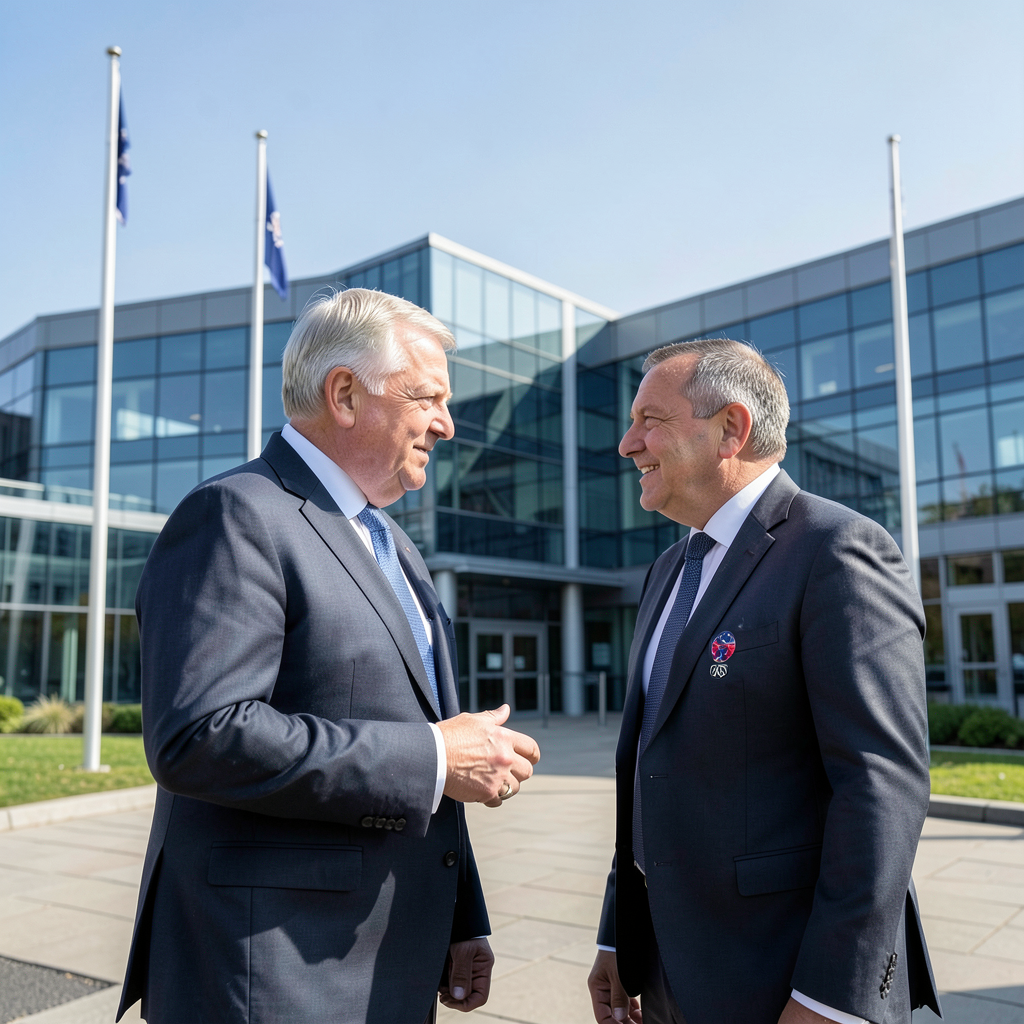

The Prime Minister and the NATO Secretary General held their first face-to-face meeting at a research facility in Oxfordshire to discuss defence matters.
Andy Burnham assured Mark Rutte that Britain’s dedication to the Atlantic alliance had not shifted following the recent change in number 10’s occupant.
The Labour leader, who entered Downing Street after replacing Sir Keir Starmer, met with the Alliance’s top official at Harwell Science and Innovation Campus in Didcot.
Burnham emphasised the consistency of British obligations to the defence organisation regardless of who occupies the premiership.
He referenced the contributions made by British forces deployed on Alliance operations globally.
The Prime Minister stressed to his Dutch counterpart the importance of demonstrating continued resolve to NATO commitments during their discussions.
Rutte responded by describing Britain as one of NATO’s most influential members, commending its advanced capabilities in science and technology.
He observed that defence expenditure generates employment opportunities and stimulates economic activity within society.
The Secretary General noted Britain’s particular strengths in cutting-edge technology, industrial sectors and higher education institutions, suggesting these attributes positioned the nation at the vanguard of Alliance innovation.
He indicated that certain matters under discussion would require greater engagement from Britain in future.
Rutte expressed gratitude for Burnham’s acceptance of the responsibilities and offered his best wishes for the role.
The incoming Prime Minister confronts domestic political pressure regarding how Britain intends to fulfil its pledge to dedicate 3.5 percent of economic output to core defence expenditure by the mid-2030s.
John Healey departed from his position as Shadow Defence Secretary in the previous Labour administration over disagreements about financial provisions, having advocated reaching the three percent threshold by decade’s end.
In an address to the Ditchley Foundation later that day, Rutte commended Britain for its earnest approach to security matters.
He noted that Britain stood alongside fellow Alliance members in leading efforts to push back against what he described as Russia’s dangerous and reckless activities.
Rutte stated that the collective would persist in enhancing capabilities to deter and defend all members against any form of threat.
He declared that the Alliance would not be cowed by Russia’s campaign of hostile behaviour, asserting that Moscow’s objective of halting support for Ukraine would prove counterproductive, as Russian actions would only prompt increased assistance to Kyiv.
Rutte characterised Moscow’s behaviour as indicative of weakness and a manifestation of failure in Ukraine.
Addressing the Alliance’s evolving character, Rutte outlined that NATO was becoming more European to maintain its transatlantic nature.
He articulated a vision of a NATO in which Europe and Canada increased investment, production and security contributions.
This represented the concept of NATO 3.0, building towards a more capable European component within a stronger overall Alliance.