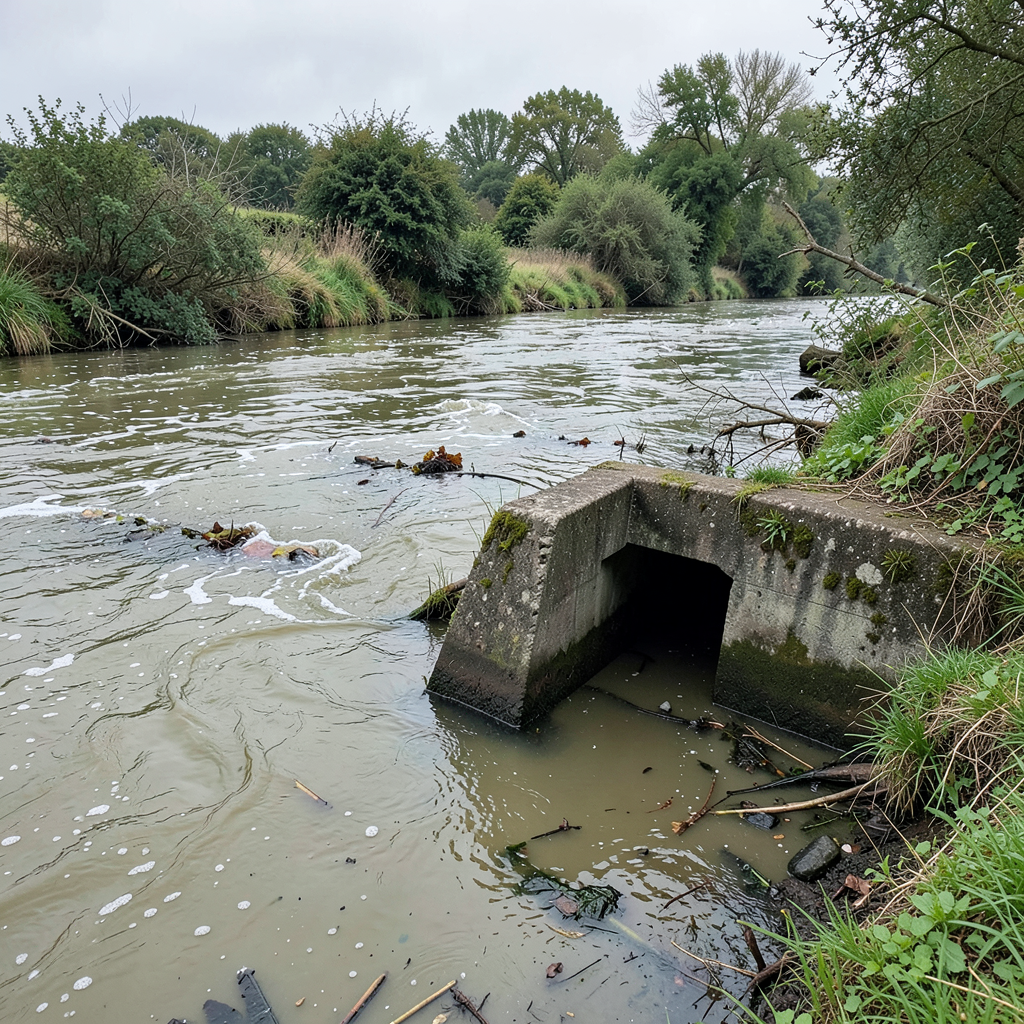

Untreated waste discharges into Oxfordshire’s river network over the bank holiday weekend have created what campaigners describe as a hazardous mixture of bacterial contamination.
The releases by Thames Water follow recent thunderstorm activity across the county and have drawn sharp criticism from environmental groups and local representatives.
The utility company conducted storm overflow discharges at multiple locations including Botley, Wheatley, Burford, Milton-under-Wychwood, Kingham, and Faringdon during the weekend period.
The incidents occurred while the region remains under drought conditions and hosepipe restrictions, with river levels significantly depleted.
Ash Smith, who co-founded Windrush Against Sewage, issued a warning about the potential impact.
Smith, who features in the Channel 4 documentary Dirty Business released earlier this year, has spent ten years documenting pollution in the River Windrush alongside fellow campaigner Peter Hammond.
According to Smith, the combination of low river volumes and sewage discharges creates particularly dangerous conditions.
Depleted waterways lack the capacity to dilute concentrated untreated waste, while overflows disturb accumulated sediment deposits within drainage systems.
Bacterial concentrations are expected to reach dangerous levels, posing risks to aquatic life, wildlife, and human health.
Smith attributed the situation to prolonged underinvestment and regulatory failures that have permitted such practices to continue.
Smith stated that the water sector and government authorities have long maintained inaccurate claims suggesting untreated discharges only occur during periods of high river flow.
Smith noted that campaigners were compelled to challenge official Environment Department content on video platforms that misrepresented the circumstances of sewage releases.
A public petition organised by Windrush Against Sewage has accumulated nearly 200,000 signatures and is scheduled for parliamentary consideration in September.
The petition advocates for a public referendum on water company ownership and has gathered more than double the signatures required to trigger parliamentary debate.
Smith expressed satisfaction that the matter will be examined in Parliament and hopes it will encourage further action on the issue.
Oxford City Sheriff Linda Smith, who serves as cabinet member for housing and communities, has been pursuing improvements in water quality standards at Port Meadow, the designated bathing area on the Thames.
According to Smith, sewage discharges into rivers represent an unacceptable practice that should not occur in a developed nation during the current era.
Smith attributed the situation to Thames Water’s failure to invest adequately in infrastructure capacity and its focus on profit extraction and executive remuneration.
An ultraviolet water treatment system has been installed by Thames Water upstream from the Cassington facility, though Smith indicated additional measures remain necessary.
Water quality assessments continue to show unsatisfactory results, and a collaborative initiative involving charitable organisations, volunteers, Thames Water, and the Environment Agency is being developed to identify pollution sources.
Thames Water has been examining elevated bacterial contamination levels, commonly referred to as faecal matter, in the affected area for more than four years.
Smith expressed hope that incoming Prime Minister Andy Burnham would fulfil commitments to reform privatised utility services to safeguard environmental interests and secure improved terms for consumers.
Witney MP Charlie Maynard has also urged the new Prime Minister to take action following the weekend waste releases.
Maynard observed that extended dry conditions followed by initial rainfall immediately prompted sewage facility discharges into both the Windrush and Evenlode catchments.
Maynard declared the situation unacceptable and called for Thames Water to be placed under Special Administration.
Special Administration represents a modified insolvency framework for essential service providers that maintains operations but does not constitute nationalisation.
Maynard has repeatedly advocated for this intervention.
During a parliamentary address on September 1, Burnham, formerly Mayor of Greater Manchester, indicated his administration would find reversing water company privatisation extremely challenging, given the transfers occurred approximately four decades ago.
In his initial Prime Ministerial address, Burnham committed to pursuing greater public oversight of essential services, with ministers examining potential solutions for the water sector.
Thames Water issued a statement emphasising its environmental responsibilities.
The company reported a reduction in pollution incidents by 18 percent and serious pollution incidents by 27 percent during 2025.
A company representative stated that substantial investment is underway to enhance river conditions, with the most significant wastewater infrastructure upgrade in 150 years currently in progress.
The equivalent of over seven million pounds is being invested daily, with all profits being reinvested.
No shareholder dividends have been distributed for two years, and no external dividends have been paid since 2017.
The company explained that storm overflows function within regulatory parameters established by the Environment Agency.
These systems incorporate significant rainwater dilution and were designed specifically to prevent sewage from entering properties during intense precipitation.
The spokesperson noted that company operations cannot address the issue independently, citing contributions from agricultural, industrial, and highway sources alongside increasingly severe weather patterns.
During the recent prolonged summer period, hardened ground absorbed less rainfall.
When substantial precipitation occurred, accelerated surface runoff reached rivers and drainage infrastructure rapidly, placing additional strain on wastewater systems.
The reduced absorption capacity combined with drainage discharge is generating concerns about potential sudden flooding events during the autumn season.
Cherwell District Council and Oxfordshire County Council are jointly organising an Oxfordshire Flood Preparation event scheduled for Thursday, September 24, between 2pm and 7pm at Exeter Hall in Kidlington.
Councillor Chris Aramini-Brant, planning lead at Cherwell, noted that evolving climate patterns and more extreme rainfall events make it increasingly vital to assist residents in understanding flood vulnerabilities and protective measures for properties.
County environment and economy representative Councillor Laura Gordon emphasised that following a summer marked by extreme heat, flood risks must not be overlooked.
Gordon observed that Oxfordshire has experienced over twenty significant flood events since 2007, and residents should engage with specialists at the event to explore risk reduction strategies for their homes.