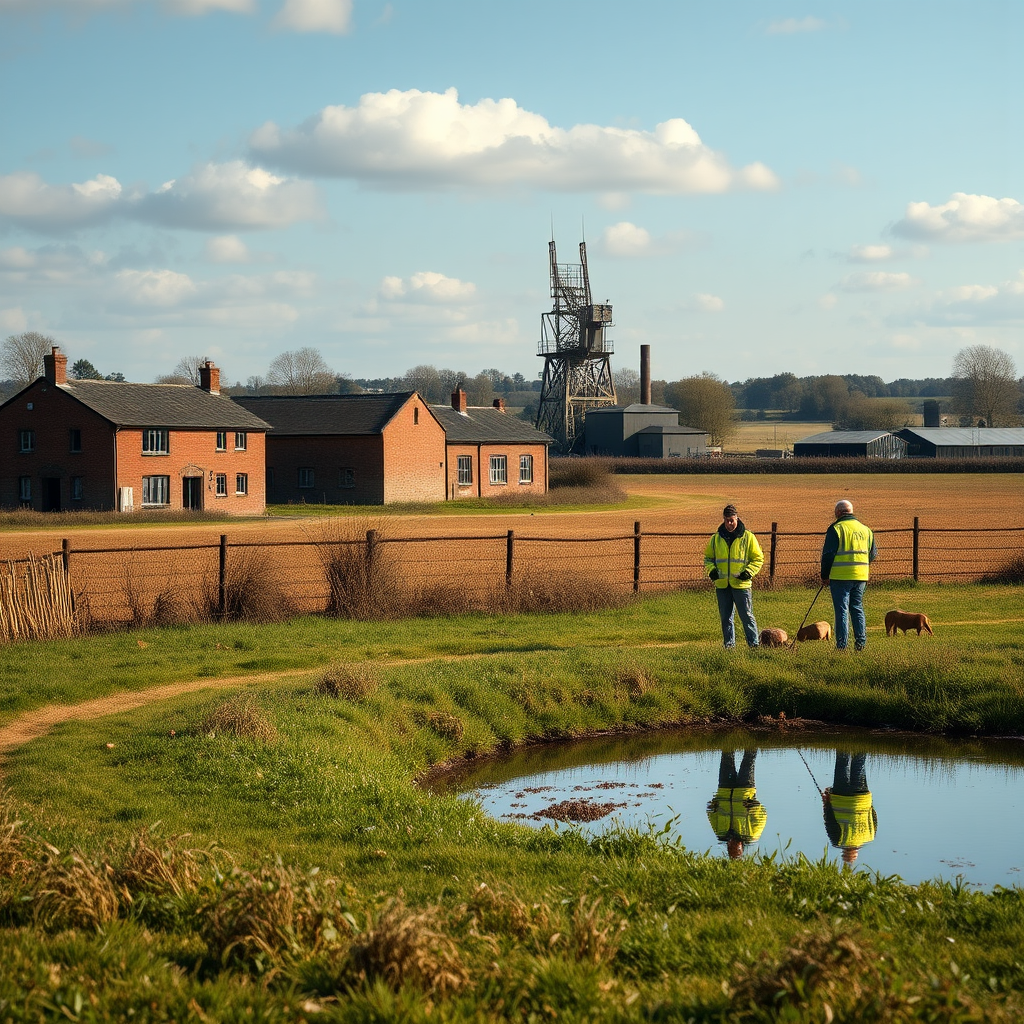

Recent water testing conducted closer to the former RAF base in Oxfordshire has revealed levels of persistent pollutants that are significantly higher than earlier estimates indicated.
A major housing development is proposed by Dorchester Living on the site of the former RAF Upper Heyford facility, which is now under increased examination after new water analysis identified heightened concentrations of per-and poly-fluoroalkyl substances, commonly referred to as PFAS.
These substances are typically linked to Aqueous Film Forming foam, a type of fire suppression agent that would probably have been employed at the installation throughout its operational period spanning 1918 to 1994.
The compounds, which resist environmental degradation, build up in human tissue and have been connected to cancer, thyroid conditions and reproductive difficulties.
Over recent years, the Environment Agency has been examining water quality in a local waterway named the Leys Farm Ditch, situated 4.5 kilometres downstream from Heyford Park.
Combined PFAS levels in surface water specimens gathered at this point reached as high as 2.296ng/l.
Gallos Brook, a local community organisation, arranged for independent analysis of a stream located just 300 metres from Heyford Park on 28 April, 2026.
The findings, evaluated by Veritas Laboratory Services, which holds accreditation for PFAS analysis, revealed PFOS concentrations measuring 27,823ng/l.
This figure exceeds concentrations previously documented by the Environment Agency at Leys Farm Ditch by a factor of 40 and surpasses the UK annual average environmental Quality Standard for PFOS by 43,000 times.
Subadra Consulting, which assessed the information, suggested that the original lower readings recorded downstream probably result from dilution caused by additional streams merging into the waterway.
Construction on the former location has already commenced, with 1,200 of a planned total of 13,000 dwellings completed during the past 15 years as part of a scheme worth £5 billion overseen by Dorchester Living.
Although the housing proposals have subsequently been scaled back, with 9,000 properties removed from the government’s new towns programme, these could still proceed if endorsed by Cherwell District Council.
Gallos Brook is now urging the planning authority to suspend review of the application while further investigation takes place to evaluate the concerns.
In correspondence to the council, the group stated that proceeding with fresh development when potential contamination exists would represent extreme carelessness, and called upon the authority to demonstrate foresight given the serious health implications for residents near affected locations, which could develop into a widespread public health emergency. The organisation warned that without prompt action prioritising occupant wellbeing, the community could face severe health consequences for generations. They emphasised that the area needs support and leadership in addressing this challenging situation.
Representatives for Cherwell District Council and Dorchester Living have been approached for response.