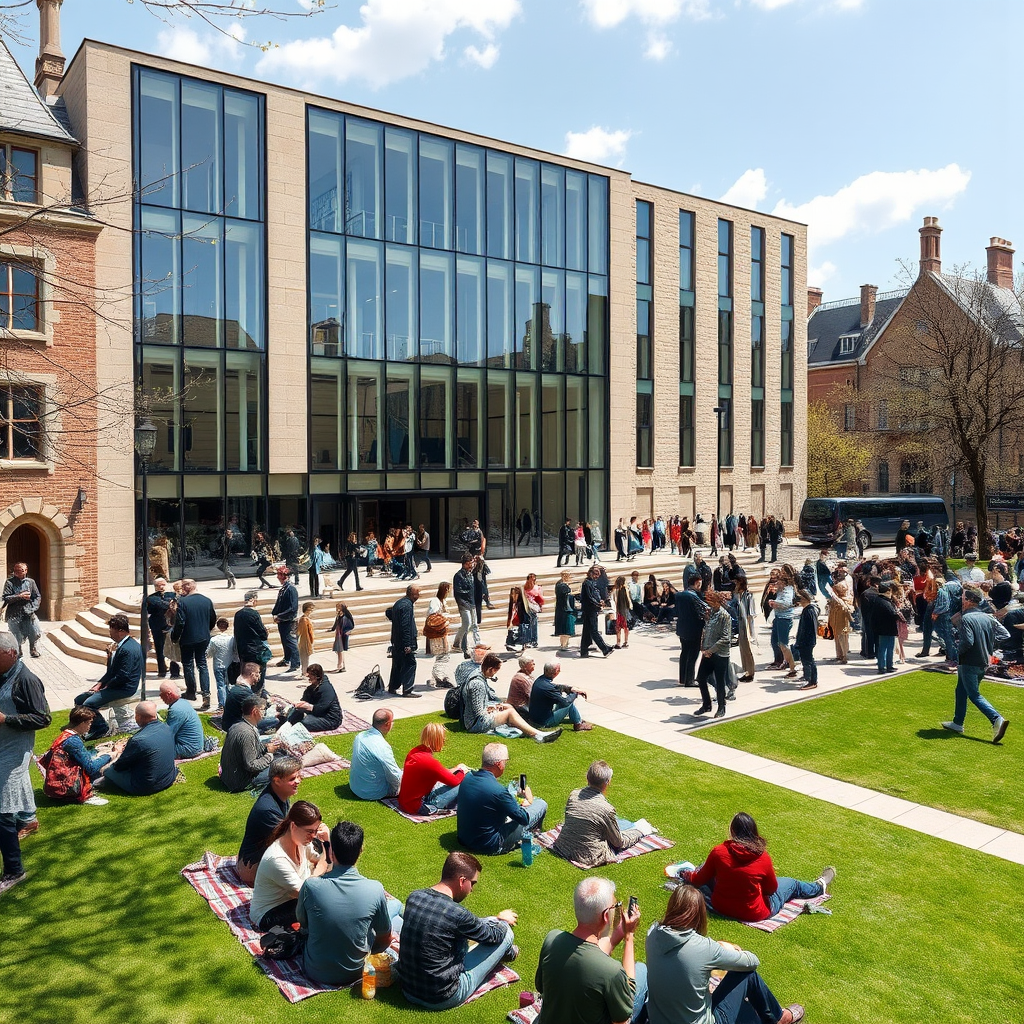

A brand new £185 million facility focused on the humanities welcomed thousands of visitors to its first public event.
The Schwarzman Centre, situated within Oxford University, opened its doors to the public on Saturday, April 25, for an open day that officially launched its inaugural cultural season.
Guests were treated to a full day of complimentary activities at the cutting-edge complex, featuring musical performances, dance shows, lectures, and gallery displays.
John Fulljames, who heads up the cultural programme at the Schwarzman Centre, said it was wonderful to see such a diverse audience connect with work created by internationally acclaimed artists. He noted that the centre brings together scholars, creative professionals, and local communities to foster fresh partnerships that make the university’s research more accessible and help people examine what it means to be human in contemporary times.
One of the major attractions was the global debut of 360 Vessels, a vocal installation created by artist Es Devlin and composer Nico Muhly.
Other notable acts included performances by the Scottish Ensemble and ZooNation.
The venue also showcased newly commissioned artworks by digital artists Refik Anadol and Anna Ridler.
The day’s schedule included contributions from arts groups based in Oxford and students from the university, alongside presentations by academic researchers.
Professor Jieun Kiaer shared her knowledge about the cultural context of K Pop Demon Hunters.
Award-winning poet Yomi Ṣode curated a collection of live spoken word pieces.
Community acts featured segments from Head over Wheels, Justice in Motion, Body Politic YOUTH, and The Cocoa Butter Club.
A custom comedy piece written specifically for the venue titled What have the humanities ever done for us?, was penned by director Richard Curtis and performed by actor Tim McInnerny.
The Schwarzman Centre represents a £185 million development, with the majority of funding coming from Stephen A. Schwarzman, the billionaire chief executive of Blackstone Inc.
The location holds significant charitable and historical significance.
It previously housed the Radcliffe Hospital, which operated from 1770 until 2007 before closing when the John Radcliffe Hospital opened.
The land was purchased in March 2003.
Archaeological work carried out between 2009 and 2010 uncovered burial sites stretching back to the Bronze Age and Neolithic era, reaching towards University Parks.
Further investigation in 2013 and 2014 identified 348 graves of poor individuals, dating from the 1600s and 1700s, situated beneath the current Blavatnik School of Government.
The reasons for death documented in these graves include railway accidents and printing press incidents, along with a handful of medical teaching cadavers.
The centre now features explanatory panels in its outdoor areas that honour the location’s extensive past.