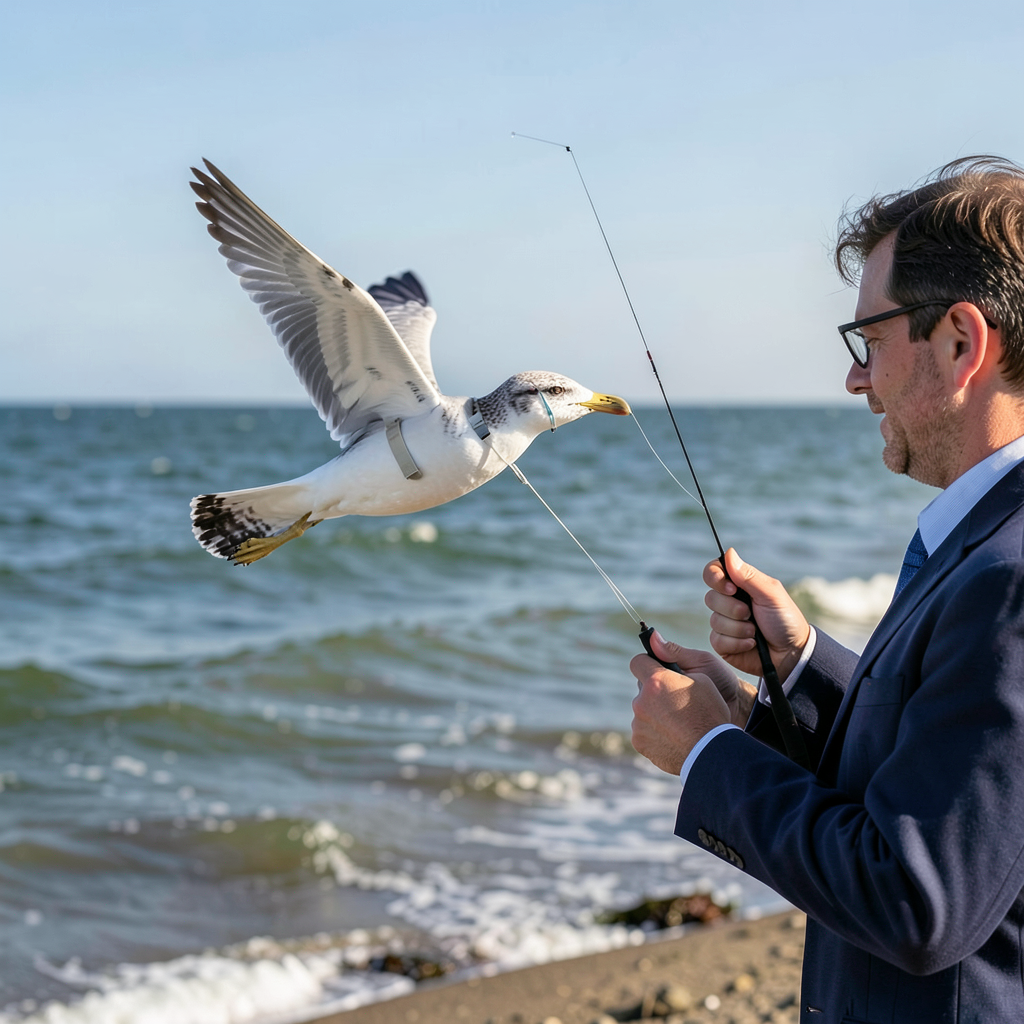

Researchers at Oxford University have identified a navigational disorder affecting seabirds during prolonged flights, with evidence suggesting that their internal clocks can become misaligned with local solar time.
The phenomenon is comparable to the time-shift experienced by passengers after long-haul travel and may prompt birds to depart from their intended courses.
The study, published in the journal Science, examined how gulls travelling hundreds of miles across the Atlantic respond when their biological clocks no longer correspond with the time at their current location.
Many bird species navigate using the sun, but an accurate internal clock is essential because the sun’s position changes throughout the day.
Sunrise normally provides a cue that allows birds to reset their clocks.
Fast movement eastwards or westwards during daylight can temporarily interfere with that process.
The researchers explained this through the journeys of shearwaters homing towards their nests.
An example begins with a bird whose clock is set to local time at 30°W.
After moving east to 15°W over six hours, it reaches a location where sunrise occurred an hour earlier.
Its internal clock consequently remains an hour behind local time, while the sun is about 20° further clockwise than the bird anticipates.
The resulting mismatch leads it to orient approximately 20° clockwise from the correct route.
To determine whether similar errors occur in natural conditions, the team examined two decades of GPS tracking information from 1,045 Manx shearwaters.
The records encompassed 3,688 foraging journeys.
This species breeds on islands along the western coasts of the United Kingdom and Ireland, travelling hundreds of miles offshore in search of food and sometimes reaching feeding areas approximately 600 miles west of their breeding colonies.
During nestward journeys, shearwaters can move quickly eastwards across several lines of longitude.
Such travel takes them into areas where the sun has risen earlier, producing the same general clock mismatch associated with flights into different time zones.
Their internal clocks may then trail local solar time by as much as roughly one hour.
Analysis of the tracked birds revealed systematic deviations from expected flight paths that matched the likely consequences of these clock shifts.
Birds travelling east tended to drift clockwise from the direction they should have followed, which is consistent with their clocks remaining behind local time.
Statistical models were used to assess whether the observed deviations matched predictions derived from the birds’ travel and the changing position of the sun.
The results supported the sun-compass explanation and fitted the tracking data more closely than a competing proposal involving alterations to the Earth’s magnetic field.
The directional mistakes continued when the shearwaters flew beside visible coastlines, even though landforms offered potential navigational guidance.
Birds flew nearer to land when the predicted compass error pointed shorewards and moved farther offshore when it pointed in the opposite direction.
This pattern indicated that the birds continued to depend on their internal clock and the sun despite having access to other navigational cues.
Study leader Dr Patrick Lewin said the findings showed that migratory animals carry internal clocks that allow them to use the sun for orientation, while small clock discrepancies can produce slight departures from their intended courses.
He noted that the research also demonstrates how animals can experience an internal clock mismatch comparable to human jet lag.
The researchers said further investigation is required to establish whether the mismatch influences the timing of important behaviour, causes physiological effects, or poses risks comparable to the effects that jet lag can have on human health.
They believe the work could also provide useful information for understanding ways of managing the sometimes disabling effects of long-haul flights.