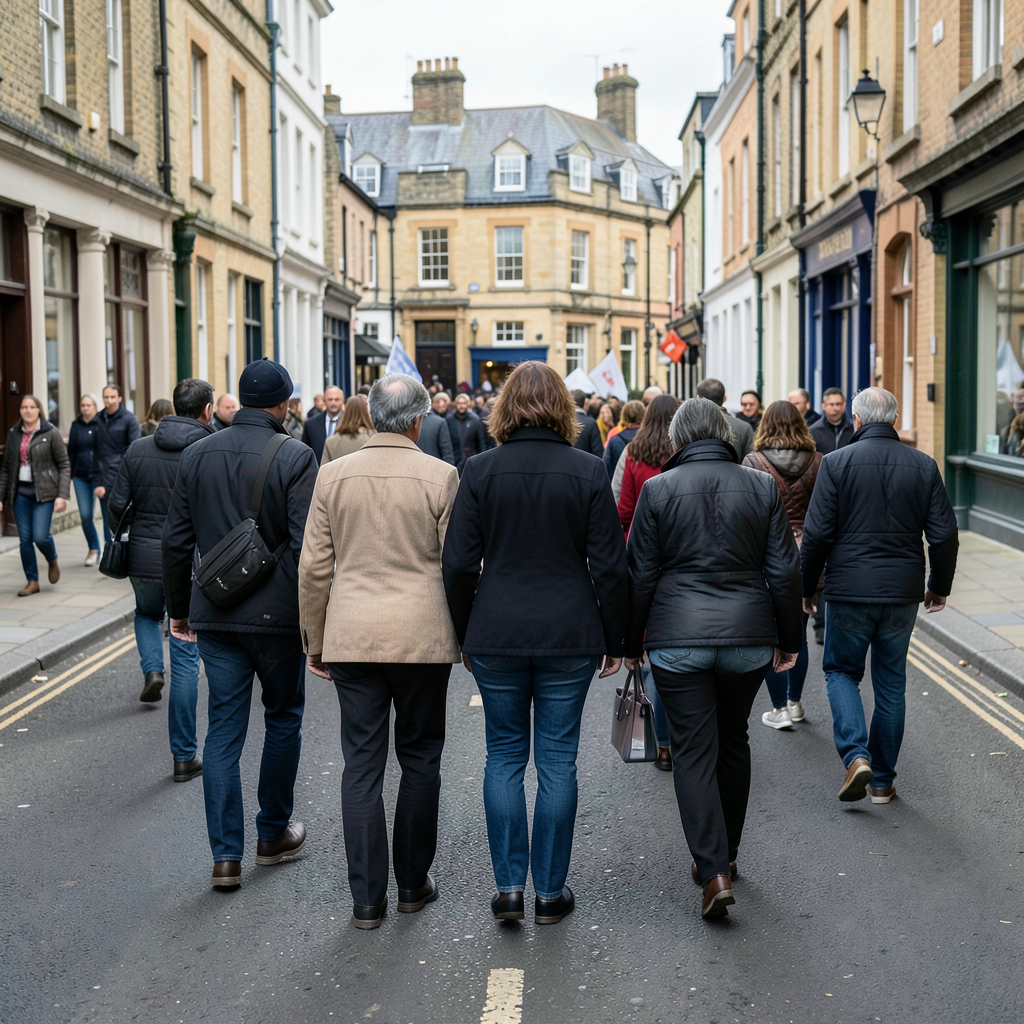

A recent Oxford protest against the far right brought together campaigners with differing political priorities, including opponents of the Campsfield Immigration Removal Centre, members of the Oxford Labour Club and Women Against the Far Right.
Their shared commitment to unity demonstrated that cooperation can develop despite disagreements on other subjects.
The gathering offered a contrast with the sustained internal conflict that has characterised British political debate.
The far right has become an increasingly prominent concern, while established parties continue to compete over their positions on immigration.
One possible response is for political groups to identify common ground and work collectively against extremist ideas without requiring identical views on every issue.
The scale of public concern was highlighted by the worst unrest recorded in the UK for a decade during the anti-migrant riots in summer 2024.
Research subsequently found that almost three-quarters of the British public were worried about right-wing extremism.
The statistic was produced two years ago, yet political action since then has done little to allay those concerns and may instead have intensified them.
Groups such as Patriot Platform have attracted large crowds while promoting women’s safety, with participants wearing black balaclavas and chanting opposition to migrant boats.
Within government, the Labour Party and Conservatives have been competing to appear tougher on immigration as they attempt to regain voters who defected elsewhere.
MPs from both parties have consequently discussed immigration in a more hostile manner than at almost any point in the past century, according to a recent Guardian study.
The Greens, despite regularly opposing the far right, have also been redefining Zionism and dividing their supporters.
Liberal Democrat leader Ed Davey has portrayed the growth of far-right ideology and shifts in UK political opinion as a historic opportunity to secure substantially more parliamentary seats, rather than as a danger to the country’s diverse communities.
Agreement on the nature of the problem has not produced agreement on how to address it.
Frequent disputes between parties have diverted attention from the need for a combined response.
Political unity, however, need not entail uniform thinking.
France provides an example of how parties can cooperate during an electoral process.
Its legislative elections use two rounds, with candidates receiving the fewest votes eliminated in the first.
Before the second round, political parties may combine their support.
In the 2024 legislative elections, a broadly left-wing grouping named Le Nouveau Front Populaire was formed between the two rounds.
It brought together more than six smaller parties seeking to counter Le Rassemblement National.
The alliance secured 182 seats, compared with 143 for Le Rassemblement National and its allies.
Although the French system requires voters to learn numerous political acronyms whenever alliances change, it demonstrates the value of cross-party cooperation.
Such cooperation involves engaging with political colleagues and people from different backgrounds to identify shared objectives, including discussion of the far right without drifting into unrelated arguments.
Unity can also be applied in everyday political activity and within Parliament.
Although it is not a complete or immediate solution, coordinated action can provide a long-term means of addressing threats facing the country’s varied communities and translating public concern into meaningful political change.