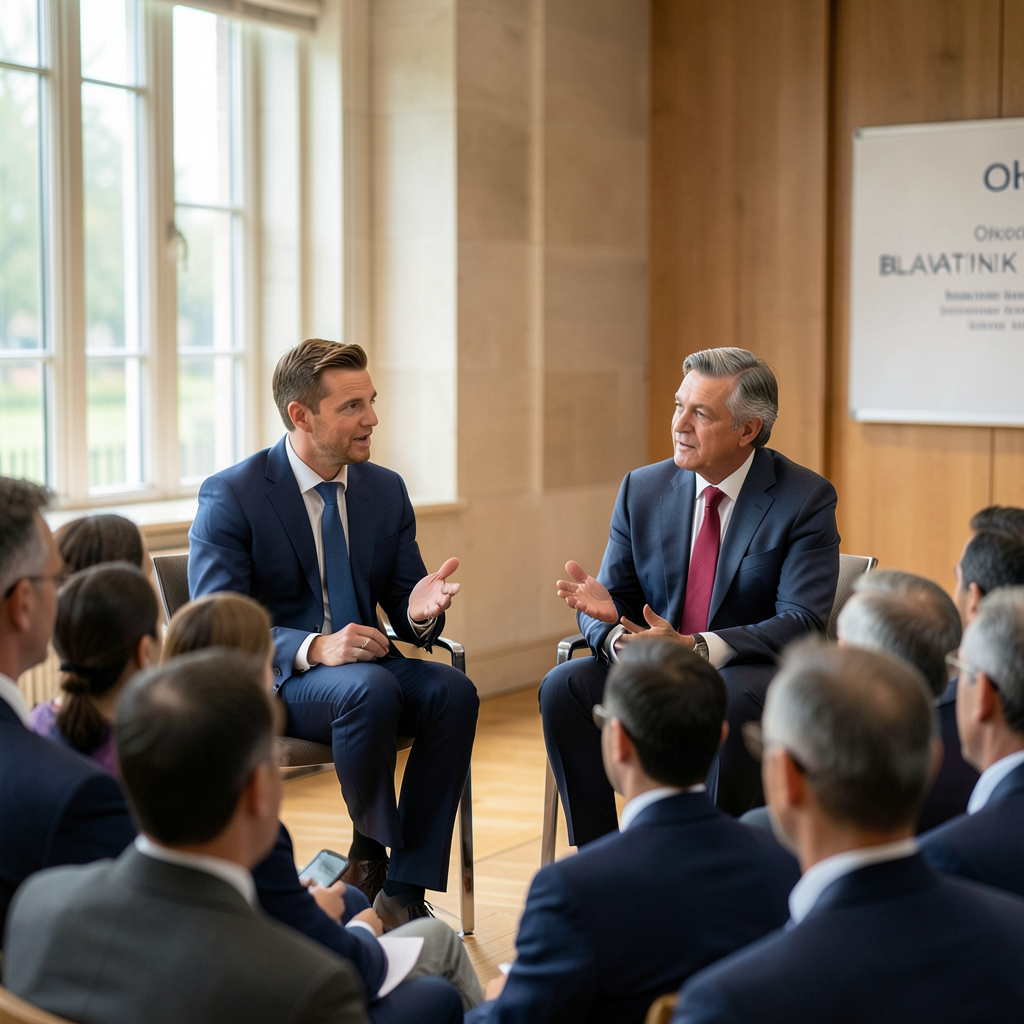

Former British prime minister Rishi Sunak and former Japanese prime minister Fumio Kishida examined the instability surrounding American leadership and the prospects for international cooperation at Oxford’s Blavatnik School of Government.
Their discussion addressed how states might preserve influence as alliances, institutions and established assumptions about global leadership come under increasing pressure.
Sunak reflected on the choices facing national leaders and said political leadership usually required selecting the least damaging course rather than finding an entirely satisfactory solution.
Kishida offered a related warning that inaction could itself present the most serious danger.
According to him, leaders confronted by emergencies must take difficult decisions, communicate the reasons behind them to the public and accept that such choices may attract opposition.
The closed event took place on Monday 19 October.
Both former prime ministers considered the changing distribution of international power.
Kishida said Japan and Britain had benefited from the relative stability associated with American leadership after the Cold War, but wars, geopolitical rivalry and deepening political fragmentation had placed that stability under strain.
He described the foundations of the post-war international order as being shaken and identified Russia’s invasion of Ukraine as a major challenge to international law because force had been used to alter borders.
He also noted increasing dissatisfaction with international institutions, particularly among countries in the Global South, alongside the pressures created by technological rivalry and vulnerable supply chains.
American foreign policy was another central concern.
Recalling his address to the US Congress in April 2024, Kishida said his support for the American alliance was based on Japan’s interest in defending democracy, freedom and the rule of law, rather than on allegiance to Washington alone.
He said Donald Trump’s return to the White House had altered the diplomatic environment, with the United States increasingly applying an America First approach to foreign policy.
Kishida had previously described American leadership as indispensable, but his comments reflected the difficulty of sustaining close relations with Washington while preparing for possible differences over strategic priorities.
The former Japanese prime minister also connected the conflict in Ukraine to wider regional security.
He argued that Ukraine might face a future comparable to that of East Asia and that European and Indo-Pacific security could not be treated as separate issues.
Japan’s handling of Russia, he said, would show the international solidarity it expected to receive if confronted with its own security emergency.
Closer cooperation between Britain and Japan during their respective premierships reflected this wider approach.
Kishida cited the Hiroshima Accord, signed with Sunak in 2023, as an important stage in bilateral cooperation covering defence, economic security and global challenges.
He also mentioned the Global Combat Air Programme, a joint project with Italy to develop a next-generation fighter aircraft.
The two initiatives demonstrated that national security could not be limited to territorial defence and formal alliances, since economic and technological dependence had become equally important.
Sunak focused on how countries outside the leading technological powers could still exert influence.
Although the United States and China had led the development of frontier technologies, he said Singapore and Gulf states had opportunities to gain economic strength through artificial intelligence even if they did not produce the most advanced models themselves.
Sunak maintained that complete independence was difficult for a middle power, but such states could become indispensable by developing capabilities on which others relied.
He cited the Netherlands’ importance in advanced semiconductor production and Japan’s manufacture of specialist materials as examples of specialised strengths that could provide international leverage.
Sunak also supported the use of smaller coalitions where agreement among a wider group of countries remained difficult.
He praised Prime Minister Keir Starmer’s efforts to coordinate European backing for Ukraine through the coalition of the willing.
He also referred to the Joint Expeditionary Force, a British-led defence partnership concerned with northern European security.
Sunak suggested that such limited partnerships could permit faster responses when broad international institutions were unable to reach agreement.
Kishida agreed that focused partnerships could create room for cooperation when consensus across a larger membership proved elusive.
At the same time, he warned that weakening rules and increasing international divisions threatened the post-war order.
He said Britain and Japan shared a duty to uphold common principles and act as stabilising forces, adding that this course needed to change to protect future generations.
When considering the qualities required of students preparing for public service, Kishida highlighted the importance of listening, integrity and a willingness to explain difficult choices to the public.
His guidance echoed the broader challenge identified during the discussion: maintaining a commitment to shared principles while recognising that refusing to act could carry substantial risks.