
Residents of Wallingford have welcomed a proposed design for the missing final panel of the Bayeux Tapestry, which places the town within the story of the Norman Conquest.
The original 70-metre embroidery is currently exhibited at the British Museum in London, where visitors can view its depiction of William the Conqueror’s conquest of England and the Battle of Hastings in 1066.
Parts of the tapestry’s final section remain absent.
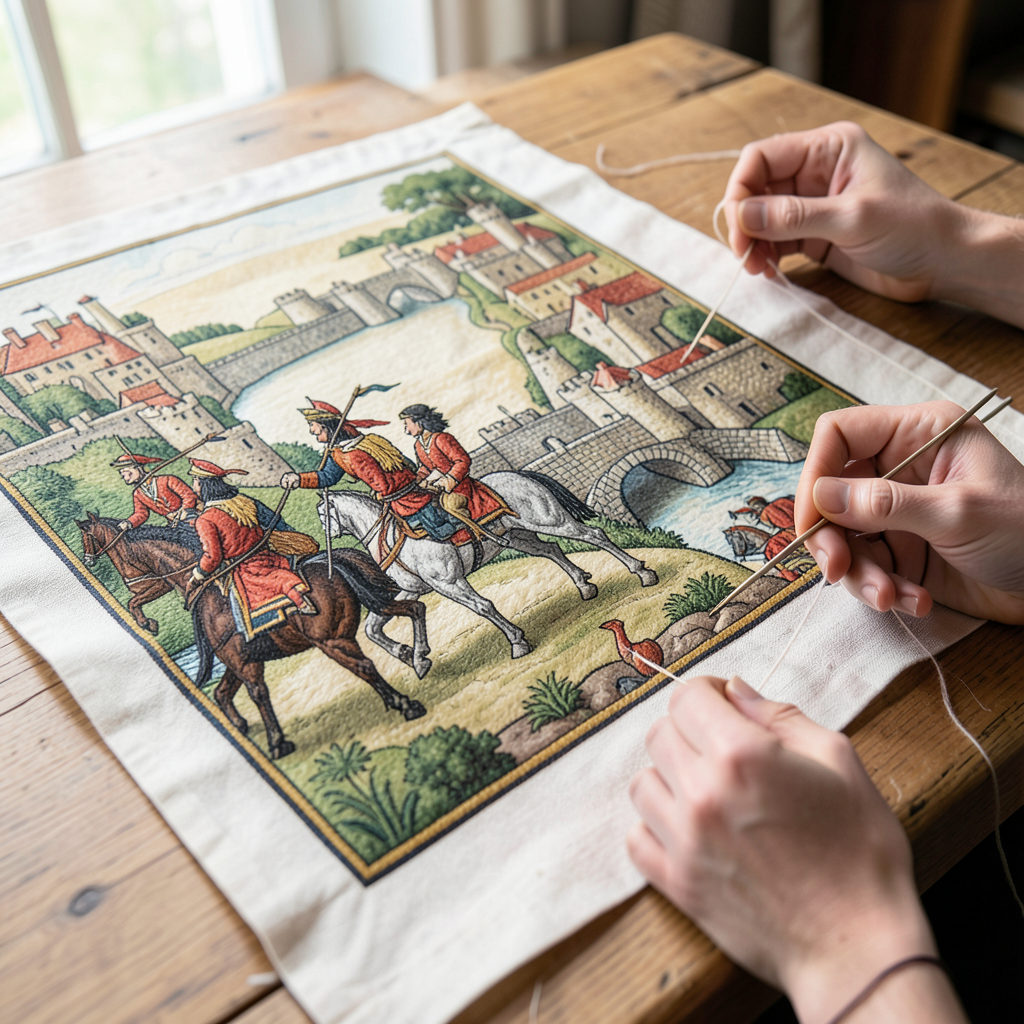
Artist Christina Greene and Wallingford historian Dr Katherine Keats-Rohan have developed a design comprising three scenes intended to fill that gap.
Around 30 volunteers are expected to reproduce the scenes in the style of the original, using crewel wool on linen and employing outline and Bayeux stitches.
The work is intended for display during a year-long European celebration of William the Conqueror’s 1,000th birthday.
Dr Keats-Rohan, who also serves as a Wallingford Town Councillor, said the original tapestry had left France for the first time in almost 1,000 years.
She said Wallingford would mark its historic connection with the events of 1066 through the proposed recreation.
Material accidentally lost amid the upheaval of the French Revolution would therefore be restored in the town.
The three compositions will show Archbishop Stigand swearing allegiance to William the Conqueror at Wallingford, the Norman army passing through the town and crossing the River Thames, and William’s coronation on Christmas Day in 1066.
The project has the support of Wallingford Museum, where the completed embroidery is due to be exhibited behind glass.