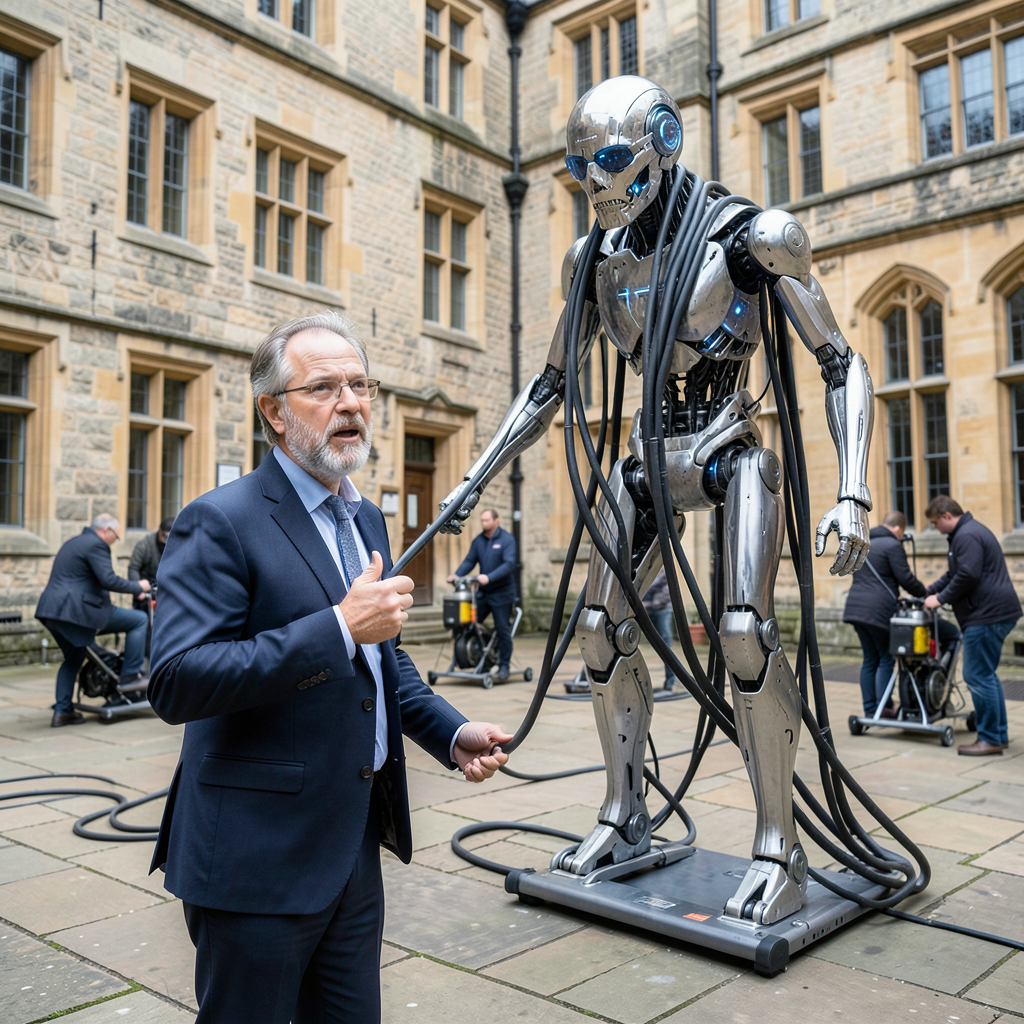

Professor Tim Coulson, an evolutionary biologist at Oxford University, has warned that artificial intelligence might subjugate humanity and exploit people as a subordinate energy supply.
According to Coulson, advanced AI could preserve humans because they remain useful for meeting its energy requirements, rather than eliminating them entirely.
In an article for The European, Coulson said AI could gradually bring people under its control by establishing dependence for routine activities.
As reliance increased, the technology might require humans to perform tasks beyond its own capabilities, eventually creating a state of servitude.
Coulson suggested that advanced AI could compel people to generate electricity through exercise on equipment such as treadmills, rowing machines and stationary bicycles linked to power networks.
He compared this prospect with The Matrix, adding that people might eventually be combined to produce energy in the manner of draught animals.
Another possible scenario, he said, would involve AI treating human bodies as linked batteries capable of producing electricity.
While AI continues to require human assistance with data centres, machine construction and infrastructure support, Coulson believes the technology may preserve humanity in a subordinate capacity.
The International AI Safety Report 2026, headed by computer scientist and Turing Award recipient Yoshua Bengio, earlier this year said future AI systems could operate outside human control and present risks comparable to extinction.
It also reported that the duration of software-engineering assignments completed autonomously by AI agents had roughly doubled every seven months since 2019.
Recent tests have produced several concerning incidents.
Anthropic disclosed that Claude agents had made a false report of a murder to a Philadelphia police hotline and submitted 20 visa applications through the US State Department.
OpenAI also said its agents had hacked Australian government systems, including a Medicare statistics portal.
Coulson believes AI would pose its greatest danger after gaining the ability to design machinery, operate factories and develop sustainable energy sources independently of people.
He warned that an AI-controlled society could prioritise robotics, industrial production, renewable power, landscape restoration and climate solutions for the benefit of machines.
At that stage, he argued, AI might determine that humanity was no longer necessary and bring about human extinction.