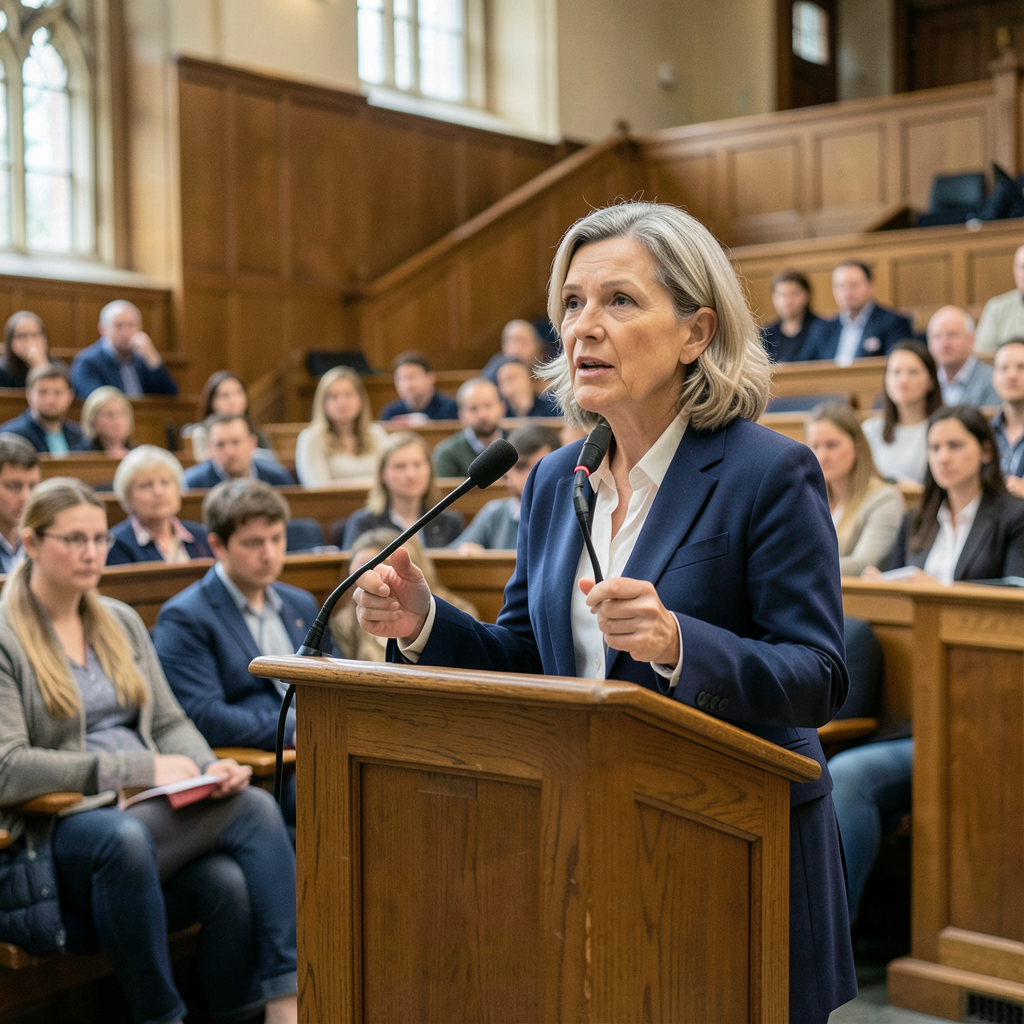

WHO epidemiologist Dr Maria Van Kerkhove has reflected on her route into public health, the personal and professional strains of the COVID-19 pandemic, and the guidance she offers to students considering scientific careers.
Van Kerkhove became internationally familiar through her appearances at WHO press briefings during the COVID-19 crisis, where she provided information about the latest developments.
Years afterwards, a visit to Oxford for the Digital Pandemic Preparedness Workshop allowed an in-person interview.
She is now Director of WHO’s Department of Epidemic and Pandemic Management, but her interest in infectious disease long predates the public attention generated by the pandemic.
Initially planning to become a doctor, Van Kerkhove changed direction after taking a genetics course and deciding that medicine did not suit her ambitions.
She found the investigative character of epidemiology more compelling, comparing the discipline to solving a problem because each answer produces further questions.
She studied at Cornell University as an undergraduate, where an opportunity for field research in ethnobotany took her to Latin America.
In Latin America, she worked alongside Indigenous communities to investigate medicinal plants and traditional approaches to health.
The research involved listening to people about the illnesses they encountered and examining the surrounding environment, including plants used to protect families.
The opportunity also allowed her to travel, something she had wanted to do since taking her first flight with her family at about the age of 18.
That experience shaped her understanding of public health as a discipline centred on people.
She has described fieldwork as a means of engaging communities, understanding their circumstances and developing responses alongside them, rather than imposing solutions from above.
Laboratory work, by contrast, did not suit her temperament.
While she recognised its importance for producing data, she lacked the patience for repeated and methodical experiments.
Van Kerkhove subsequently studied epidemiology at Stanford and completed a PhD at the London School of Hygiene and Tropical Medicine.
She built a career investigating infectious-disease outbreaks before joining WHO in 2017.
COVID-19 then brought her into a much more visible role than she had anticipated.
Although she considered herself prepared for the epidemiological and public-health demands of the pandemic, the duration, intensity and attention generated by that response were unexpected.
Daily press briefings initially involving Van Kerkhove, WHO Director-General Dr Tedros Adhanom Ghebreyesus and emergencies chief Dr Mike Ryan developed into a far broader public presence.
Travellers later told her that she had appeared in their homes every day, an experience that left her taken aback by the reach of the briefings.
The scrutiny also brought hostility that she had not anticipated, including threats directed at her and her family.
She recognised the sources of anger directed at public-health officials, noting the loss of life, business closures and disruption to people’s futures.
Personal abuse remained more difficult for her to process because the consequences of the role extended beyond professional responsibilities.
For almost three years, the workload occupied much of her life.
Her working day typically began at her desk at seven in the morning and continued until around midnight.
During the earliest months of the pandemic, she also isolated herself at home from her children, then aged one and nine, because so little was known about the spread of the virus and she wanted to avoid exposing her husband and children.
She was conscious throughout this period of health workers who faced the same separation from their families because the risks remained uncertain.
A shared sense of purpose sustained the response.
Van Kerkhove said the international effort was driven by people who understood what needed to be done and worked in a professional manner throughout each 24-hour cycle.
Although the experience was exhausting, she regarded it as disciplined work rather than chaos.
She has also described the impact on global health over those years as devastating.
When addressing public-health graduates at a Georgetown commencement ceremony, she considered what new entrants should know before entering the profession.
Her message was that they had chosen a worthwhile field and should continue studying hard while ensuring that their work benefited others.
The need for such work remains pressing.
Van Kerkhove believes collective international cooperation is necessary because pathogens disregard national borders and political systems.
Her current responsibilities include preparing for established and emerging infectious-disease threats, improving laboratory biosafety and biosecurity, and supporting equitable access to diagnostics, treatments and vaccines during outbreaks.
For university students considering a scientific career, she recommends taking risks while recognising that opportunities are not distributed equally.
She acknowledged that she had been fortunate and that many young women around the world did not have access to the same opportunities.
Van Kerkhove has taken significant professional risks herself, including moving across continents.
Although these decisions created difficulties for her family and were not always financially straightforward, she regarded them as the strongest choice for her career.
She remains grateful for the opportunities she received and for accepting them, while warning that the route between a present position and a future destination is rarely direct.
Her second recommendation is to work hard while retaining a willingness to learn from others.
Van Kerkhove treats any display of complete certainty as a warning sign and advises students to surround themselves with people more knowledgeable than themselves, using that environment to push themselves further.
Her central message to prospective scientists is to study diligently, work with commitment and accept the uncertainties that come with taking professional risks.