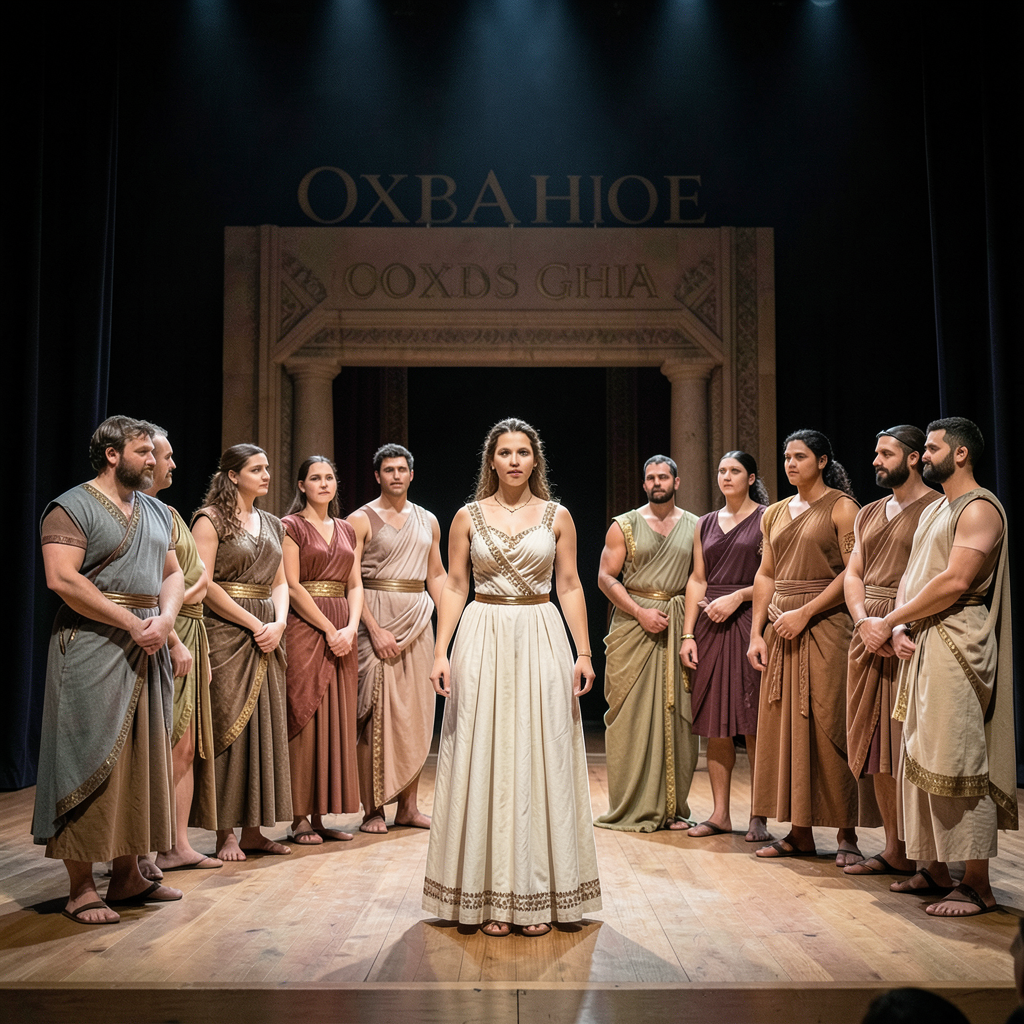

The triennial Oxford Greek Play opened on Wednesday evening at the Playhouse with Euripides’ Iphigenia at Aulis, directed jointly by Kelly Yu and Wally McCabe.
The production also marked a notable connection with the previous Oxford Greek Play, Medea, which was staged three years earlier and featured Yu as a member of its chorus.
The new presentation places Iphigenia and her family within a theatrical universe in which the boundaries between the divine, the political and the domestic are repeatedly crossed.
Its set design established the cosmos in a single expansive space.
A large sheet stretched across the stage to represent both a tent and the horizon, with stars above and an ocean below.
A kitchen table stood at the centre, while a moon hung overhead and was extinguished when Iphigenia died.
The arrangement brought celestial imagery and ordinary family life together, presenting the tragedy as both elevated and closely connected to human experience.
That combination defined Yu and McCabe’s production.
Its treatment of ancient Greek tragedy for a twenty-first-century Oxford audience brought out both the emotional immediacy of the story and the cultural distance between ancient Greece and contemporary life.
Agamemnon’s anguish reflected the tension between his obligations to his family and his duty to his country, while Clytemnestra’s reaction to her daughter’s death provided the central expression of maternal grief.
At the same time, the chorus emphasised how unfamiliar the conventions and traditions of Greek tragedy can remain for modern spectators.
The chorus was almost continuously present and fulfilled several dramatic functions.
Its members spoke in precise unison, frequently while dancing, and supplied moments of both comic relief and tragic force.
Their coordination and contribution were praised as outstanding elements of the production.
Music also played a central role.
Peter Hardisty composed the score, which supported the directors’ attempt to combine Greek tragedy with Irish and Celtic ritual and pagan traditions.
The music provided an emotional foundation and conveyed cultural depth and beauty.
On occasion, however, its rhythm did not correspond closely enough to the metre of the Greek verse, causing the music and spoken language to lose some of their individual impact.
The production also had to resolve the conflicting ways in which Iphigenia could be understood.
She can be presented as an innocent victim of a superstitious ritual, but this staging instead portrayed her as a determined and courageous patriot prepared to sacrifice herself for her country.
Ademide Obagun carried that difficult interpretation in the role of Iphigenia.
Her appearance for the sacrifice in a white gown reinforced the sacred and archaic qualities of the production, while her performance gave the character strength and composure.
Although classical literature often privileges the voices of men, Clytemnestra emerged as the dominant presence.
Michelle Rodrigues portrayed her with maternal grief, anxiety and anger, while also providing comic relief in the first act through her exchanges with the minor characters and Achilles.
Rodrigues was praised for the intensity of the character’s emotional distress and for her versatility across both tragic and lighter material.
Seb Foster’s Agamemnon and James Harper-Jones’s Menelaus conveyed a complex bond between the two brothers, although their performances were judged less effective than those of the leading women.
Foster’s Agamemnon was described as excessively emotional in places, which weakened the force of the scenes involving his daughter’s death and his confrontation with Clytemnestra.
The portrayal was also considered less commanding than expected of a Greek general and warrior.
Despite these reservations, Foster’s interpretation challenged conventional ideals of masculine heroism.
Harper-Jones presented Menelaus as charming and tender.
His delivery sometimes sounded distinctly English rather than consistent with the wider foreignising approach of the production.
This created an interesting contrast, although at times the result resembled a familiar British comic portrayal of a Greek hero rather than a man defined by anger, pain, the loss of his wife or a desire to go to war.
Tristan Morse’s Achilles offered a more grounded version of the young Phthian warrior.
He moved dynamically across the stage and embodied the character with an appealing combination of physical energy and emotion.
Language remained central to McCabe’s production.
Some passages were retained in Greek and others translated into English, reflecting both thematic considerations and accessibility.
The choice reinforced the capacity of Greek tragedy to prompt close attention to language and its meanings.
The production also highlighted the female body as an instrument of both war and peace.
The Greek troops were described as being stirred towards war by Helen’s body.
By contrast, Greece’s salvation depended upon Iphigenia’s body, with her sacrifice characterised as payment through children’s blood.
Female sacrifice and injustice consequently emerged as dominant themes: Iphigenia was required to surrender her body, while Clytemnestra was forced to surrender her daughter.
The staging of Iphigenia at Aulis combined these political, familial and gendered concerns with an ambitious visual and musical conception of Greek tragedy.