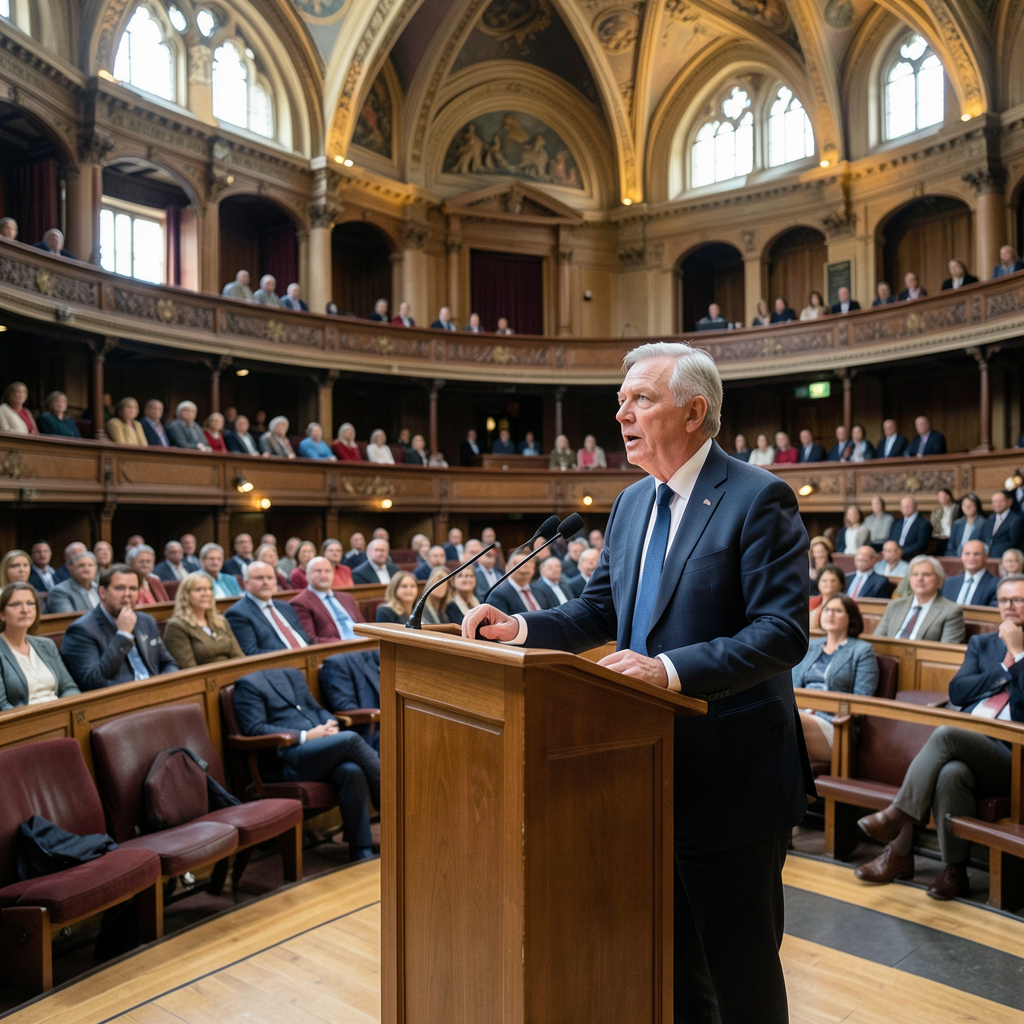

Lord William Hague, Chancellor of the University of Oxford, presented the 2026 Europaeum Annual Lecture at the Sheldonian Theatre on 4 November.
In his address, Hague argued that closer relations between the United Kingdom and the European Union must be treated as an urgent priority.
He called for stronger cooperation across technology, defence and climate change, while also emphasising the need to defend democracy and reinforce multilateral engagement.
The lecture was the second in the Europaeum series, which assembles prominent academics from leading European universities to examine major challenges facing the continent.
Hague characterised the present period as the most dangerous since 1945.
He argued that Europe could avoid continued decline by pursuing renewal and resilience.
Prime Minister Andy Burnham has called for the United Kingdom eventually to rejoin the European Union.
Hague expressed doubts about the practical feasibility of that proposal, while maintaining that Britain’s relationship with Europe remains closely connected.
On artificial intelligence, Hague warned that Europe could end up as either a digital colony of the United States or a technologically dependent partner of Beijing.
He called for the continent to regain greater control over its digital future by protecting the free movement of global talent across borders.
Universities were presented as engines of ideas and important drivers of innovation.
Oxford ranks as Europe’s leading university for spinout value creation and accounts for 20% of all investment in European spin-outs.
Britain’s record summer temperatures formed part of Hague’s appeal for stronger climate adaptation measures and greater investment in emerging technologies.
The areas identified included carbon capture, geoengineering and genetic engineering.
Referring to Greece’s recent launch of a satellite system for wildfire prevention, Hague encouraged the United Kingdom and the European Union to develop a comparable Europe-wide system on a larger scale.
He also advocated closer alignment of carbon markets and easier electricity trading.
Cherwell questioned Hague about reducing tuition fees for European Union students attending British universities, a subject under consideration within the UK-EU negotiations.
Hague indicated that he would welcome easier access to British universities for European Union students, although government agreement would be required.
He also supported a youth mobility scheme allowing young British and European Union citizens to live and work in each other’s countries.
Hague noted that disputes over equalising tuition fees for European Union nationals and British citizens could hinder a broader improvement in UK-EU relations.
In return for establishing a youth mobility scheme, he encouraged the European Union to include Britain within its Made in Europe industrial policy.
Closer defence cooperation was another priority.
Hague supported UK involvement in the European Union’s €150 billion Security Action for Europe loan scheme.
He also called for joint British and European Union leadership in international governance of emerging technologies, including measures designed to place safeguards around artificial intelligence.
Europaeum was established in 1992 by Roy Jenkins, a former Oxford Chancellor and the only British President of the European Commission.
The organisation provides postgraduate programmes through 17 European universities.
It describes its membership as an alliance of pre-eminent universities committed to interdisciplinary learning and Europe’s principal challenges.
The University of St Andrews is the organisation’s only other British member, while its headquarters remain at St Antony’s College, Oxford.