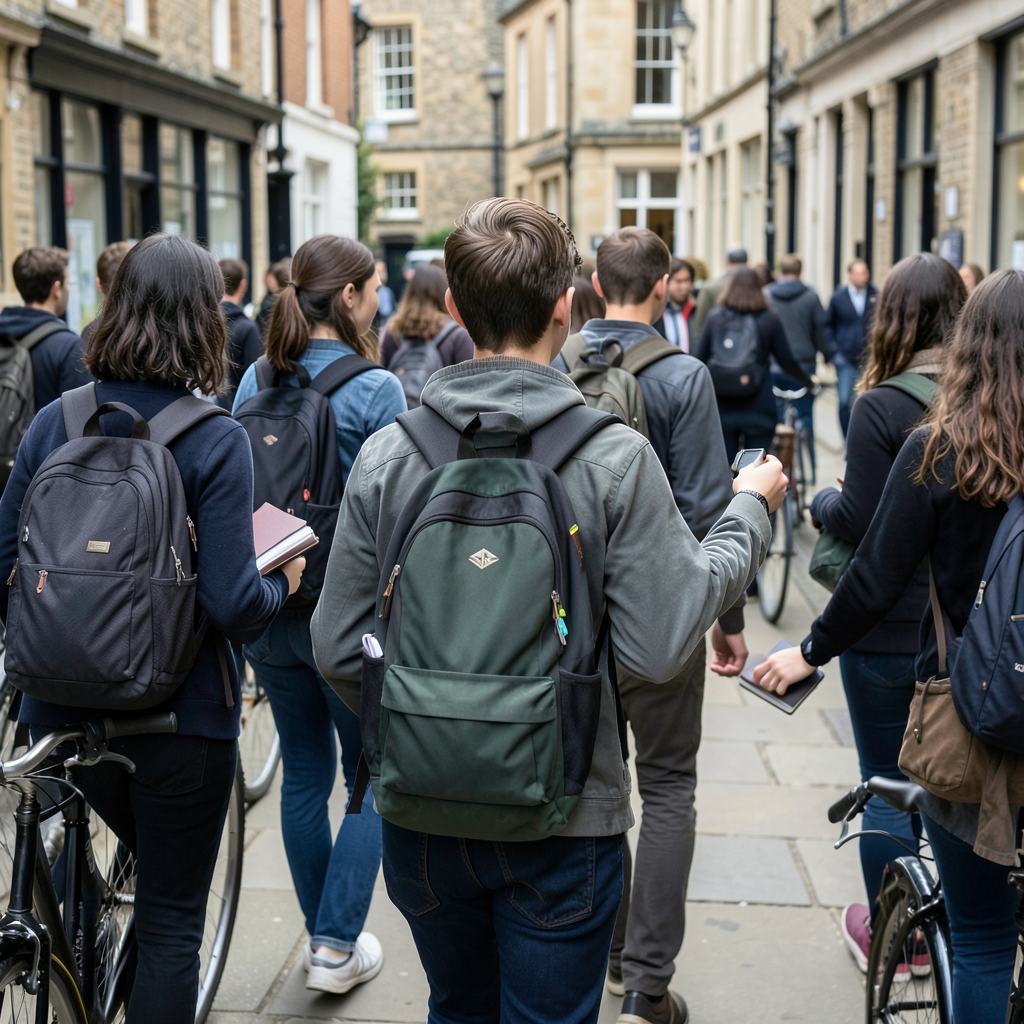

A culture of busyness has become increasingly visible at Oxford, where students often describe university life through the volume of work, society commitments, hobbies and social plans they have completed or are about to begin.
During Week 5 of Michaelmas, the pressure to maintain such a schedule can leave little room for rest.
A brief conversation on Broad Street may involve little more than a question about how someone is doing, while a video call with family elsewhere can become an occasion for listing everything occupied on the calendar.
The language of busyness extends beyond private conversations.
Oxford day-in-the-life features on the English Faculty website have referred to a busy day and presented periods containing little or no free time.
Videos about life at Oxford on YouTube have attracted millions of views and similarly portray packed schedules.
Coverage by Cherwell has also described the Oxford lifestyle as intense and associated it with long lists of tasks.
Although such material may be produced partly for entertainment, it can reinforce the standards used in ordinary interactions.
Descriptions of packed schedules are repeated in coffee shops, colleges, kitchens and corridors.
When being occupied is treated as a sign of success, a full diary can acquire value regardless of its contents, while periods of downtime may be viewed with concern.
The resulting culture is not limited to a single institution: the London School of Economics student paper The Beaver has discussed performative busyness and a relentless-hustle mindset at LSE.
The Daily Cardinal at the University of Wisconsin-Madison has reported a comparable belief that rest is difficult to justify unless it follows exhaustion.
At Oxford and elsewhere, free time can be interpreted as falling behind academically, socially or in the range of experiences gained from university.
The pressure, however, may be more than a means of earning social approval.
Some students appear to stay busy because they fear they are not doing enough for their own futures, not simply because their peers might regard a quieter schedule as inadequate.
This creates a language in which making the most of university time is equated with taking on as much as possible.
Social plans, recreation and other activities are consequently presented as additional items to complete.
The subject has also drawn attention from students writing about Oxford during the summer vacation.
Competition for graduate employment provides one possible explanation.
Sixty-two per cent of Oxford undergraduates move directly into highly skilled jobs after leaving the university, with opportunities concentrated in areas such as finance, consulting, law and technology.
Large numbers of graduates therefore compete for a limited number of positions at prominent firms, where even a small advantage on a curriculum vitae can matter.
This can encourage students to feel that their years at university should be used to add every possible distinction or achievement to their applications.
Cherwell’s archive contains a discussion of whether Oxford works too hard.
The article portrayed the experience of studying alongside people with exceptional abilities, including a neighbour who was a world debating champion and spoke five languages, as well as a college mother who had been recruited by NASA.
Such comparisons can create an additional incentive to remain active and avoid falling behind.
The structure of university life can intensify these expectations.
Much of the workload is organised around students’ own time, with no conventional nine-to-five boundary.
There is no fixed office from which to leave at the end of the working day, nor a clear separation between academic responsibilities and extracurricular commitments.
Even so, Oxford students are not solely concerned with productivity.
Busyness also extends to activities chosen for enjoyment rather than usefulness, reflecting the belief that the more opportunities students pursue, the more they will gain from their time at university.
That belief can make spare moments appear suspect, as though time spent standing still allows enjoyable experiences to pass unnoticed.
The approach resembles the labour theory of value, which links a good’s worth to the amount of labour required to produce it.
Applying a similar principle to university life can lead students to regard an unoccupied day as a poor use of their time, even when a wide range of recreational possibilities is available.
Mainstream economics has rejected the labour theory of value for more than a century, but the underlying fixation with productivity can nevertheless persist.
The strongest defence of a packed schedule is that university offers young people a valuable period in which to explore interests.
Oxford’s academic work is not confined to a convenient daily window, and neither are the opportunities available beyond it.
Students live close to friends and have access to societies, sports teams and student productions.
The perceived value of that period is increased by the knowledge that a demanding working life lies ahead and by the limited duration of each term.
Terms last eight weeks, followed by a lengthy holiday.
The short span of teaching can make the opportunities seem temporary and encourage students to maintain a rapid pace throughout each term.
The approaching break is sometimes treated as permission to work intensively while the term lasts, with tiredness deferred until the holiday.
The difficulty is that this pattern treats the Oxford experience primarily as a burden to be managed.
Oxford is well known for attracting ambitious and talented students from a broad range of disciplines, including but not limited to academia.
Its combination of people, activities and opportunities is part of what draws students there.
Yet a packed schedule can become a standard that appears wasteful to fail to meet, with hobbies and social commitments recited as reassurance that students are not neglecting a fortunate position.
The underlying choices have not necessarily changed.
Societies, events and plans with friends are still undertaken for enjoyment rather than to prevent an idle evening.
What has changed is the language surrounding those choices.
Describing them as tasks to be completed can attach the pressure of necessity to experiences that might otherwise be approached with enthusiasm.
At an institution with so much to offer, that effect can make the accumulated possibilities of university life appear daunting.
The resulting cult of busyness is therefore created as much through how activities are described as through the activities themselves.
A more positive interpretation would recognise that busy schedules can reflect the wealth of experiences available at Oxford rather than an obligation to extract every possible benefit from a short stay.
Such a change would preserve the achievements associated with university while removing the sense that leisure must be justified by productivity.
It would also allow a simple question about how someone is doing to remain a friendly exchange rather than an assessment of their accomplishments.