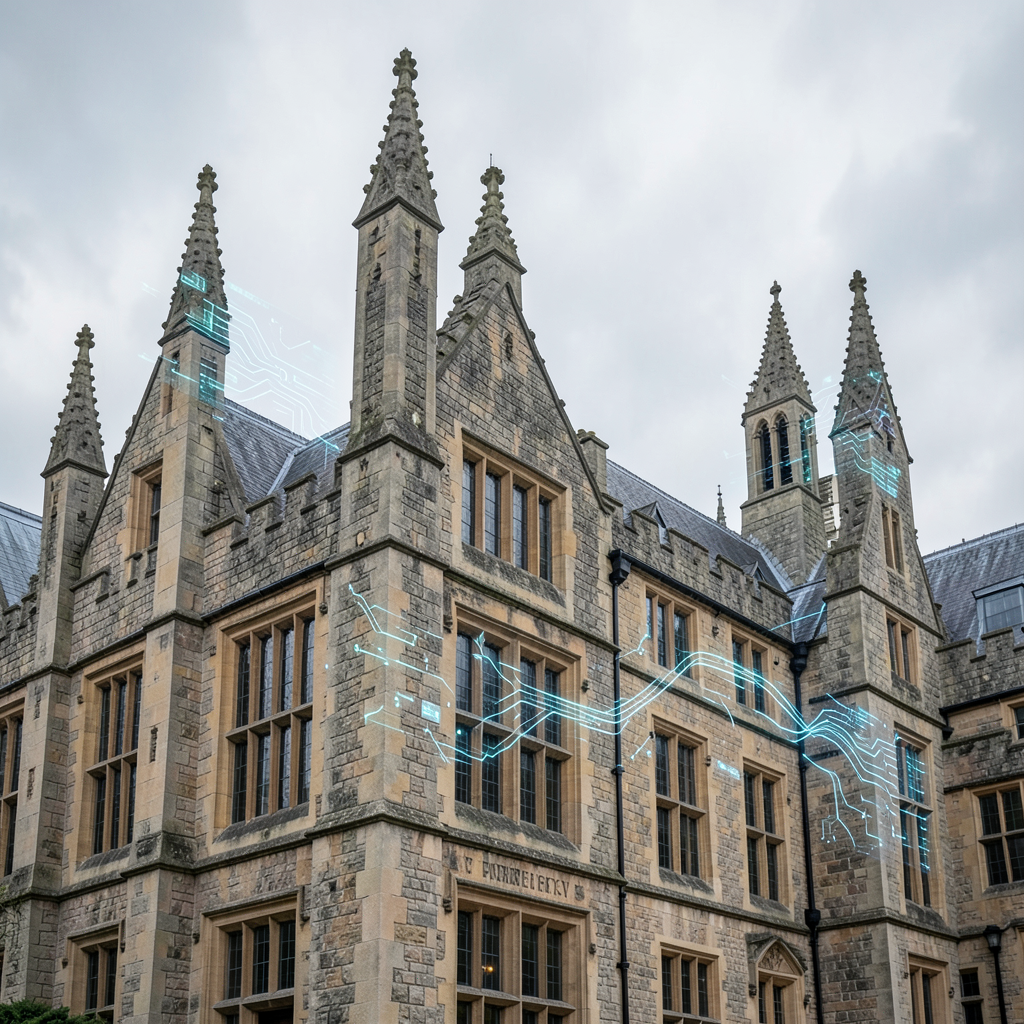

Oxford University has been ranked tenth in a newly published 2026 assessment measuring which higher education institutions in the United Kingdom are most equipped to support the development of future artificial intelligence-driven enterprises.
The institution placed behind both the University of Leeds and the University of Surrey in the standings.
The University of Leeds secured second position while the University of Surrey ranked eighth, leaving Oxford two spots lower.
Imperial College London topped the overall rankings as the United Kingdom’s most prepared institution for artificial intelligence, with the University of Bristol finishing in third place.
Additional universities positioned ahead of Oxford included Birmingham, Liverpool, Loughborough, Edinburgh and Nottingham.
Despite the modest overall ranking, the assessment recognised Oxford’s strengths in teaching provision, graduate career prospects and business commercialisation activities.
The research established that Oxford currently maintains 123 operational spinout companies operating within engineering, physical sciences and mathematics disciplines.
This figure ranked second only to the University of Cambridge, which documented 174 such enterprises.
The study measured a sixty-five percent full-time employment rate among recent science, technology, engineering and mathematics graduates from Oxford, compared with seventy-two percent at Imperial College London.
The evaluation encompassed institutions appearing on the official Universities UK register of recognised bodies alongside other establishments possessing legitimate university status under the law.
Course information from UCAS was examined to identify programmes featuring artificial intelligence, machine learning, data science, robotics and automation terminology in their titles.
Programmes duplicated across sandwich years, industrial placements or part-time delivery models were excluded, while courses offered as separate qualifications or at varying academic levels were preserved.
Graduate employment data was drawn from the most recent available dataset published by the Higher Education Statistics Agency, covering the 2023/24 academic year.
The analysis concentrated specifically on graduates from computing, engineering and technology, and mathematical sciences programmes.
The HESA University Spin-out Register was also reviewed to catalogue active companies connected to universities across engineering, physical sciences and mathematics fields.
Joe Phelan, business finance specialist at money.co.uk, explained that the findings arrive at a time when artificial intelligence tools are becoming increasingly available to smaller enterprises, potentially reducing both the financial investment and specialist knowledge previously necessary to establish and expand operations.
The statement noted that while artificial intelligence is frequently linked with technology companies, the technology can equally assist organisations across different industries in automating processes, gaining customer insights, creating products and challenging larger competitors.
This context suggests the upcoming wave of artificial intelligence-enabled enterprises may not exclusively comprise conventional artificial intelligence startups, but could equally feature smaller companies leveraging the technology to develop novel offerings, enhance current services or streamline their operations.
Institutions training graduates with these capabilities while simultaneously nurturing spinout ventures and facilitating commercial translation could substantially influence the structure and character of emerging small businesses throughout the United Kingdom, according to the analysis.
The complete top ten consisted of Imperial College London, University of Leeds, University of Bristol, University of Birmingham, University of Liverpool, Loughborough University, University of Edinburgh, University of Surrey, University of Nottingham and Oxford University in descending order.