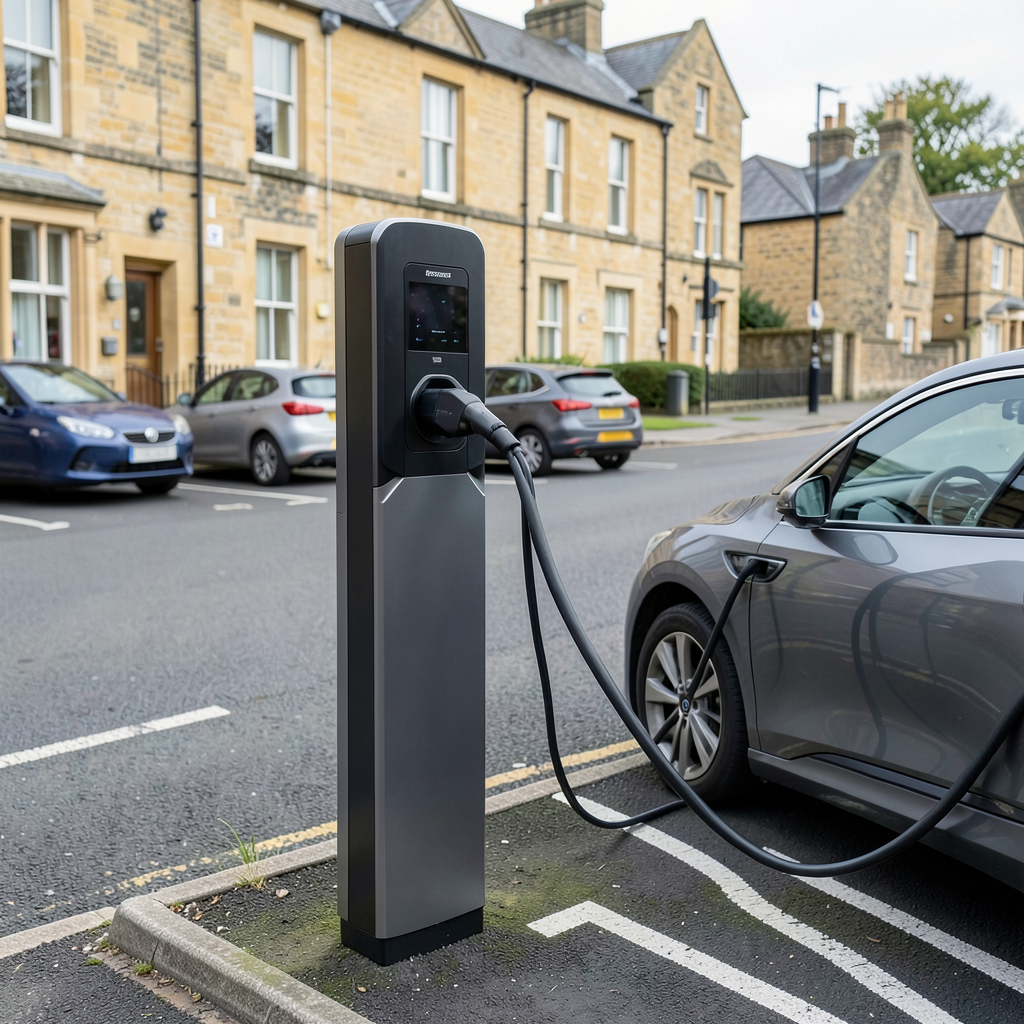

A programme to install electric vehicle charging infrastructure across Oxfordshire has received the green light from local authorities, with conventional parking provision set to be converted at eleven sites throughout the county.
During a council session, transport lead Gareth Epps sanctioned the establishment of charging points, as part of a Government-backed initiative worth £4 million that aims to deploy 1,500 public charging units across the region, both on roadsides and within council-operated car parks.
The proposals have attracted criticism regarding reduced parking availability for combustion engine vehicles, alongside worries about pavement access for pedestrians, with a consultation on the scheme drawing substantial opposition.
Approval was not granted for every location put forward.
Several proposals were postponed for additional deliberation, two applications were rejected outright, while conditions were attached to four other sites before consent was given.
Council officials outlined that each location would need a minimum of four charging units to satisfy the commercial requirements of appointed contractor Connected Kerb, given the substantial expense involved in establishing electrical grid connections.
Schemes in Oxford, Berinsfield, Burford, and Henley secured unconditional approval, while additional provision in Oxford and Kidlington was sanctioned subject to certain requirements being met.
A proposal for Deddington was delayed because the area falls within Mr Epps’ electoral ward.
Schemes for Bampton, Shrivenham, Headington, and Witney were also deferred pending resolution of local community objections.
Applications for facilities in Carterton and Eynsham were declined.
Transport lead Mr Epps told the meeting that responses and documentation relating to the scheme amounted to more than one thousand pages.
Representing the Coalition for Healthy Streets and Active Travel campaign alongside the Summertown and St Margaret’s Neighbourhood Forum, Alison Hill addressed the assembly.
She requested that the installations be evaluated for their impact as obstructions on footpaths, urging council members to identify locations where charging equipment would not create barriers for pedestrians.
The organisation expressed conditional support for certain planned locations, provided that a minimum two-metre width was preserved on pavements.
Resident Melanie Greene, based at The Phelps in Kidlington, warned that the plans would result in parking capacity being halved in her neighbourhood and challenged whether the council had assessed the impact across all 476 households potentially affected.
She argued that vehicle purchase decisions would be influenced more by electric car pricing than by charging accessibility.
Ms Greene advocated for designated daytime charging periods, similar to arrangements she had observed in comparable schemes, which would permit local residents to utilise the spaces during remaining hours.
Spencer Komodromou, a Bampton resident, told the meeting that concerns about the Market Square proposal centred specifically on positioning.
He explained that parking restrictions would redirect drivers to alternative areas, potentially those lacking adequate safety measures, with associated risks of excessive congestion.
He questioned the council’s insistence on imposing a predetermined quantity of spaces in that particular town location.
A search for a suitable alternative site within Bampton is now underway.
A council official emphasised that the grant allocation would guarantee that rural communities and economically disadvantaged areas received adequate provision, describing the site selection methodology as having undergone extensive evaluation.
The official clarified that approximately two-thirds of the planned units would be situated in car parks, with remaining installations positioned on street frontages to guarantee residents could access facilities within a short walking distance.
Acknowledging that certain consultation materials had not been communicated with sufficient clarity, the official suggested that concerns about diminished parking availability might present an inaccurate picture.
The official characterised the changes as reallocating parking provision rather than eliminating it, noting that those spaces would accommodate electric vehicles expected to enter the local vehicle fleet in the near future.