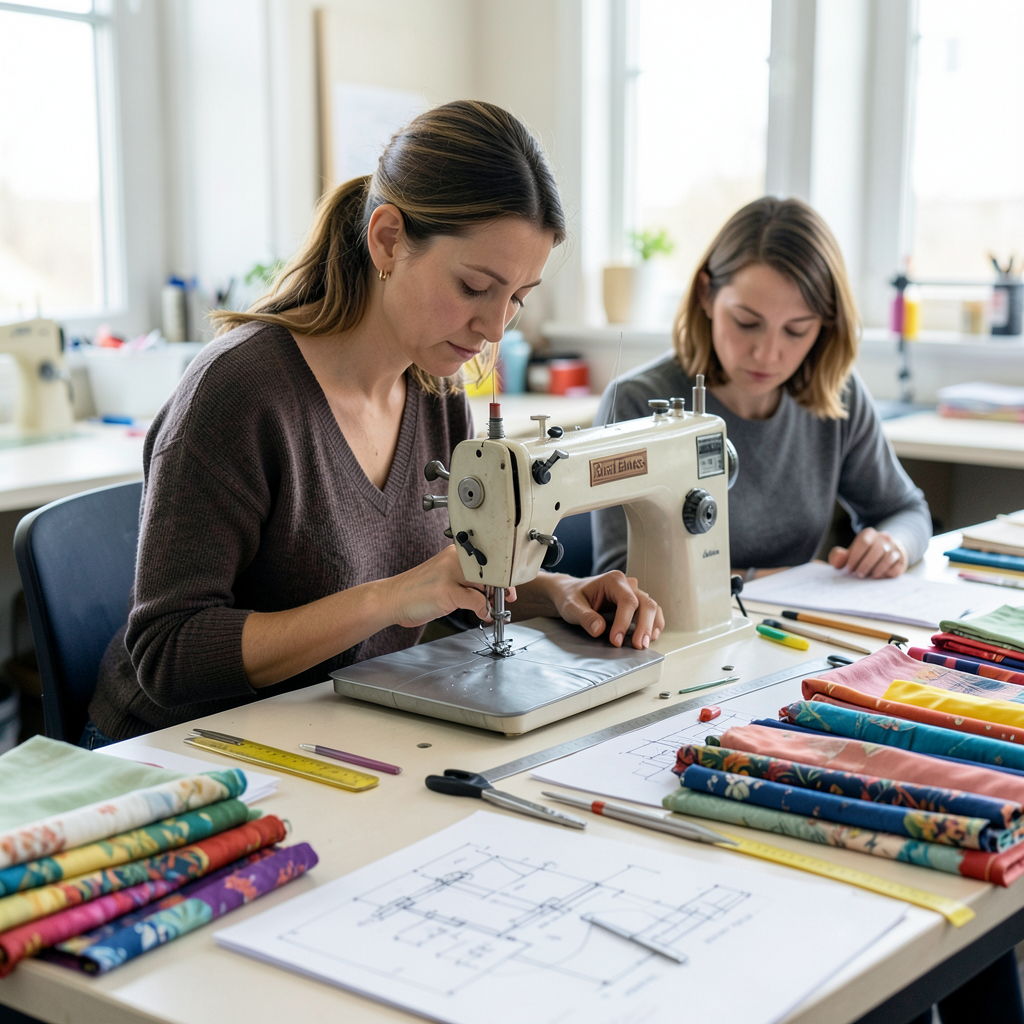

A graduate from the University of Oxford who secured a place among the final three contestants on the BBC television programme The Great British Sewing Bee has described how her engineering studies equipped her with the skills necessary to excel in one of broadcasting’s most demanding creative challenges.
Dr Beth Eames pursued Engineering at St Hilda’s College before obtaining a DPhil in Mechanical Engineering.
At age 24, she advanced through multiple rounds of the popular series, attracting commendation from judges Patrick Grant and Esme Young for her precise technical execution and inventive design solutions, though she ultimately fell short of claiming the championship prize.
In an interview conducted by the college, Dr Eames discussed her progression from childhood sewing lessons to her appearance in the competition’s concluding stage.
Despite having envisioned participating in the programme for several years prior, she indicated that the actual experience differed substantially from her expectations.
Her analytical approach, honed through engineering disciplines, motivated her to concentrate intensely on precision to guarantee proper garment construction.
The constrained time limits presented considerable difficulties throughout the contest.
A particularly challenging moment occurred during the hand-stitching examination in the final round, where she lost ground due to limited experience with that particular technique.
However, managing to recover from that difficulty emerged as one of her most significant sources of personal accomplishment.
She recalled feeling pleased that she managed not to allow that setback to undermine her performance.
She expressed that taking satisfaction in her completed work felt akin to demonstrating something to herself.
Her interest in sewing originated from her grandmother’s influence, with her initial efforts commencing at age eight when she crafted sleepwear that subsequently disintegrated during laundering.
A couple of years afterward, her engagement with the craft intensified considerably, before she subsequently refined her abilities through instruction at the Carolyn Rose School of Sewing.
Following her matriculation at Oxford, sewing evolved beyond a casual interest into a means of managing academic pressures alongside her demanding engineering programme, and simultaneously offered a method for constructing a functional personal wardrobe.
Dr Eames identifies considerable parallels between engineering principles and sewing techniques, including the process of developing patterns from two-dimensional templates to create three-dimensional garments.
Her technical education furnished her with the mental framework essential for performing under considerable pressure.
She considers her capacity to maintain composure during high-stress situations a particular strength, explaining that she instinctively shifts into a problem-solving mindset, addressing immediate tasks systematically without succumbing to anxiety that might consume valuable time.
Reflecting on her participation, she identified self-confidence as the most valuable lesson acquired through the experience.
She noted that the competition demanded considerably more physical endurance and emotional strength than she had anticipated, and emerged from the process feeling capable of confronting future challenges of significant magnitude.
Currently employed as a mechanical engineering consultant at the Transport Technology Forum, she intends to maintain simultaneous development in both her technical profession and her creative pursuit.
She expressed enthusiasm for demonstrating that sewing represents an accessible activity suitable for all individuals, conveying that it can serve as an immensely valuable and fulfilling ability.