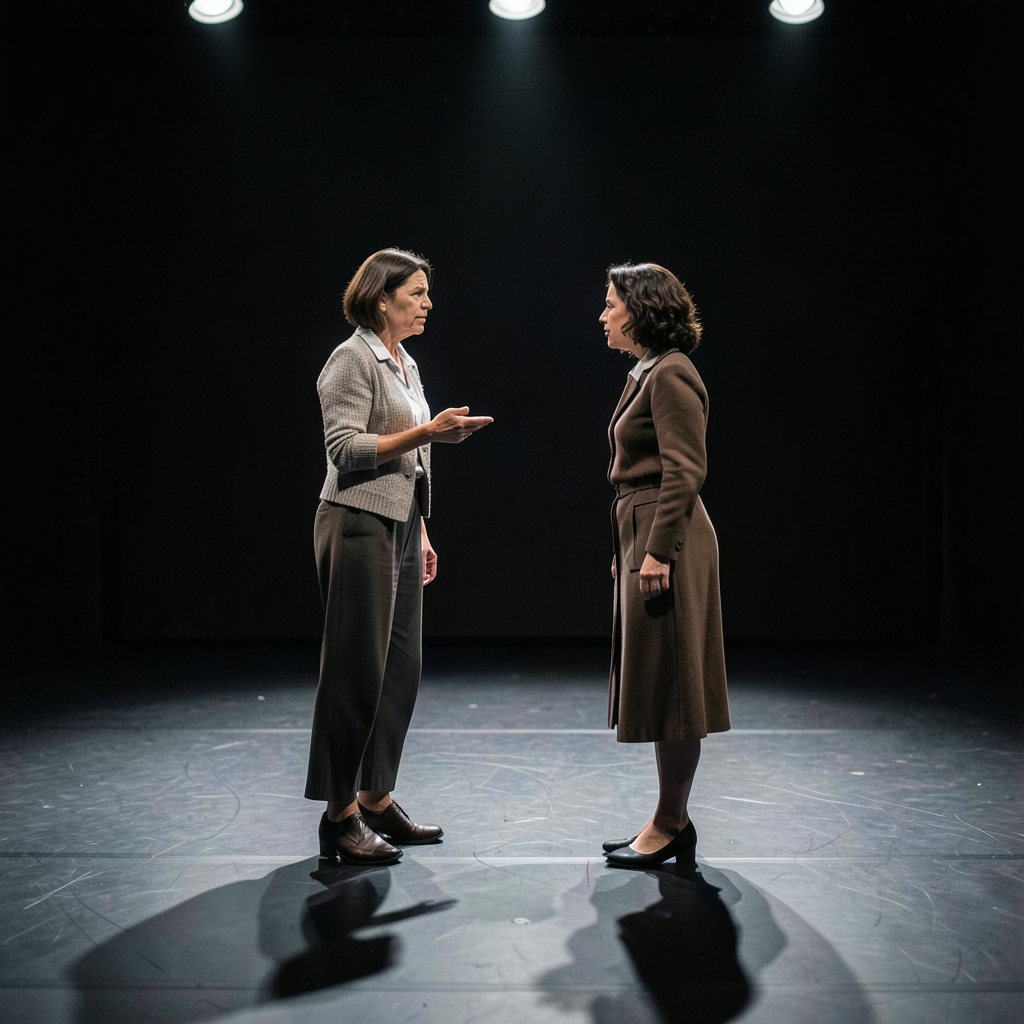

Lillian Hellman’s 1934 play The Children’s Hour examines how a partial truth can devastate an established life.
A production by Silly Snail Productions, presented at the Michael Pilch Studio on 5 November, uses stark staging and carefully controlled lighting to explore deception, authority and social rejection.
The play follows Karen, played by Mayah Savjani, and Martha, played by Elouise Wills, two teachers who jointly operate a boarding school for girls.
Their comfortable existence is disrupted when Mary, a pupil played by Zoe Lim, makes a false accusation that the teachers are involved in an illicit relationship.
The allegation leads to lies, reputational damage, family conflict and personal loss.
The production frames its central conflict around the tension between patience and hatred, showing how an initial disturbance can escalate into the rapid collapse of the teachers’ social position.
Authority is presented through physical placement.
The set is deliberately sparse, consisting largely of rows of seats and an old radio that emits an unsettling buzz.
A raised platform allows the actors’ movements and relationships with space to carry greater importance.
Its division between elevated and ground-level positions initially reinforces the expected hierarchy between adult teachers and their pupils.
Mary’s behaviour and false accusation subsequently overturn that arrangement, undermining the assumption that adults possess unchallengeable power over children.
Mrs Lily Mortar, played by Daphne Husson, is initially presented as a commanding matriarch.
Seated above the girls in an armchair, she appears to dictate the terms of the school, although her exaggerated theatricality quickly satirises and weakens her authority.
Mary then fills the resulting power vacuum, taking control of the stage and asserting ownership of the space.
Her companions Peggy, played by Kaiden Roque, and Evelyn, played by Xinmi Zhou, become compliant under her psychological manipulation and physical intimidation.
Mary is consistently associated with a stronger red light, especially during her most threatening moments.
Director Avani Rao uses lighting and sound as active dramatic elements rather than leaving them as incidental features of the production.
The first act closes with a fade to black that reverses its opening arrangement.
Mary now occupies the position of supreme authority, while Lily’s superficially elevated role is shown to have carried little genuine power.
The change illustrates the transfer of influence from apparent authority to control exercised through fear and deception.
The second of three acts begins in a different location, unsettling the established geography of the production.
Agatha, the maid, is played by Anne Hensley Young.
Her energetic physical comedy, vocal projection and timing briefly relieve the tension created by the preceding events.
The humour does not, however, alter the direction of the plot.
As the red lighting associated with Mary intensifies, the apparent force of Agatha’s comedy gives way to the developing pattern of deception surrounding Karen and Martha.
Mary’s grandmother, Mrs Amelia Tilford, played by Izzy Goldberg, assumes the elevated matriarchal position once held by Lily.
From that position, she telephones parents and warns them of the supposed events involving the teachers.
Mary’s manipulation is reinforced by her apparent excitement about the influence created by her allegations.
She draws Rosalie, played by Nayana Crowe, into the deception and uses her as a scapegoat.
When challenged, Mary treats the suggestion that she is a liar as something to be accepted rather than avoided, revealing her determination to continue the scheme.
The teachers’ efforts to respond are represented by a weakening purplish light.
Mary’s stronger red illumination and her apparent invincibility gradually overwhelm it.
Joe, played by Eunsul Kim, is also associated with the purple lighting as he defends his fiancée.
In contrast, those connected to Mary’s red light form an expanding group, with individuals drawn directly or indirectly into her influence.
The lighting arrangement presents the opposition between good and evil in a simplified but effective theatrical form.
During the second interval, an as-yet-unintroduced character played by Holly Dodd moved among the audience and asked audience members questions about gossip relating to the protagonists.
She then circulated between separate groups, delivering different messages to each.
The pause between acts highlighted the deterioration in Karen and Martha’s position and heightened the audience’s involvement in the subject of gossip.
When the character subsequently entered the stage as a taunting homophobe, she heckled the teachers.
Her confrontational remarks appeared more severe after the audience interaction, making the different sections of the audience feel more complicit in the unfolding social judgment.
The final third of the play forms its emotional climax.
The cast’s expressions of anger, sadness and isolation convey the emptiness experienced by Karen and Martha after their exclusion from society.
Martha occupies the elevated seat that had previously symbolised authority, but the placement now emphasizes the absence of real power.
Below her, Joe and Karen discuss the new life they intend to share away from the school.
Martha’s anger towards her aunt and her circumstances is followed by a more resigned response.
She eventually moves to sit on the floor, reaching both the lowest physical position in the staging and the lowest point of her emotional state.
The scene in which Martha acknowledges the ashamed truth behind the accusation becomes the clearest expression of connection between the two teachers.
Karen, meanwhile, struggles to accept that the statement which destroyed their lives contained only a small element of truth.
The flickering of the red and purple lights accompanies the mental distress surrounding Martha, intensifying the sense of conflict and desperation.
Martha’s suicide provides the play’s final tragic event.
Lily’s nervous panic contrasts with Karen’s slow, restrained movements, and the two responses sharpen the emotional impact of the death.
At the conclusion, the radio returns with music rather than the static buzz heard earlier.
As the light fades and the high-pitched sounds from the beginning recur, the cyclical design marks the final stage of decline and recalls what has been lost through the scandal.
Silly Snail Productions’ staging gradually adjusted to the size of the performance area before the cast fully asserted themselves within it.
Each performer then dominated the available space in turn.
The result was an unsettling examination of defamation and its consequences within a closed-minded and unforgiving society.
Martha represents the individual driven to suicide by shame and exclusion, while Karen is left behind in confusion.
The production traces how malicious action, initiated by Mary from the opening stages, develops into a sequence of betrayal, damage and loss that destroys innocent lives.