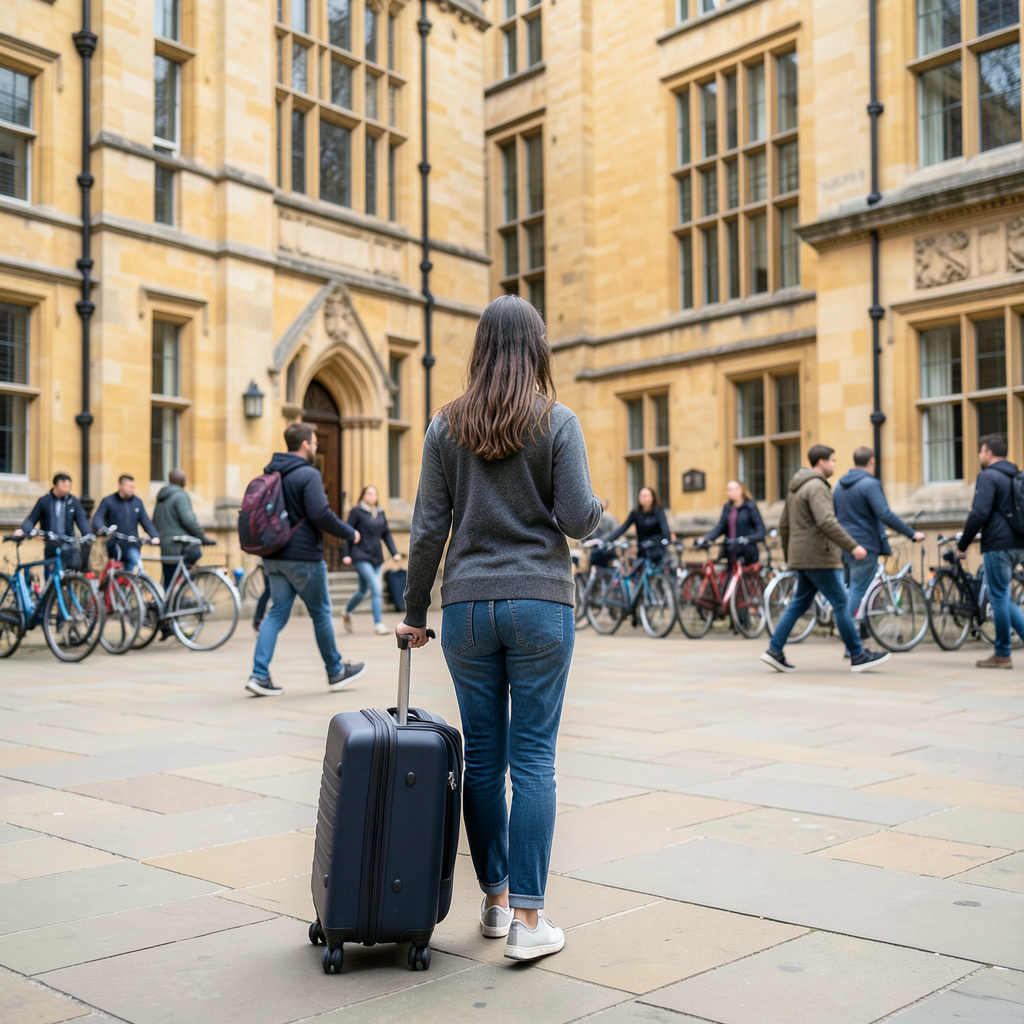

A student from a small Cheshire village described the contrast between rural life and the pace of Oxford after receiving an offer to study at the university.
Her home community has a population of 200 and lies in the quiet countryside.
A church, a pub and an upscale coffee shop popular with passing cyclists are all within walking distance, while a car is necessary for most other journeys because the village has no public transport.
The acceptance of the Oxford offer prompted considerable interest from local residents.
The student was questioned about her plans at tractor runs, the village fête and birthday parties, reflecting the limited number of young people in the area.
The prospect of leaving for Oxford caused more concern than the reading requirements or collegiate structure.
The most daunting aspect was the prospect of living in a city where activity continued throughout the night.
Oxford’s constant movement initially appeared overwhelming.
Tourists crowded the narrow lanes while examining the large wooden doors of the colleges, and buskers performed on Cornmarket Street as people gathered around their open guitar cases.
Ambulances passing beneath her bedroom window also woke her at night.
Despite these disruptions, the city offered an energy that the student had not encountered in the countryside.
The Oxford street network resembles a flowing river, with pedestrians packed closely together and moving in different directions.
Stopping to take in monuments or historic buildings attracted impatient reactions from people attempting to get past.
During her first Michaelmas term, the student encountered this on the way to a lecture at the Schwarzman Centre.
She stopped to examine lettering on a stone in the churchyard at St Giles’, a sight that recalled the older churches familiar from village life and her childhood as the daughter of a rural priest.
A woman thought to be about 20 years older pushed past her and delivered a strong rebuke.
The encounter illustrated how personal priorities and public behaviour can differ when people are absorbed in their own routines.
The student subsequently sought to make greater use of Oxford’s history by navigating around pedestrians and exploring the winding streets.
The relative anonymity of the city required time to adjust.
Conversations with strangers were a normal feature of country lanes but were unlikely to occur in an Oxford alleyway.
This difference was particularly noticeable at the post office, where she sent letters to her mother and bought postcards for future correspondence.
Her conversation with the shopkeeper about the recipient and the less personal contents of a letter received only occasional nods and mildly judgemental stares.
Other students also tended to pass without acknowledging friendly attempts at interaction.
Many walked quickly with their heads lowered, carrying backpacks or handbags and wearing puffer jackets that were often left unzipped.
They appeared to be heading for the library, coffee shops or lecture theatres.
The student initially found this behaviour surprising but later recognised how demanding university life can be.
Laundry, meal preparation, essays and problem sheets leave students with limited energy for social contact.
Finding suitable places for eating, studying and visiting presented another difficulty.
The range of possibilities was far greater than the limited options available in the village, where familiar locations included a bedroom, a garden and nearby footpaths.
The student adapted by experimenting with screen time, study locations and social arrangements.
This approach involved balancing the risk of becoming excessively focused on work against the opposite temptation of putting off important tasks.
The attractions of city life can interfere with study and place pressure on limited finances.
The student also found that having pizza delivered was one of the benefits of independent life.
Despite the number of available options, she concluded that every student needs a calm place within the rhythm of Oxford.
A stable personal space provides rest and helps prevent the city’s pace from overwhelming academic routines.
The bedroom desk remained one reliable study location, having become familiar during her A-levels.
University Parks offered the closest equivalent to the open farmland around her home village.
The account also cautioned against expecting immediate adjustment.
Settling into Oxford involved learning to navigate the city as well as becoming more independent in daily life.
A visit home at Christmas provided a further contrast.
Requests for lifts into town highlighted how readily Oxford can be explored without relying on rural transport.
The freedom associated with city living cannot be reproduced easily in the countryside, and the student anticipated that this difference would become more apparent when the time to leave Oxford arrived.
For the present, she was focusing on her growing independence and the academic demands of university while maintaining a sense of accomplishment at the progress made so far.