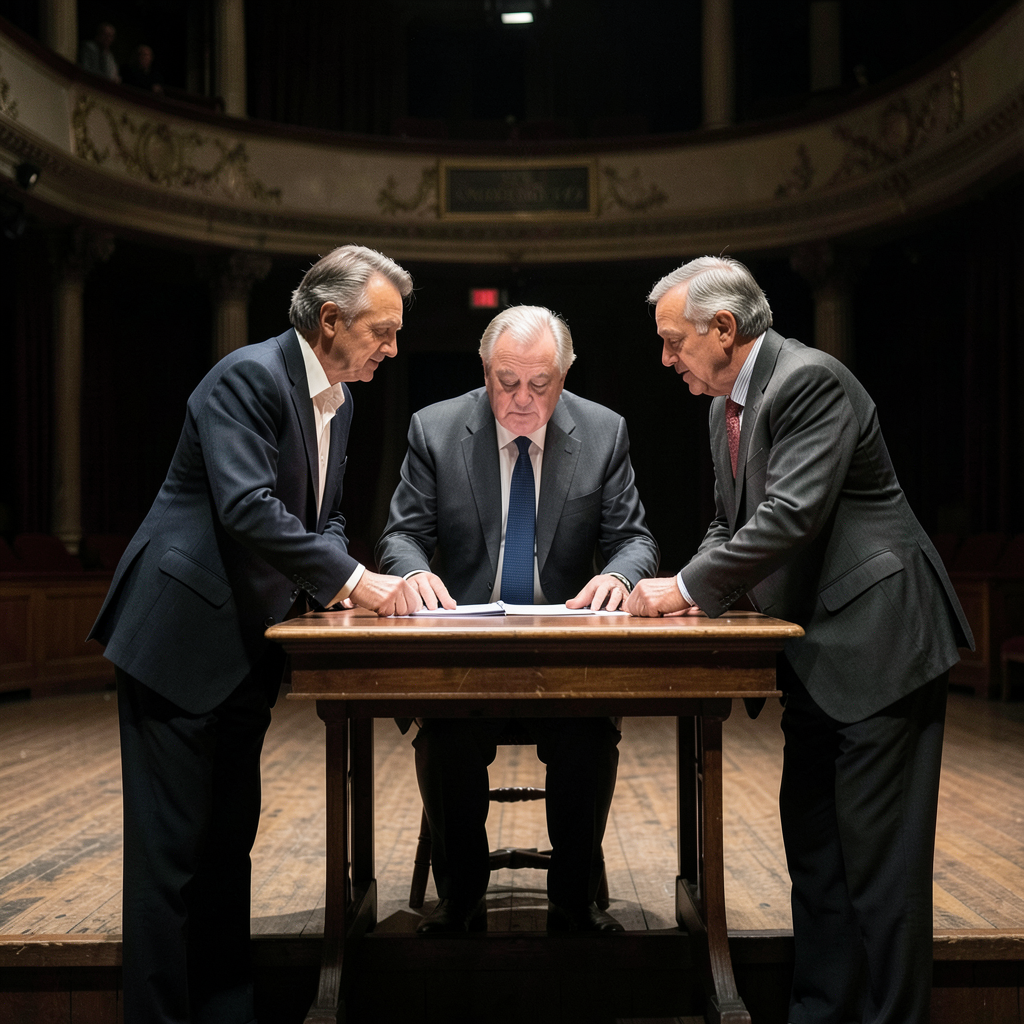

*The Gang of Three* examines the political ambitions of Roy Jenkins, Denis Healey and Anthony Crosland, three senior figures within the Labour Party.
Created around half a century ago, the play covers the turbulent 1970s and includes a brief return to 1940.
Industrial conflict, economic decline and continuing political instability form its historical backdrop, although the action concentrates on private negotiations rather than public events.
Jenkins, Healey and Crosland seek influence and power, but each of their principal ambitions ends in defeat.
Crosland does not win the deputy Labour leadership in 1972.
The three men are also defeated by Jim Callaghan in the 1976 leadership contest, while Healey’s involvement with an IMF loan fails to prevent Labour’s electoral defeat in 1979.
Michael Foot later defeats Healey in a separate contest for the party leadership.
Although political leaders receive only occasional and often dismissive references, Jenkins, Healey and Crosland all regard themselves as the rightful holders of power.
Much of the drama emerges through conversations held away from the main centres of political activity.
The domestic set reinforces that isolation with warm lighting, a wooden bookshelf and a red leather sofa.
Every scene is located in one of the three men’s homes, allowing their exchanges to reveal ambition, rivalry and the shifting balance of authority between them.
The opening scene includes radio extracts from Jenkins’s resignation as deputy Labour leader.
That context leads into Crosland’s request for Jenkins’s support in the ensuing deputy leadership election.
Audio also supplies brief political and historical reference points, including an apparently misplaced extract from Ted Heath’s 1973 Christmas speech.
A later return to 1940 features Churchill’s wartime speech about blood, toil, tears and sweat, establishing the atmosphere of wartime Britain.
The selection signals that the 1980s have begun and that Margaret Thatcher is now in power, while also establishing the strained mood of a group reduced to two remaining participants.
The production shifts chronology to 1940, when Jenkins and Crosland were undergraduates at Oxford.
This passage examines how their relationship and understanding of power developed over time.
Their familiarity is presented through both dialogue and behaviour.
Crosland repeatedly recounts wartime experiences that Jenkins has heard many times, and he also challenges Jenkins over his involvement in liberal sexual reforms during the 1960s.
Their bond combines mutual regard and longstanding affection with intense competition and competing egos.
The portrayal of Healey adds another dimension to the group.
Colin Tierney plays him as a distinctive and intimidating figure, with the character’s prominent eyebrows, pomposity and abrasive manner all receiving emphasis in the performance.
Jenkins’s lisp is similarly incorporated into Tom Salinsky’s portrayal.
Salinsky, a co-writer of the play, takes the part of Jenkins in place of Hywel Morgan.
Crosland delivers much of the production’s sexual humour and several of its political jokes.
One remark about Jenkins being legally permitted to act as he wishes recalls Jenkins’s record as Home Secretary and prepares the later disclosure of a physical relationship between the two men.
Another exchanges a confident prediction that technology has no future, while Jenkins takes the question of Europe more seriously than the others.
The political humour also includes Healey mistakenly identifying a new member of Labour’s left wing as Gerald Corbyn.
These references connect the play’s political concerns to contemporary arguments surrounding economic management and Britain’s relationship with Europe.
The production is currently touring the United Kingdom.
Its Oxford staging has added significance because Jenkins, Healey and Crosland all studied at Oxford around the same period shortly before the Second World War.
The Oxford Playhouse stands close to Balliol College, where the 1940 sequence involving Jenkins and Crosland is set.
That geographical connection provides a specific setting for a play concerned with the personal relationships, private negotiations and political ambitions of three of the Labour Party’s best-known figures.