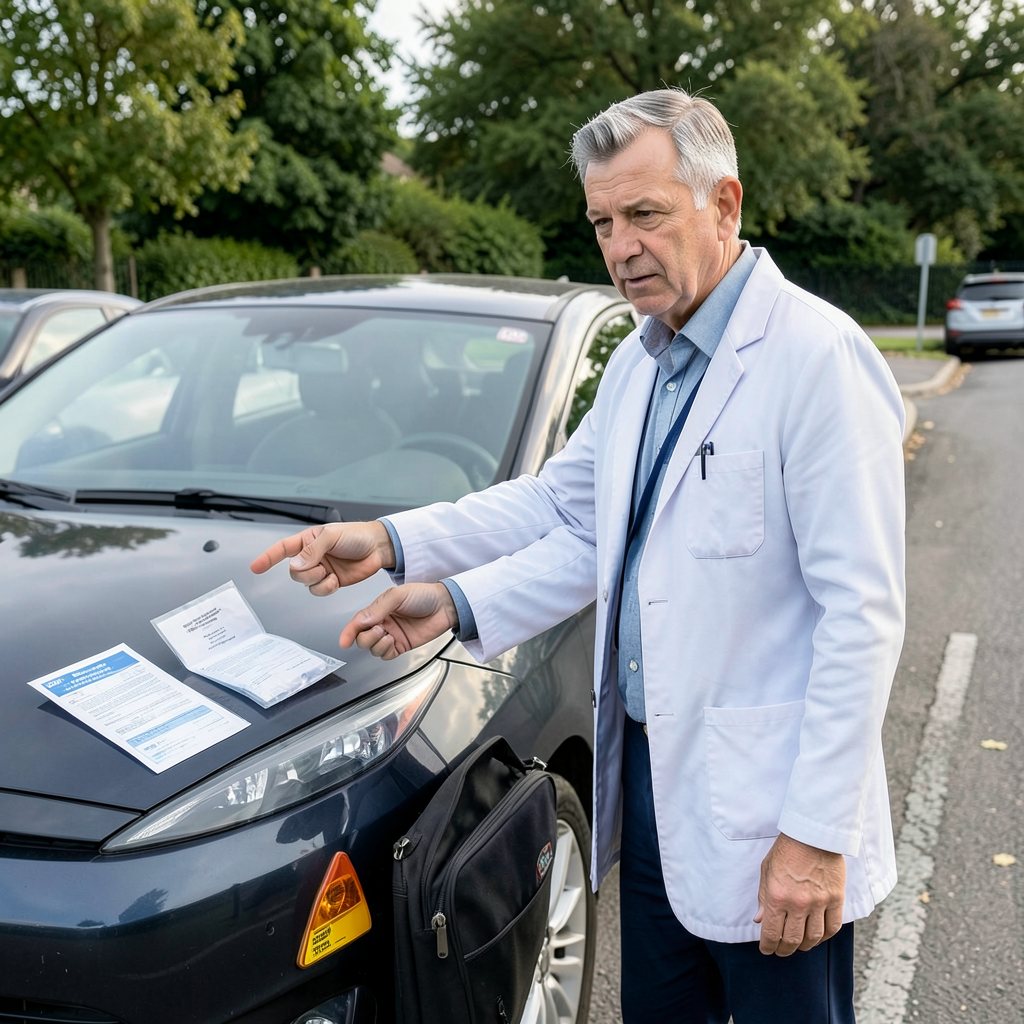

An Oxford-based doctor who regularly attends urgent mental-health incidents is contesting almost £5,000 in traffic penalties issued by Oxfordshire County Council, which has acknowledged an administrative mistake involving his parking permit.
Dr Hasanen Al-Taiar, a consultant forensic psychiatrist, is responsible for assessing vulnerable patients and responding to psychiatric emergencies.
He has received 49 Penalty Charge Notices carrying a combined value of £4,940.
The evidence in the case comprises 31 charge certificates relating to late payments of Penalty Charge Notices, valued at £3,255, and 10 notices registered as debts worth £1,160.
Seven full-charge notices and one further standard charge also remain outstanding.
Al-Taiar has questioned whether the council’s automated traffic-enforcement arrangements properly consider healthcare professionals who need to travel for essential NHS duties.
He maintains that penalties continued after the original administrative problem was discovered and that some were subsequently pursued through debt recovery and enforcement procedures.
A letter from the council confirmed that an error was identified in January when the doctor’s vehicle was not properly associated with his traffic permit.
The authority acknowledged that this mistake led to penalties being issued incorrectly and that those penalties were subsequently cancelled.
Oxfordshire County Council said the initial error was fixed on January 12 following an investigation by its automatic number-plate recognition enforcement manager.
According to the council, later charges were generated because the vehicle being used at the time had not been designated as the active vehicle on the permit.
The psychiatrist rejects that account as unfair and considers that greater discretion should have been exercised given the nature of his clinical responsibilities.
He says a doctor travelling to carry out urgent psychiatric assessments can be left facing thousands of pounds in penalties when an enforcement system gives insufficient weight to individual circumstances.
He also notes that demands arising from mental-health emergencies can be sudden, leaving limited opportunity to prepare in advance.
His concern centres on whether local traffic policies reflect the practical requirements of emergency healthcare provision.
Although Al-Taiar does not advocate an automatic exemption from traffic restrictions for healthcare staff, he believes enforcement should be proportionate where a journey is connected with essential clinical work.
He disputes liability for the penalties and maintains that compensation should have been provided because the case originated with an error acknowledged by the council.
The authority rejected his formal complaint on September 22 and refused both his request to cancel the subsequent penalties and his request for compensation.
The letter confirmed that one penalty which had already been enforced had been settled and closed.
In a separate statement about the outstanding charges, Al-Taiar said he would prefer to give £4,950 to a charity supporting vulnerable people rather than transfer the sum to the council.
His stated position was that the money could assist people in need while the disputed penalties remain unresolved.
A council spokeswoman said the authority could not comment on an individual account.
The traffic-filter scheme also provides permits for personal cars used by healthcare and social-care professionals.
Eligibility covers vehicles required for clinical or social-care services across multiple Oxford locations on the same day, as well as urgent or short-notice journeys to Oxford to address matters involving the welfare of patients, students or staff, or the security or safety of buildings.