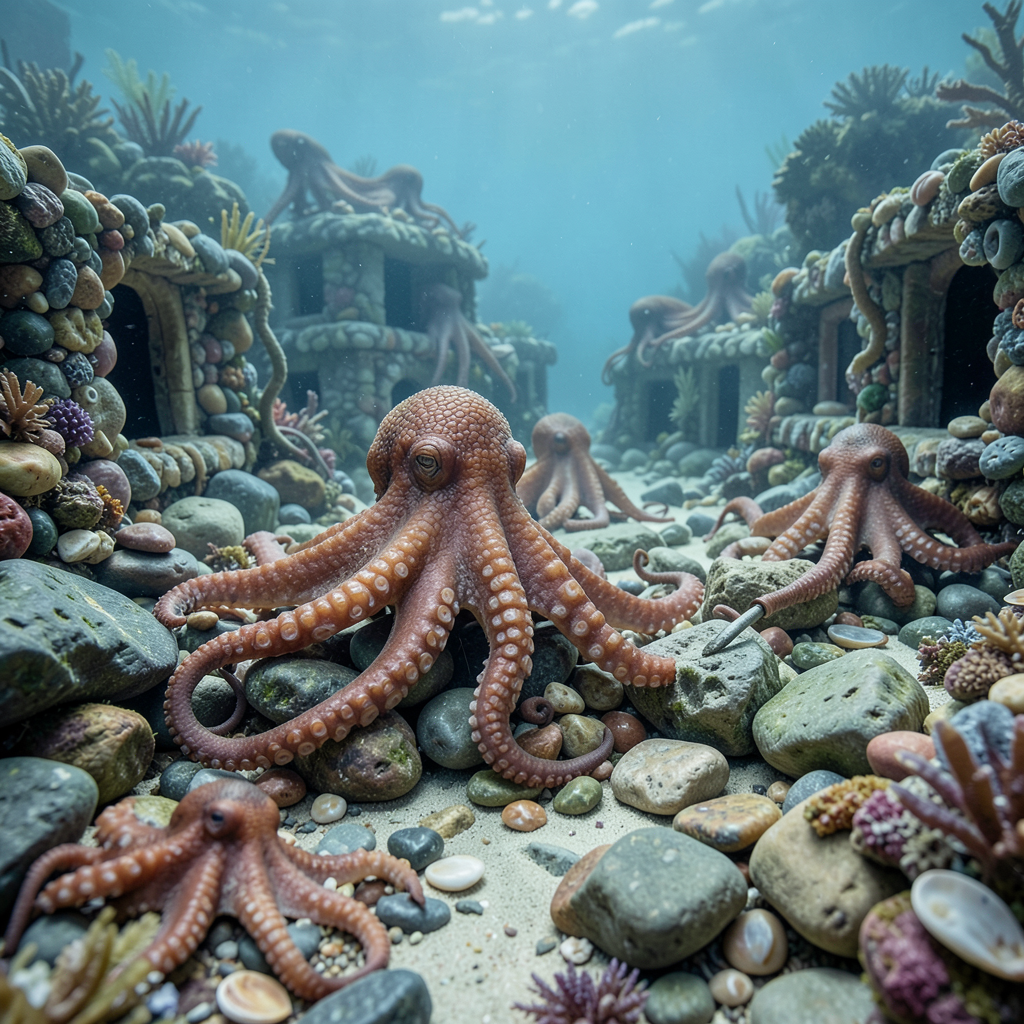

Researchers at Oxford University identified octopuses as the species most likely to assume dominance if people disappeared.
Professor Tim Coulson, a population biologist at the University of Oxford, has argued that octopuses possess the physical capabilities and mental faculties required to form a new civilisation.
Coulson said octopuses could eventually create complex tools and establish an extensive, Atlantis-like society beneath the sea.
Their dexterity, curiosity, communication skills and intelligence could provide the foundations for such an outcome.
Although octopuses are considered unlikely to become fully terrestrial animals, Coulson believes they already demonstrate sufficient intelligence to survive for extended periods outside water while developing new hunting techniques.
He described octopuses as the species best placed to populate Earth if people were eliminated through war or climate change.
The species occupying the same ecological role would need considerable manual dexterity, allowing it to manufacture sophisticated tools, alter its surroundings and spread across the planet in a manner comparable to people.
Several bird species demonstrate high intelligence and construct communal nests that can endure for decades.
Crows, ravens and parrots are among the species cited.
Certain insects also build elaborate, tower-like structures resembling human settlements.
Experts maintain that birds and insects are unlikely to succeed people because their manual capabilities are less developed than those of people and octopuses.
Primates have traditionally been considered the most credible successors because they can handle objects and modify their environment.
Chimpanzees and bonobos are intelligent, possess opposable thumbs, use tools and can travel upright.
Primates could face extinction alongside people because they encounter many of the same threats.
Even if they survived, their prospects would be restricted by predators, competition, the range of available ecosystems and comparatively slow reproduction and development.
Their survival also depends on close social groups that coordinate activities including hunting, grooming and protection from predators.
Limited population numbers could make adaptation to a transformed environment more difficult.
Coulson considers octopuses better placed to occupy the ecological role vacated by people.
Octopuses can distinguish physical objects from virtual ones, solve puzzles, alter their surroundings and use advanced tools with tentacle limbs that function in a manner similar to thumbs.
They inhabit varied environments, ranging from deep-ocean trenches to coastal waters, and can endure difficult conditions.
They are also skilled hunters with a varied diet that includes clams, shrimp, lobsters, fish, sharks and birds.
Their relatively brief lifespans last between 1.5 and five years, but they reproduce and reach physical and intellectual maturity rapidly.
Although octopuses can display social behaviour, they generally fend for themselves and lack the rigid, coordinated social systems characteristic of primates.
The absence of a skeleton makes fast and efficient movement ashore difficult, making the development of land-dwelling octopuses improbable.
Some specimens nevertheless reach 20 feet in length and 110 pounds in weight.
Coulson believes octopuses could conceivably establish underwater cities and towns comparable to land-based settlements.
Evolutionary changes over millions of years could allow them to breathe outside water and hunt land mammals such as deer and sheep.
Equipment resembling scuba breathing apparatus could extend their time on land, although such developments remain possible rather than likely.
Coulson cautioned that the future course of evolution cannot be established with certainty.
Random mutations, unexpected extinction events and population bottlenecks could significantly alter the direction in which life develops.
It is therefore impossible to determine whether another species would acquire intelligence comparable to that of people or develop an inclination to build cities.
Nevertheless, Coulson maintains that octopuses could replace both people and primates if those species disappeared.
The possibility that octopuses could establish large underwater settlements, venture onto land with breathing equipment and hunt land mammals cannot be ruled out.
People learned to catch fish and navigate on and below water during their early development.
Coulson said octopuses might eventually acquire similar skills on land, subject to the uncertainty surrounding other proposed evolutionary outcomes.
Under suitable environmental conditions, octopuses could develop into a civilisation-building species after people disappeared.
Their problem-solving abilities, tool use, capacity to adapt to changing surroundings, advanced neural organisation and decentralised nervous systems could help them enter new ecological niches and respond to environmental change once human influence had diminished.
Within a world dominated by mammals, octopuses remain a less widely recognised contender for future supremacy.
Their cognition, tool use and adaptability offer a possible foundation for the planet’s next intelligent civilisation if people cease to exist.