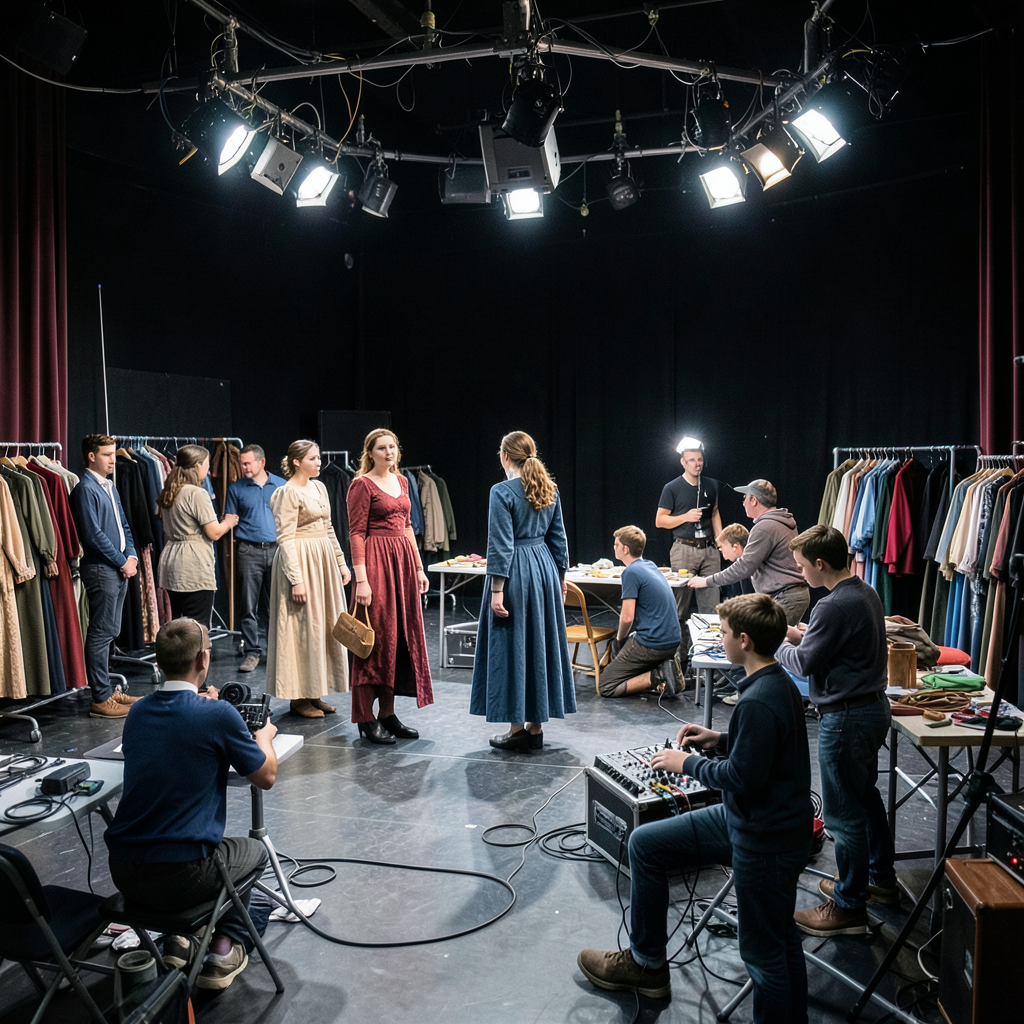

Oxford’s student theatre landscape offers some of the most vibrant cultural experiences available in the city.
The infrastructure supporting these productions involves numerous interconnected elements that may not be immediately apparent to newcomers.
Production companies, technical and costume departments, performers, and specific terminology such as the garden play all form part of this ecosystem.
Three individuals associated with the scene – lighting designer Gabriela Panova, performer Caeli Colgan, and reviewer Flora Molnar – have provided insight into how theatrical productions at Oxford function and how prospective participants can engage with the programme.
The university hosts an extensive theatrical calendar with approximately 30 productions staged each term.
The repertoire spans from established Broadway musicals to entirely original works.
These performances attract audiences comprising both university students and residents from the surrounding area.
The productions are realised through the efforts of dedicated cast and crew members, many of whom discovered their passion for theatre while studying at Oxford.
A significant characteristic of the scene is its accessibility: prior experience is not a prerequisite for involvement, while experienced technicians and performers readily share their expertise with newcomers.
One participant progressed from complete novice to securing a lighting designer position on ambitious productions within less than twelve months.
The venue and production structure involves the University of Oxford maintaining ownership of several performance spaces throughout the city, alongside contractual arrangements with additional theatres.
The Burton Taylor Studio offers intimate black box facilities, while the Oxford Playhouse provides seating for 600 audience members.
Students seeking to stage productions may submit applications and receive support from OUDS, the Oxford University Drama Society, and OUTTS, the Oxford University Technical Theatre Society.
The process for securing a venue begins with registering a production company through OUDS at no cost.
This registration entitles the company to participate in the venue allocation process.
Once founders have selected a project, they assemble department heads through a crew call, complete the required application documentation, and attend an interview assessment.
Following approval, a cast call is publicised and rehearsals commence shortly afterward.
Information regarding crew and cast opportunities appears on the Oxford University Drama Portal Facebook page and oxfordstudentthreatre.org.
Financial support primarily derives from college JCR motions and OUDS grants, with revenue from ticket sales covering the majority of production expenditure.
Technical departments play an essential role in bringing productions to fruition.
The initial stages of development require heads of department, which include positions such as director, producer, lighting designer, sound designer, set designer, costume designer, stage manager, production manager, marketing coordinator, welfare officer, and choreographer.
These individuals develop the primary elements of their respective areas and make executive decisions regarding production elements.
However, they require assistant support.
Similar to crew and cast calls, production companies publicise openings for assistant positions.
This avenue proves particularly suitable for those seeking to explore a department under the guidance of experienced practitioners who supervise and instruct in task completion.
Individuals may apply for assistant roles on any production throughout the academic year.
Those new to technical work may alternatively join a training show or attend an OUTTS workshop.
Training shows are specifically structured to accommodate trainees, providing opportunities to shadow department heads and receive instruction.
Sign-up information for training shows appears on OUTTS.org.
Additionally, OUTTS arranges technical workshops throughout the year featuring industry professionals who share their expertise with participants.
This structured approach enables Oxford students to adapt acclaimed works or present original creations by accessing the university’s pool of creative talent and supplementing productions with professional-grade equipment.
For those interested in performance, auditioning for OUDS productions may appear intimidating to first-year students, yet involvement in acting represents one of the most effective methods for establishing friendships beyond one’s own college.
The numerous production companies operating within OUDS might initially seem overwhelming, though the volume of shows being staged translates directly into abundant audition opportunities.
At the commencement of each term, production companies publish cast calls for their productions on the OUDS Facebook page.
Prospective participants may respond by booking an audition appointment or submitting a self-taped audition according to specified requirements.
Following initial auditions, companies may invite candidates to a second session taking the form of a group callback.
While this stage may seem daunting, all participants find themselves in similar circumstances.
Not receiving a casting offer from the first production auditioned for should not discourage further attempts, as this outcome occurs regularly.
The rehearsal period proves enjoyable, and the rapid pace of Oxford theatre creates strong bonds among cast members quickly.
Many participants cite acting as the means through which they formed lasting friendships.
An additional benefit of OUDS involvement is that expanded social networks lead naturally to attending more productions.
Celebratory gatherings following performances at local establishments frequently create cherished memories.
The diversity of theatrical offerings ensures options suited to varied tastes, though individuals may also choose to stage their own productions.
Whether participants possess prior acting experience or wish to attempt something entirely new, OUDS membership offers excellent opportunities for developing theatrical knowledge and connecting with fellow creative students.
The garden play represents a distinctive feature of Oxford’s theatrical calendar.
When summer arrives in Trinity term, certain colleges present productions commonly referred to as garden plays.
These performances take place outdoors rather than within traditional theatre spaces, providing colleges with opportunities to utilise their green areas.
Oxford’s college gardens rank among the most attractive in existence, and garden plays make effective use of these settings.
The productions are entirely student-managed and organised at the college level, operating according to principles similar to OUDS productions but scaled accordingly.
Cross-college auditions remain possible, often proving necessary to achieve adequate cast numbers for smaller productions.
Attendance at or participation in a garden play captures the essence of summer in Oxford.
Observing the sun descend at ten in the evening against backdrops of vines and historic walls creates an almost fantastical atmosphere.
The tradition frequently features Shakespearean comedies, with A Midsummer Night’s Dream representing the genre particularly well.
However, an increasing number of colleges have begun presenting contemporary works or entirely original plays during their garden play slots.