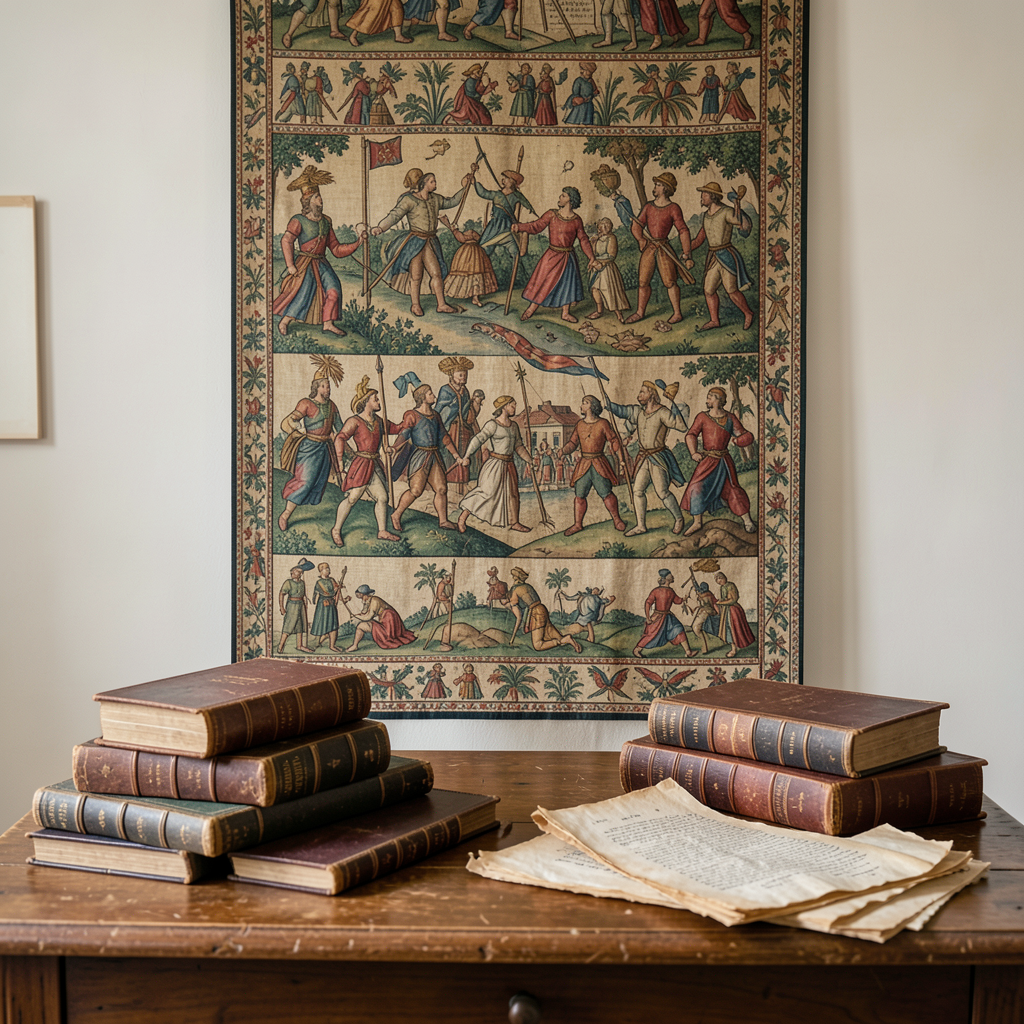

A Wallingford antiquarian bookseller has assembled a remarkable set of rare volumes, manuscripts and printed ephemera documenting the ascent of the Bayeux Tapestry from obscurity to global fame over three centuries.
The collector, who operates from Howberry Park in the Oxfordshire town, spent years curating materials that trace the tapestry’s rediscovery and growing prominence.
At 32 years old, he has brought together a comprehensive archive examining how the medieval embroidery became an internationally recognised symbol of the Norman Conquest and the pivotal events of 1066.
The collection coincides with the Bayeux Tapestry’s unprecedented appearance at the British Museum, marking the first time the nearly 1,000-year-old embroidered linen has been exhibited at the institution.
The assembled archive, offered as a complete private sale for £17,500, includes a fully illustrated catalogue produced to mark the exhibition’s opening.
The archive commences with the first printed examination of the tapestry, a 1729 publication by Antoine Lancelot.
Subsequent items document Bernard de Montfaucon’s groundbreaking volume containing the inaugural complete reproduction based on original drawings.
The gathering then follows every significant attempt to reproduce the tapestry through printing, encompassing the first colour reproduction, Charles Stothard’s celebrated drawings, and the inaugural comprehensive photographic record produced in 1875.
The archive also addresses darker chapters in the tapestry’s history, including a contemporary newspaper report of its narrow escape from destruction in 1794, alongside Napoleon’s 1803 Louvre exhibition catalogue demonstrating how the work was deployed as propaganda during plans to invade England.
The sale carries particular local resonance, given that William the Conqueror’s forces crossed the Thames at Wallingford during their advance on London in 1066, one of the final stages of the campaign depicted in the tapestry itself.
The same town that featured in the historical campaign now houses the expert who has compiled this chronicle of the artefact’s journey from near-oblivion to cultural icon.
According to the collector, while the tapestry itself was crafted in wool upon linen, its widespread recognition was ultimately established through printed reproductions.
Successive generations rendered the work using the printing technologies available to them, from early engravings and hand-colouring through chromolithography to photography, with each reproduction serving as a record of both the tapestry and its contemporary era.
The strongest book collections convey narratives, and this archive demonstrates how a singularly important historical object progressed from complete anonymity to drawing enormous public interest and ticket queues.