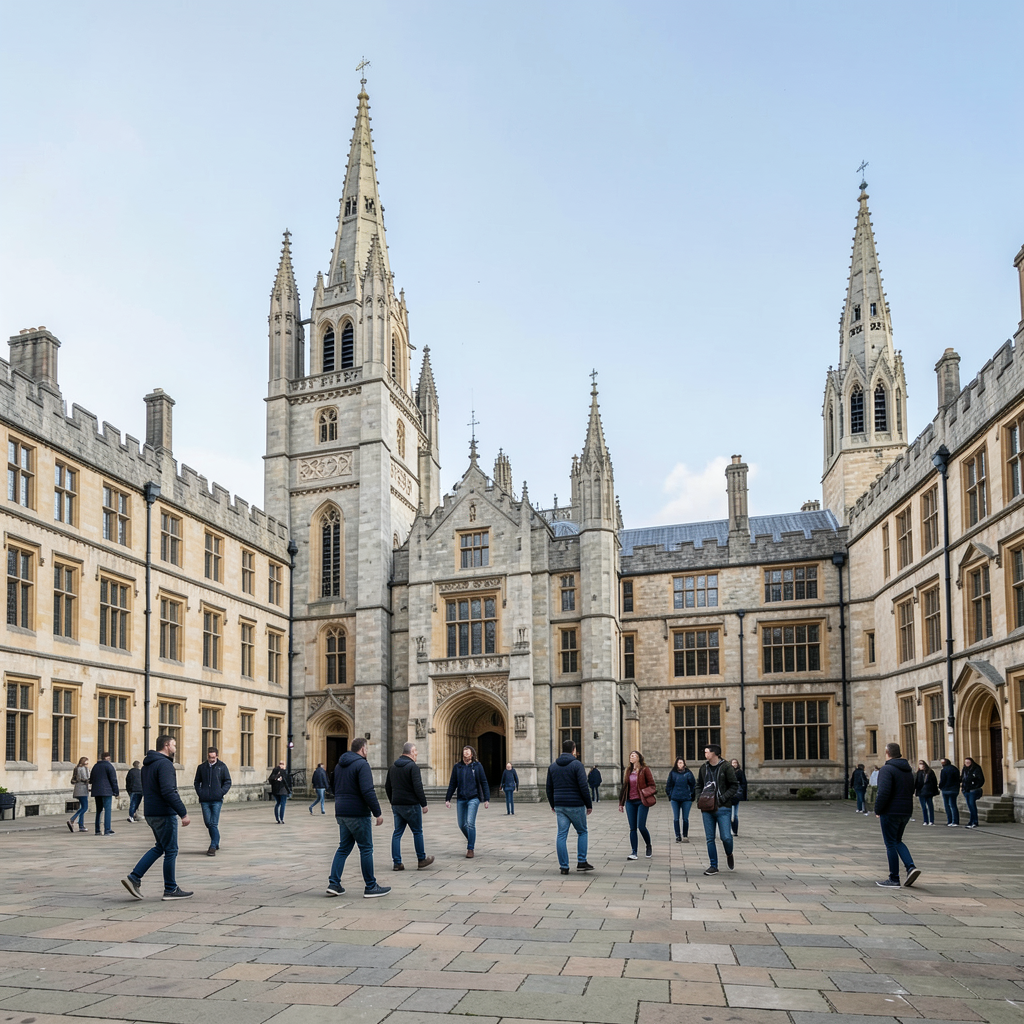

Oxford University has secured a position among the United Kingdom’s leading institutions in the 2027 edition of the Times and Sunday Times University of the Year guide, though its standing has shifted from the previous year’s assessment.
The institution, long recognised as one of Britain’s most prestigious seats of learning, has achieved fifth place in the latest rankings.
This places it behind four other universities: the University of St Andrews, the London School of Economics and Political Science, Imperial College London, and the University of Cambridge.
Oxford’s current fifth-place position marks a change from last year’s result, when the university shared fourth place with Cambridge.
The guide publishes detailed institutional data alongside its rankings, revealing several key statistics for Oxford.
The UCAS tariff requirement stands at 197 points.
Academic outcomes data shows that 92.3 percent of Oxford students obtained first-class or upper second-class honours degrees.
Employment and further study figures indicate that 84.1 percent of graduates secured high-skilled positions or continued into postgraduate education.
Progression data suggests 98.1 percent of students advance to their second year of study.
Beyond its national standing, Oxford received recognition as University of the Year for the Southeast region.
The institution also finished as runner-up in the Scholarships and Bursaries category.
The guide’s top ten for 2027, alongside each institution’s position from the previous year, reads as follows: St Andrews at second place; the London School of Economics and Political Science at first; Imperial College London at sixth; the University of Cambridge at equal fourth; Oxford at equal fourth; Durham University at third; the University of Warwick at eighth; the University of Bath at seventh; the University of Strathclyde at eleventh; and the University of Bristol at tenth.
Helen Davies, who serves as editor of the Times and Sunday Times Good University Guide, offered commentary on the broader higher education landscape.
She described intellectual rigour, innovation, inspiration and ambition as characteristics evident across British university campuses.
She noted that editing the guide consistently energises her through the optimism, scholarship and pioneering research that enhance the country’s leading institutions.
According to Davies, a notable feature of the current year is the increased focus on preparing students for future careers.
Universities have restructured their facilities to accommodate practical learning, incorporating simulated courtroom environments, clinical training spaces, and trading floor facilities.
She acknowledged, however, that the coming period presents considerable difficulties for the higher education sector, with institutions managing financial pressures and graduates facing the most competitive jobs market in over a decade.
Davies outlined questions prospective students frequently consider, such as affordability and the value of degree-level study.
She stated that the guide aims to assist students navigating decisions about subject selection, institutional choice, and understanding how student financing operates.
Oxford declined to provide additional comment but directed attention to its recent achievements, which include being ranked top university in the United Kingdom according to the Guardian’s University Guide for 2026, and maintaining first position in the Times Higher Education World University Rankings for ten consecutive years.
A 96-page supplement accompanying the Sunday Times publication is scheduled for September 20.