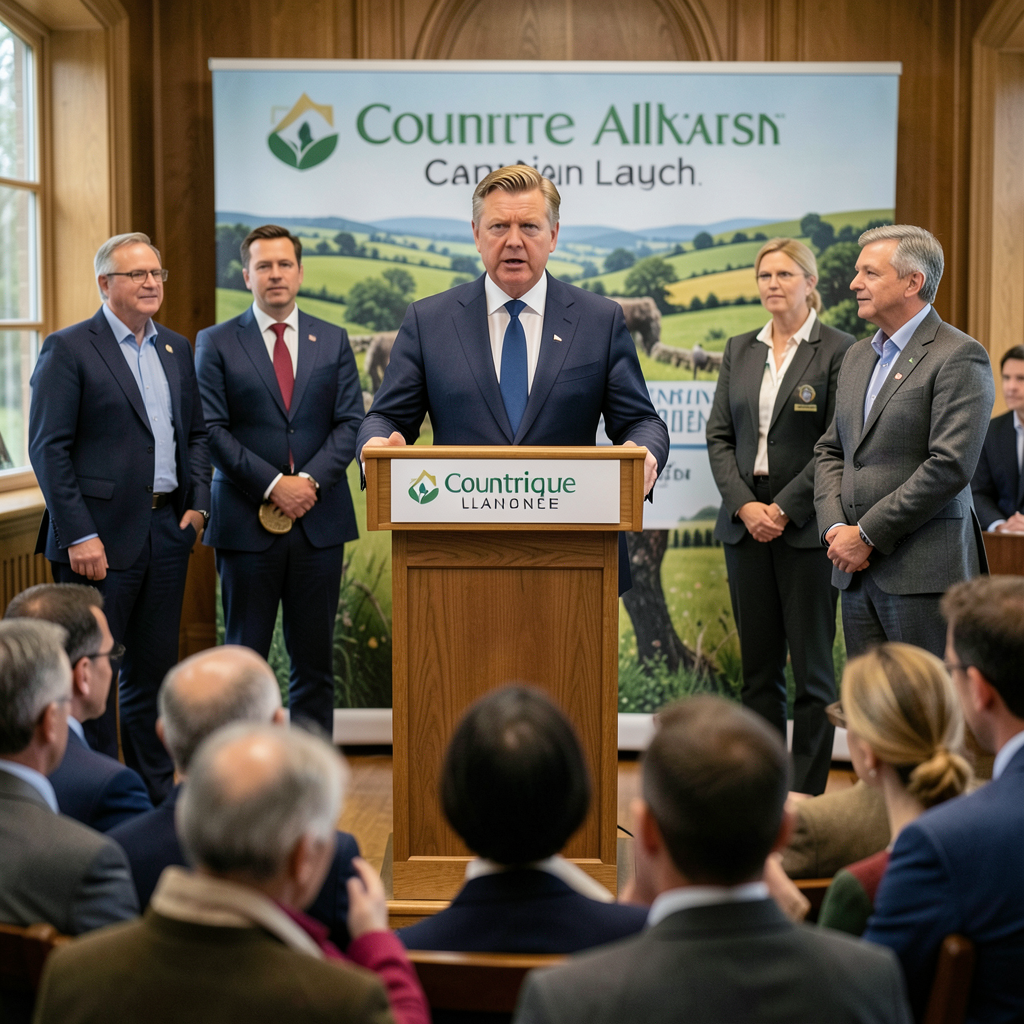

Former prime minister David Cameron has urged countryside communities to unite in opposing government policies they view as harmful to rural areas.
The call came during the launch of a campaign demanding that authorities reconsider their approach to rural Britain.
The initiative, orchestrated by the Countryside Alliance, was presented at an event in Westminster this week.
According to the organisation, 27 measures introduced or considered by the Labour administration since taking office in 2024 have created difficulties for countryside regions.
Oxfordshire provides a striking illustration of rural England’s character, with farming and countryside covering roughly 74 percent of the county.
A quarter of the area holds protected status as Areas of Outstanding Natural Beauty, encompassing portions of the Cotswolds, Chilterns and North Wessex Downs.
Lord Cameron, who represented Witney in the Commons and now resides near Chipping Norton, argued that collective action was necessary to influence both Houses of Parliament and the executive.
He dismissed the proposed inheritance tax changes affecting agricultural properties as misguided.
He also voiced opposition to potential restrictions on trail hunting and further controls on shooting activities.
The peer labelled the proposed ban on trail hunting as hypocritical, pointing out that Labour had previously promoted trail hunting as an acceptable alternative when fox hunting was outlawed in 2004.
Baroness Batters, who previously headed the National Farmers’ Union, and former Labour home secretary Lord Blunkett were among those addressing the gathering.
Representatives from farming, shooting, racing and trail hunting interests also attended.
Lord Blunkett described both the farm tax and trail hunting prohibition as errors, calling for improved dialogue between metropolitan and countryside populations.
He insisted that urban and rural interests were inseparable and that a more sophisticated appreciation of their interdependence was needed.
Research carried out by ORB International for the Countryside Alliance, questioning 2,081 adults, showed that only 15 percent of countryside residents considered the Labour administration sympathetic to those living and working in rural areas.
The same study indicated that 55 percent of those surveyed felt the government prioritised urban over rural concerns.
Tim Bonner, the Countryside Alliance’s chief executive, stated that the results demonstrated the importance of reversing recent policy errors while presenting an opportunity to forge a renewed relationship with countryside communities.
He characterised the polling as a cautionary signal about the perils of concentrating on matters disconnected from public priorities, and as motivation to abandon or revise damaging proposals in favour of genuine engagement with rural Britain.