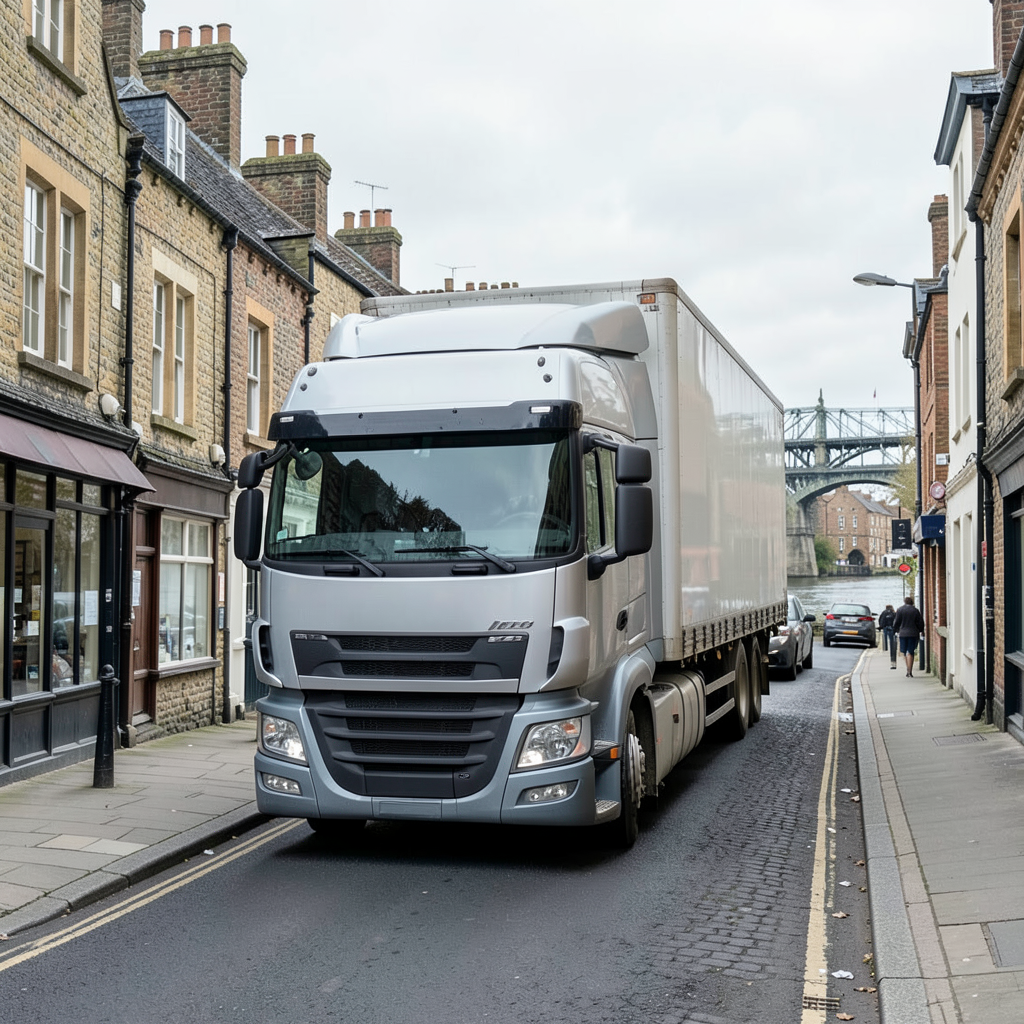

Henley could see a road user charge imposed specifically on large lorries to prevent heavy freight traffic from cutting through the town centre.
Local advocacy groups have long pressed for stronger action to safeguard foot traffic and historic structures, as well as to address airborne pollution levels.
A gathering on Wednesday brought together Henley MP Freddie van Mierlo, municipal councillors, and senior officers from Oxfordshire County Council to examine potential solutions.
Three distinct approaches were tabled during the discussion to confront the persistent problem of heavy commercial vehicles traversing the town.
The first pair of options centred on road modifications, including the introduction of narrowed sections and sharper turning points, along with mandatory restrictions governing vehicle dimensions, clearance, and mass.
The alternative strategy involved implementing a financial levy targeting heavy goods vehicles during peak periods.
These concepts will be formally reviewed by the council’s cabinet, which holds highways responsibilities, when it convenes on September 15.
Should cabinet members endorse the initiative, approximately £140,000 would be allocated to commission an independent assessment of viability, with results anticipated by the end of the calendar year.
A subsequent cabinet session would then consider which option to progress, potentially convening during the opening months of the following year.
The gathering drew participation from numerous stakeholders, among them mayor Ian Reissmann, town and district representative Stefan Gawrysiak, Julian Brookes and Geoff Luckett representing the Henley Society heritage group, alongside county council officers Martin Reeves and Tim Bearder.
The local MP characterised the exchange as productive, noting that meaningful headway on this long-standing problem had finally been achieved.
He emphasised that action was overdue, expressing particular worry about the strain on architectural heritage, the general character of the town, and ambient pollution.
The parliamentarian pointed out that pedestrians, particularly those with prams, found themselves at the level of vehicle emissions while navigating public highways, describing this as an unreasonable imposition on local residents.
The mayor supported these observations, underlining the hazards that sizeable lorries posed to public safety and environmental conditions.
While acknowledging that implementation would require careful deliberation, he stressed that developing a robust strategy took precedence over rushing forward.
The district councillor conveyed optimism that an appropriate resolution remained achievable.
His remarks outlined the primary objectives, which encompassed addressing notorious junctions, most notably the intersection of Bell Street and New Street, alongside examining the feasibility of applying a congestion-based charge to vehicles exceeding 18 tonnes.
David Dickie and Ian Prosser, representatives from the community surveillance initiative Henley HGV Watch, were also present at the gathering.
The organisation, founded in 2020, lobbies against the passage of substantial commercial vehicles through residential streets and maintains logs of instances where safety protocols were compromised.
Mr Dickie observed that the town had been effectively converted into a trunk route despite its designation as a market settlement, though he indicated that corrective measures were now in development.