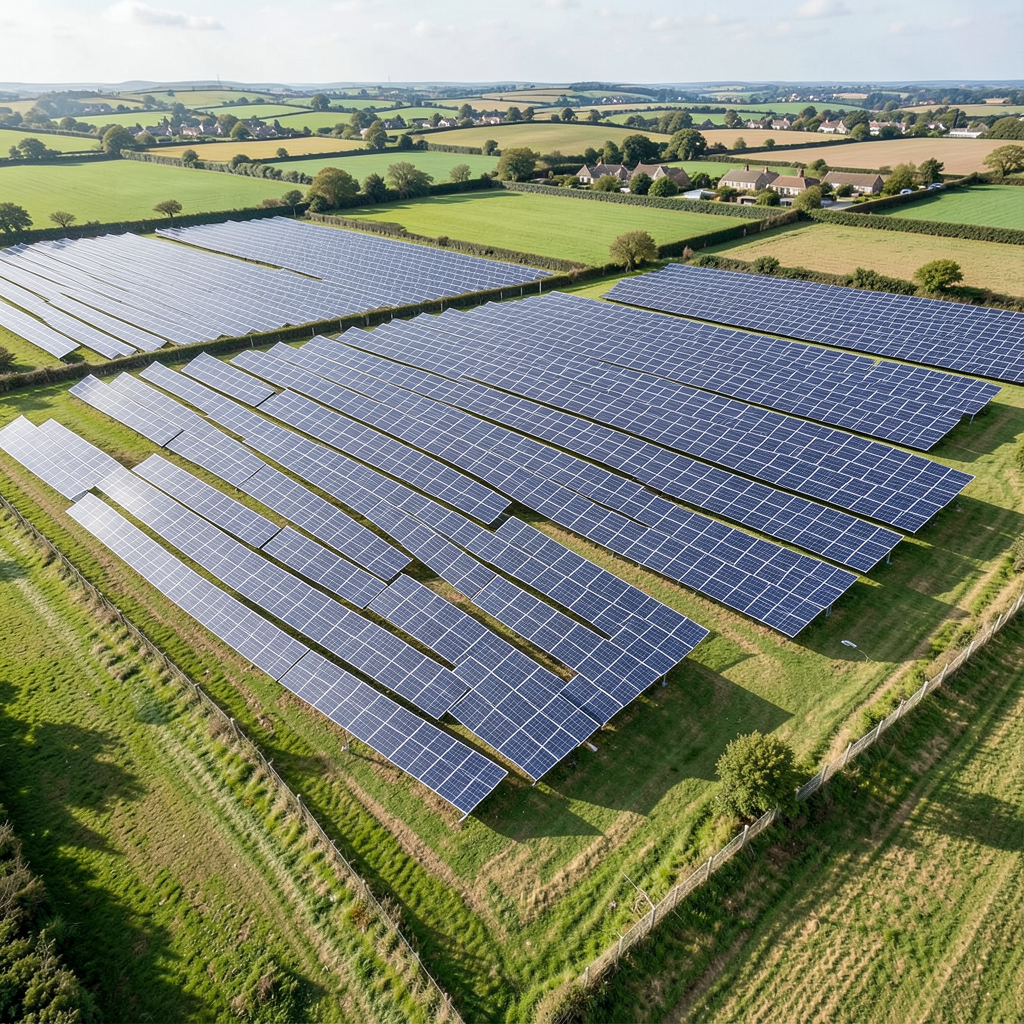

A new solar development proposal has emerged in Oxfordshire, promising to become the largest facility of its kind in the region if approved.
Cearn Solar Farm would occupy a site stretching across land between several rural communities, positioning itself between Garford to the south, Charney Bassett to the west, West Hanney to the south, Goosey to the north and Baulking to the south-west.
The installation would span approximately 2,800 acres, significantly exceeding the scale of nearby Botley West which covers 2,471 acres.
In aviation comparisons, the proposed development would surpass Gatwick airport in footprint and fall just 200 acres short of Heathrow, one of Europe’s busiest airports.
Grid connection capacity has been offered at up to 500 megawatts, sufficient to supply electricity equivalent to approximately 143,000 households annually.
Power would be transmitted through underground cables to the proposed Farmoor substation operated by National Grid, located roughly 12 kilometres north-east of the site.
The scheme incorporates battery storage facilities designed to retain excess generation for deployment during periods of high demand.
Due to exceeding 100 megawatts in capacity, the proposal qualifies as a Nationally Significant Infrastructure Project.
This classification means the Planning Inspectorate would conduct the examination phase, with the ultimate decision resting with the secretary of state.
No planning submission has been lodged as yet.
Initial workshops with stakeholders are scheduled for September and October, followed by a public consultation period during early 2027.
The scheme is promoted by Cearn Solar Farm Ltd, a company wholly owned by Telis Energy UK.
The developer has justified the initiative by emphasising both environmental and economic imperatives driving the shift towards renewable energy sources.
Industry data indicates that despite recent expansion, solar installations currently occupy less than 0.1 per cent of UK territory.
Research from Lancaster University suggests that achieving future decarbonisation targets would require only 0.22 to 0.39 per cent of national land area for solar deployment.
Oxfordshire has attracted multiple major solar proposals.
Botley West, covering around 300 acres less than the Cearn proposal, remains under consideration.
That installation would generate 840 megawatts, powering approximately 330,000 homes and occupying an area equivalent to one-fifth of Oxford city or 0.3 per cent of the county’s total landmass.
Its scale approaches 1.5 times the size of Gatwick airport.
A smaller installation at Burcot in south Oxfordshire extends across roughly 140 acres.