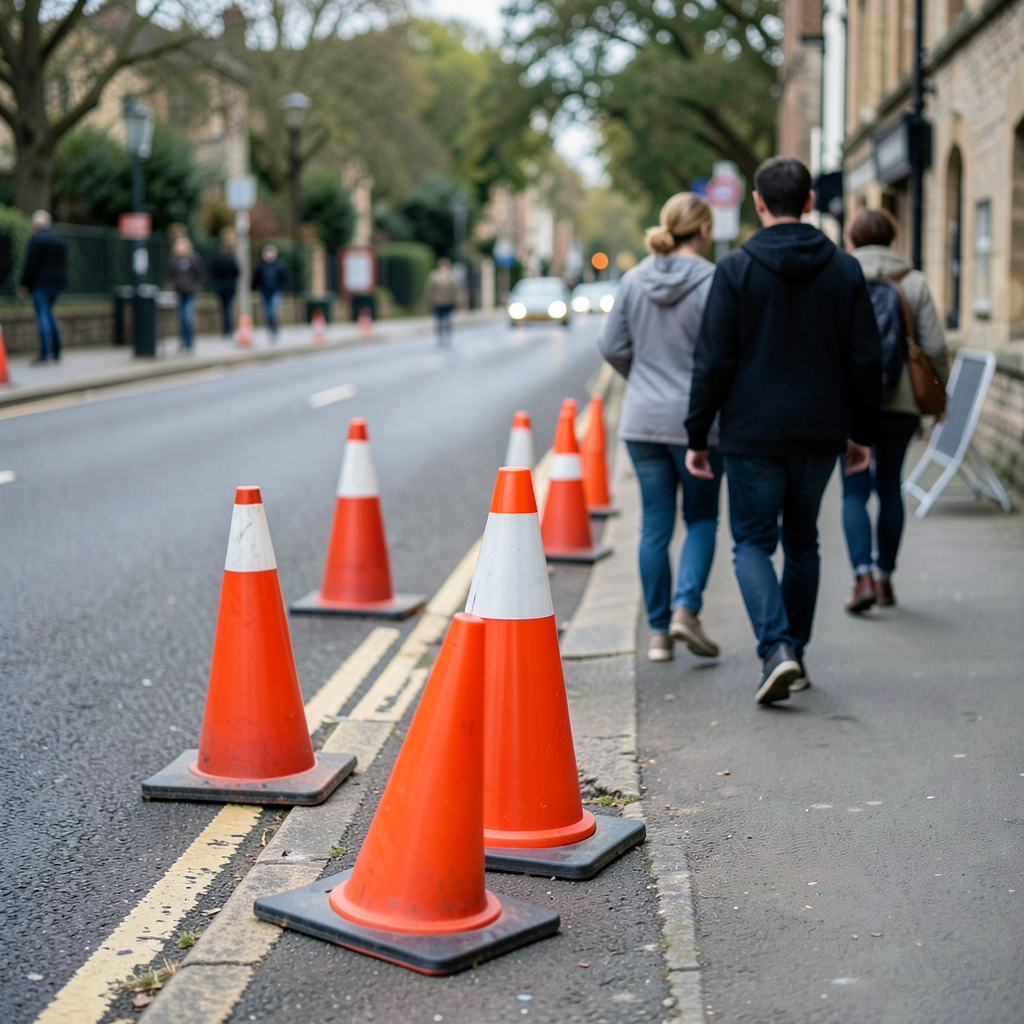

Pedestrian traffic on a bustling Oxford commercial thoroughfare has risen by just one percent since the traffic levy was implemented, with critics calling the figure absurd.
The fee came into force on October 29 of last year, with motorists lacking permits or exemptions charged if they travel through six monitored checkpoints throughout the city.
In January, figures revealed that over 31,000 penalties had been issued to drivers who failed to pay the charge, generating more than £700,000 from the £5 daily tariff.
Fresh information from MRI Software has now demonstrated that footfall along Queen Street climbed by one percent during the four-month period following the introduction of Oxford’s temporary traffic levy, when measured against the equivalent timeframe the prior year.
The modest rise was branded laughable by independent councillor David Henwood, who called on the authority to eliminate buses from Queen Street to substantially improve pedestrian numbers.
The county council is releasing figures each month to assist in assessing Oxford’s temporary traffic charge, with a spokesperson stating the most recent statistics offered a snapshot of one section of the city.
Andrew Gant, the county council’s transport management cabinet member, observed that this modest rise could stem from numerous reasons, and they cannot link it specifically to the temporary traffic charge.
He said it remains premature to establish any definitive patterns, and the information being gathered will help construct a clearer picture over time regarding how the temporary charge is performing.
Mr Gant noted that it is reassuring that from the limited pedestrian data currently available, the Queen Street figures are encouraging, especially when contrasted with other urban centres that have experienced some reduction, according to the same data supplier.
He explained that this suggests Oxford’s central area continues to be an appealing and vibrant location for retail and recreation.
He added that efforts are being made to obtain more comprehensive pedestrian and spending data across Oxford, though some difficulties in obtaining this information have been encountered.
Various appeals to fully pedestrianise Queen Street have been made over the years, but the county council has thus far declined to relocate all buses, which coexist alongside shoppers and cyclists.
Mr Henwood, the county council’s opposition transport management spokesperson, stated that framing the one percent pedestrian increase as a triumph for the traffic charge was ridiculous.
He continued that this is insignificant change presented as meaningful impact.
He said that even as someone who opposes the traffic charge, he would not need to manipulate the figures to describe this for what it is: disappointing at best, unsuccessful at the worst.
He added that here is the difficult reality – if the same individuals had exercised even marginally more intelligence, they might have devised something that actually functions.
He called for buses to be relocated from Queen Street, a proper exclusive cycling route to be established, and the area to be transformed into something genuinely welcoming for pedestrians.
He said that is how genuine pedestrian growth is achieved – not by celebrating a one percent uptick as though it represents a major achievement.